Saturday, April 22, 2023

Species hunting adventures in South Korea: Busan.

Back on the South Korean mainland, we arrived in the city of Busan quite late and grabbing some instant noodles and snacks we headed to our hotel in the Seomyeon area. In the morning, we jumped on the subway and got off at Dongbaek. From there we went for a walk around Dongbaek Park to Dongbaekseom Lighthouse. My expectations for the fishing around Busan were pretty low, but when we spotted half a dozen anglers on the rocks below the lighthouse, I was slightly encouraged. I need not have been. Climbing down the rocks, so I could have a cast, we didn’t see them catch anything and I didn’t catch anything either.

It looked so fishy. There were banks of very long seaweed that made things tricky, but I fished in the gaps between them. After an hour or so, we headed back up to the path and headed towards Haeundae Beach.
Haeundae Beach is a very popular place in the summer when the water warms up. The sea around mainland South Korea probably livens up in the summer as well.

Halfway along Hueundae Beach is the Sealife Busan Aquarium, so we took the opportunity to get out of the sun for an hour or so and I reminded myself what a fish looked like. I had a feeling the fishing around Busan was going to be very challenging, and I might not see another fish.

These threadfin trevally were probably my favourite. They're so cool!

Carrying on along to the end of Haeundae Beach, I had a quick cast or two over the sand inside the small harbour there, but predictably caught nothing. We grabbed a potato spiral each to refuel and then caught the Haeundae Blue Line Train that follows the coastline north.

Spicy snack time!

We hopped off at the Cheongsapo Daritdol Skywalk, a glass floored platform that extends out from the cliffs seventy metres above the sea. Walking to the end of this and back to the station didn't take too long, and rather than wait for the next train we decided just to walk along the coastal path to Gudeokpo. I tried my luck fishing in the small harbour there. The water was crystal clear, but there was no sign of any fish. Dropping my bait in close next to the tetrapod blocks at the harbour mouth eventually produced a solitary fish in the shape of a sunrise.

Success! I'm not sure why they are called a sunrise. They should be called a greedy green gobbed goby if you ask me.
They have green mouths. I thought this one had a parasite in its mouth, so tried to remove it with my forceps.
It actually turned out to be a very long, half digested, pipefish that was almost as long as the sunrise! So instead of doing the fish a favour, I ended up stealing its last meal!

Happy to have caught something, we carried on along the coast until we reached Songjeong Beach. Taking a leisurely stroll along that, we ended up at Jukdo Park where we continued our ramble and soon arrived at the beautifully decorated Songiljeong Pavilion.

Painted in the tradition Korean style, like all the temples we'd visited in Seoul.

Before catching the subway back to Seomyeon, I had one last roll of the dice. Half an hour fishing around at the mouth of Songjeong harbour under its red lighthouse. Again, this did not produce any bites, so we headed off for a big pot of spicy kimchi stew.

Yummy!

The following day, I was determined to find some better fishing, so we caught the subway again and headed down to Diamond Bay Park. There were two other anglers already fishing when we got there using float tactics, so I did likewise. On a plus note, I spotted what I thought were small groups of darkbanded rockfish suspended under the long flowing seaweed. I also saw what looked like bream deeper down, at the base of the seaweed, occasionally rolling onto their flanks and giving themselves away with a silver flash. Neither could be tempted though despite my best efforts, so I admitted defeat, and we headed off for some lunch.

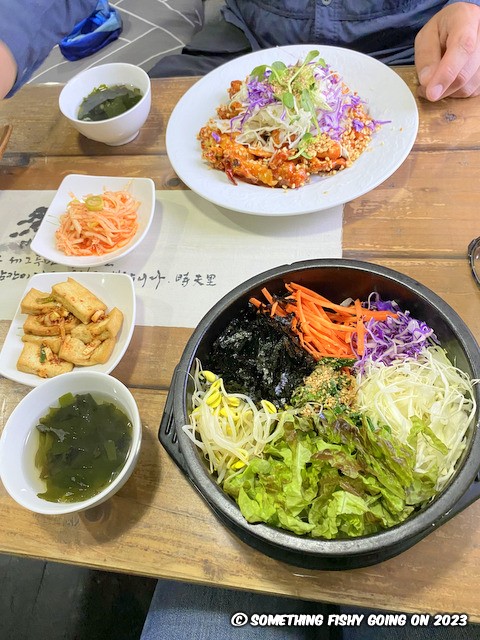
Lillian's choice of restaurant was pretty healthy and the food was delicious!

Being a glutton for punishment, we headed to Millak-dong Breakwater to try fishing from the large tetrapod blocks on its seaward side that face the impressive bi-level highway Gwangan Suspension Bridge. I'd seen someone catching a nice gurnard and a few other fish from them on YouTube but walking around there were several signs saying no fishing from the tetrapods. I get why fishing from them is dangerous, but the problem for anglers is that they are used in the construction of most harbours in South Korea, so that really limits fishing options.

I was planning on clambering down these tetrapod blocks.
Google Lens is great for getting bad angling news. £1800 is a hefty price to pay!
A heron clearly flaunting the law.

Frustrated, we walked further along the coast and up the Suyeonggang River where there were more tetrapods and no fishing signs. In the end, I gave up, and we headed to the subway, so we could go and pray for my fishing fortunes to improve at the Haedong Yonggungsa Temple further up the coast.

Haedong Yonggungsa Temple. The self proclaimed most beautiful Buddhist Temple in all of South Korea.

After throwing a few coins and saying multiple prayers, we walked along the coast and ended up in Dongamhang Port, a small fishing harbour. It was clearly a very busy harbour and there was lots of fish and seaweed drying out on lines and racks.

Drying fish and kelp.

Predictably, the fishing was tough again, but eventually I managed to catch a single goby. The Buddhist gods must have forwarded my prayers on to the Japanese God of good fortune, the ocean, and fishing folk, Ebisu, as requested. The coins we donated back at the temple had been a good investment!

This is a hairchin goby. It has little barbules on its chin. Another new species added to my tally. Thanks Ebisu!
This is Ebisu. The Japanese God of good fortune, the ocean, and fishing folk. The only God a desperate angler requires!

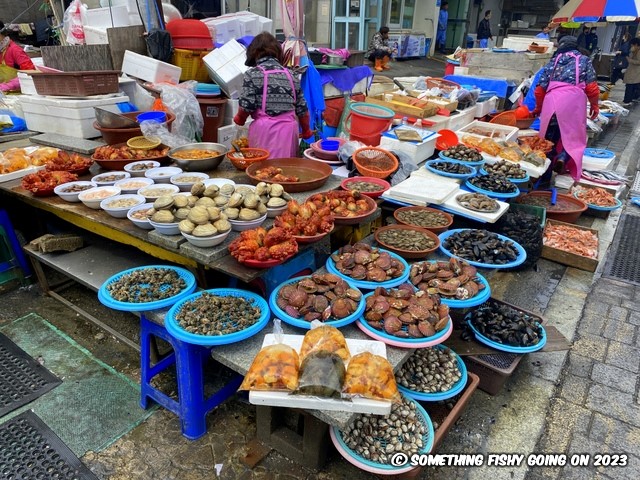
By now I had accepted that the fishing around Busan was limited and very poor. I told Lillian we'd be having a fishing free day the following day, but in the morning she said she wanted to ride a cable car that was near a "fishing park". My will power deserted me however, I just couldn't leave my tackle in the hotel when we set off! On the way to the cable car, we went for a stroll through Jagelchi Fish Market to assault our senses.

An incredible assortment of seafood was on display. Some familiar, some not.
Scabbard fish,..
...dried fish,..
...flower crabs,..
...sea pineapples...
...and weirdest looking of all, spoon worms.

Leaving the sights and smells of the market behind, we walked south until we reached Songdo Bay Station, where we took the Busan Air Cruise cable car across the bay. At the other side, we headed down the hill to the Amnam Park Embankment "fishing park". We needn't have bothered, after an hour or so I hadn't had a bite, and we didn't see anyone else catching anything either. By that point it was pretty much what I expected, so we didn't hang about any longer, I packed my gear away, and we caught the cable car back over the bay.

I think this is the first cable car I've taken over the sea.
The Amnam Park Embankment fishing park. Basically it's a raised area at the edge of a large car park by the sea with a railing running along it and a few containers for anglers to put their rubbish in.

On the way back to the hotel, we treated ourselves to a coffee and cookies and bought some expensive berries to try. Back at the hotel the rain began absolutely hammering down and showed no sign of stopping, so we popped to a nearby 7Eleven and got some instant noodles, kimchi, snacks and a few beers. Lying in bed, we ate, drank and watched Korean Fishing TV. My idea of a great night in! All the fishing on the shows seemed to involve charter boats or remote islands. Maybe the shore fishing is poor all year? Surely not?!

These mountain berries cost £9.00. They were delicious though!

It was still pouring down in the morning, so we were lazy and had a lie in. When we got up, the rain had eased off, and we decided to definitely have a fishing free day. Instead, we caught the subway and visited a fishing tackle shop, so I could try and get some Sunline Small Game braid. Afterwards we went for a stroll around some gardens on a hill. The cherry blossoms were in full bloom, which was nice.

Getting to the point. I've visited one of these stores in Japan before and they are great.

Mission accomplished! I replenished my stash with two spools and got a few packets of my favourite Thirty34Four Octpus Aji lures as well.

It was the peak of cherry blossom season in South Korea while we were there.

In the evening we went out for dinner in a Taiwanese restaurant where we enjoyed a large bowl of spicy mapo tofu and a few mango beers. Afterwards we had a few more drinks in a heavy metal pub before shooting a few racks of pool in the Star Billiard's Club.

Nice and spicy mapo tofu washed down with...
...a few fruity mango beers.
An impressive vinyl collection in the rock music basement bar.
Where did all the solids and the 8 ball go?

Finally, to end the evening off perfectly, we visited the Danakka Fishing Cafe, a cafe located in a basement with a large fishing pond inside where you pay an hourly rate to fish for carp, catfish and sturgeon and win prizes. 


Catch it all! Indoor fishing cafe.

I was looking forward to a fun, fishy end to our evening, but sadly it wasn't open as advertised, so Lillian got her fishing free day after all! Feeling slightly drunk, we headed back to the hotel for a few more beers and to do some drunken packing.

Our four days in Busan were over and the following day we were off to Gimhae International Airport to catch a short flight to Jeju Island. We'd enjoyed our stay, even if the fishing in Busan had been almost as bad as the fishing around Seoul. I guess in March, the saltwater shore fishing around the mainland of South Korea is just not very good due to the cold water temperature. I had my fingers crossed that the waters around the "Hawaii of South Korea" would be a little warmer and the fishing a little more productive!

Tight lines, Scott.

Click here for Jeju Island. 

Thursday, April 20, 2023

Species hunting adventures on Okinawa: Part 3.

On day four of our stay on Okinawa, we made a one and a half hour bus journey to the Busena Marine Park. Getting off the bus, we headed straight to its underwater observatory at the end of a long walkway that extends out into the ocean. Once you walk out to the end, there are spiral stairs that take you down below the surface. In the circular room beneath the waves, there are lots of glass portholes that you can look out of. Depths at the end were about five metres and there were lots of different types of fish swimming about.

Busena Marine Park's underwater observatory.
On the seafloor were lots of damselfish!
But the odd larger fish were swimming around too. No doubt attracted by visitors tossing in lots of fish pellets from above.

Making our way back up to the platform, I bought a small container full of fish pellets. Throwing a few in at a time, there were lots of snappers, emperors and even large wrasse coming right to the surface to gobble them up. The fish were clearly conditioned to quickly grab anything that made a splashing noise. Seeing this, I knew if I could find a spot to fish nearby, then I would be in with a great chance of catching some larger fish. Fishing from the walkway was out of the question, but the pier nearby that the park's glass bottom boat was operating from didn't have any no fishing signs posted, so we walked out to near the end of that, and I set up a float rig. Large squid tentacles were the bait of choice and after about twenty minutes I had caught three nice fish.

My first wrasse of the trip was this blue barred parrotfish.
This spangled emperor put up quite a scrap.
These were followed by a manybar goatfish that I caught after increasing the depth of my bait so that it was being slowly dragged along a sandy patch on the bottom.

My fun was interrupted at this point by a member of staff from the park. They politely informed me that fishing was not allowed on the pier, so I apologised and told them I'd pack up and leave immediately. Suspecting that fishing was not permitted anywhere in the park, we opted to walk all the way along Busena Beach, so I could fish from a small rocky pier at its southern end that was just outside the boundaries of the park. Sadly, the fishing here produced absolutely nothing. Quite a contrast to the spot I'd been ejected from, and in my mind a result of the fish all being regularly fed around the observatory's platform.

Plan B was quickly formulated, we caught a bus south and got off near Cape Maeda. I was hopeful that I'd be able to find a fishing spot there, but after walking up the hill to the point, we were greeted by a very large sign that looked important. Google Lens translated it for us, and I was frustrated to find out that fishing was banned around the cape due to the area being very popular with divers. Quite annoyed, we stomped back down the hill and waited for another bus to take us back to Sunabe. I can respect no fishing areas. I think it was all the waiting for and sitting on buses that was the worst part of the day. The public transport network on Okinawa isn't great. The buses aren't on time, visiting every small town along the coast, and passengers take a long time to get on and off due to the fare system. It was a reminder of the benefits of having a hire car. Anyway, I'd probably have taken the three fish I caught at the start of the day, so I shouldn't moan too much!

It had been quite a tiring day, so after dinner in a restaurant we grabbed a box of umibudo, which translates from Japanese as sea grapes, and headed back to the hotel.

Farmed in Okinawa, it is a type of seaweed. The taste is hard to describe, but is very pleasant. It tastes like the ocean in your mouth.

Our last day on Okinawa had arrived. It was very windy, and the sea was quite rough, so we headed back to the drainage canal near American Village. At the bottom section, where I'd caught plenty of fish a couple of days earlier, the water was all coloured up and there was no sign of any fish, so we walked inland again to the area where the canal opened up. The water was clearer there, and a few fish were clustered around the rocky areas and using small hooks I was able to catch a few including two new species of damselfish.

This one is a freshwater demoiselle. This was the small species I'd tried to catch already at the canal.
This one is a twospot demoiselle. The name comes from two spots it has as a juvenile fish but loses in adulthood.

Catching damselfish was getting a bit boring, so we headed off to visit a tackle shop. I wanted to try and get a couple of spools of Sunline Small Game braid, but unfortunately they didn't stock it. We then caught a bus and headed north through Kadena Air Base before getting off and heading back to the stepped area near the top end of the Kadena North Sea Wall, as I thought this area might be out of the wind. Again as luck would have it this proved to be a great choice as I caught a couple of small but very colourful triggerfish, the first time I've caught triggerfish in fact.

First to munch my squid tentacle was this blackbelly triggerfish.
Followed shortly afterwards by this funky whitebanded triggerfish. Also known as the Picasso triggerfish or the Lagoon Triggerfish, amongst other names.
Before we left, I also caught a few grey demoiselle. Yet another damselfish species!

Before heading back to Sunabe we walked all the way to the other end of the Kadena North Sea Wall and I had a go fishing in the deep channel entrance to Kadena marina. This didn't produce anything at all and rather bored I dropped my bait in front of a land crab. It scuttled straight over and grabbed it. I've tried this before, but they usually let go and scurry off. This time the crab was tangled in my line and I managed to lift it up for my second crustacean close up inspection of the trip.

Crustaceans are so weird! The land crab had really strange looking claws. Obviously specialised around their diet. Popping it back on a near vertical rock surface, it climbed back down slowly like a spider.

Walking back to the bus stop, Lillian pointed out all the Shisa statues outside people's houses. They come in pairs and are the guardian lions of Okinawa. One has an open mouth and the other's mouth is closed. The open mouth Shisa wards off evil spirits, the closed mouth Shisa keeps good spirits in.

Shisa keeping the good spirits in.

Arriving back in Sunabe, we started walking up the hill to visit Coco Ichibanya again. We both love Japanese curry, and I was looking forward to trying the level ten spicing. Lillian, who doesn't like spicy food as much as I do, challenged herself by trying level five, which is still pretty damn spicy!

On the way up there, we stumbled across a small stream and I could see it had a few small fish in it. Permission was given for one last short session. Light was fading fast, and as I had tossed all of my bait away, a quick trip to a nearby supermarket to get some bread was necessary.

Small, but fishy!

Standing on one of the bridges that crossed the stream, I tied on a small hook to see if I could catch the small fish I'd seen. Dropping a few free flakes down saw some larger fish coming up from the bottom and grabbing them from the surface with a splash. Lowering down the hook bait quickly saw me catching some of these very cool little predators. I didn't manage to catch any of the smaller fish I'd initially spotted as a result, but didn't mind too much!

I caught three of these little jungle perch. What an awesome looking fish!
I also caught two of these Tolson's snakehead gudgeon.

My final, if totally spontaneous, fishing session on Okinawa over, we carried on up the hill to enjoy our spicy meal with a few beers. I should investigate freshwater fishing opportunities more when I'm doing my research for foreign trips. I tend to focus on saltwater fishing, but freshwater can be great fun too!

Coco Ichibanya curry level ten! It was very hot, but most enjoyable. I'd have it again, for sure.

In the morning, we were flying back to Seoul and catching the high speed KTX train to Busan on the south coast. Lillian loves the Korean action horror film "Train to Busan.", and whilst I enjoyed it too, I was hopeful the second stage of the journey would be a comfortable and zombie free experience!

We'd enjoyed our time on Okinawa. Lillian had been very patient, allowing me to do a lot of fishing. I think given how poor the fishing in South Korea had been, she wanted me to catch a few fish. I'd done just that, catching thirty species in total. We'll certainly be returning to Okinawa again, perhaps as part of another extended trip to Japan, as it's only a few hours to fly down there from the mainland. We want to explore more of the island and perhaps even visit others in the chain. Next time however, I'll definitely be making sure I have the correct International Driving Permit!

Tight lines, Scott.

Click here for Busan. 

Tuesday, April 18, 2023

Species hunting adventures on Okinawa: Part 2.

After a relaxed lunch on day three, we did a bit more exploring and wandered further up the drainage canal. About half a kilometre from the sea it opened out and two smaller drainage canals ran into this area. There were lots of small fish swimming around and before too long I’d caught a few of them. Predictably, a few of the fish were damselfish. After a while, I eventually caught something else in the shape of a crested grunter. Much easier to identify!

This is a crested grunter. Even Google Lens can positively identify them with ease!
Based on the shape and slight yellow tinge of the tail fin and dorsal fin, I think this one is a brackish damselfish, which would make sense given where I caught it. 

After a while the action dried up and even the damselfish lost interest. We decided to walk back towards the hotel. On the way, we passed a couple of spots I thought looked a bit fishy. I had a quick fish in these two areas and caught another new species at both. Different types of environment usually hold different species.

Over a shallow sandy area I caught this cylindrical seaperch. The seaperch family was a new one to me, so when I caught it I had no idea what this fish was which was pretty exciting in itself!
In a deep silty area I caught this solitary common ponyfish. They are incredibly slimy.

Walking back in the direction of the hotel again, we made one last stop before heading for some food, I fished at one of the Sunabe Seawall piers for an hour or so as light faded. It turned out to be a great decision because fishing with small hooks straight down the front of the pier, I added four new species to my tally.

Yet another damselfish species added to my growing list. The whitespotted devil, whose spots are in fact blue!?
A vagabond butterflyfish, another awesome capture
I somehow managed to catch this tiny but very colourful member of the triplefin family that has no English common name. Cousin of the black faced blenny, this one is a male and is called a ヨゴレヘビギンポ (Yogorehebiginpo) in Japanese. 
After the sun went down, I caught what I suspect is a blackstripe cardinalfish.

So, it had been a very productive day! We relaxed in the evening with burritos and beer. The next day we were catching a bus and heading north to the Busena Marine Park where we would visit its underwater observatory. As well as seeing what fish were around further out from the shore, I was hopeful that I would perhaps find a fishing spot nearby or perhaps on the way back where the water was deeper and where I could maybe fish with heavier tackle and try to catch some bigger fish. 

Tight lines, Scott.

Click here for Okinawa : Part 3.