Showing posts with label Moroccan White Seabream. Show all posts

Thursday, February 26, 2026

More species hunting adventures on Tenerife: Part 3.

Keen to catch some different species, we decided to visit the small concrete pier located at the northern end of Playa de Fañabé, a long artificial beach in Costa Adeje made from golden sand imported from Africa. Armed with a few loaves of bread, a couple of cans of sardines and a mop bucket and a large metal spoon borrowed from our accommodation, the plan was to freeline and float fish bread to catch whatever species we could attract and get feeding. Making up a bucket of groundbait and spooning some into the sea soon drew the attention of some small mullet and derbio. Freelining tiny pieces of bread flake on #20 hooks, I soon caught a couple of mullet, a derbio and bogue.

The small mullet turned out to be golden grey.
A bit more cautious, a small group of derbio sat further out and were eating the groundbait much lower in the water column. Adding a small split shot helped get my bait down past the mullet intact.
A few small bogue were also in amongst the shoal of golden grey mullet.

After a while, I turned my attention to catching one of several redlip blenny that Nick had spotted straight down the side of the pier, sitting on the submerged rocks. They are fussy eaters, possessing a specialised mouth that is adapted to scraping food from the surface of the rocks they live on. Usually, it takes a bit of patience to catch one, and even that doesn’t guarantee success. Much to my delight, one of them lashed out aggressively, hit my small prawn chunk almost straight away and was hooked.

This redlip blenny was acting aggressively, in my opinion, not feeding. Possibly this was purely territorial behaviour.

By this point Ryan had given up trying to catch a golden grey mullet, having hooked one but failed to land it. He had switched to fishing pieces of prawn on the sand further out and was rewarded with a nice striped seabream that put a nice bend in his ultralight setup.

Seeing Ryan catch this nice striped seabream, I wanted to catch one too.
Switching to similar tactics soon saw me catch a few, but none were as big as Ryan’s fish.

Next, I spent some time fishing with soft plastics close in, slowly bouncing them through the boulders there in an attempt to tempt an island grouper. I didn’t manage to locate any sadly, so before the end of the session, I spent some time casting a split shot rig baited with prawn out into the open sea. The bottom there was rocky, so this unsurprisingly produced a few Canary damselfish, ornate wrasse and puffers. Eventually, my persistence paid off when I finally caught something else.

This ended up being the only planehead filefish of the trip. Note the damaged tail. Probably the result of living with hundreds of pufferfish.

The following day, we fished from a comfortable rock mark at the back of Los Abrigos Harbour. Nick and Ryan fished heavy gear to see if they could catch some stingrays or sharks. I fished out over the sandy bottom. This produced lots of wide eyed flounder, some Atlantic lizardfish, a couple of greater weever, lots of puffer and a couple of stunning pearly razorfish.

Despite the fact they don't grow very big, wide eyed flounder really give a good account of themselves from deep water. Not as colourful, but its floral markings are very pretty.
Puffer were again a bit of a pain, but the less common of the two species, the Macaronesian sharpnose puffer, are undeniably beautiful.
The beautiful pastel shades of the pearly razorfish. Easily my favourite species of wrasse from this part of the world. Very tricky to handle as they are quite flexible and will try to bite as well!

Towards the end of the session, I spent some time fishing with some light metal jigs and a sinking hard plug, but my efforts went unrewarded. After packing up, we headed off to get some bait from the supermarket so that we could have a second evening session out with the heavy gear. Unfortunately, after spending a fair bit of time driving around to multiple supermarkets, none of them had any fresh mackerel, sardines or scad in stock. Rather than go out with inferior bait from the frozen section, we decided to visit the breakwater of Playa de San Juan’s harbour with lighter tackle to see what smaller nocturnal species we could catch. It was quite a productive session, and we managed to add a few more species to our trip’s tally.

As you would expect, we caught quite a lot of cardinalfish.
I caught this very large Madeira rockfish. When it came to the surface I thought it was a black scorpionfish because it was so big!
I caught the only axillary seabream of the trip.
We also caught a few bastard grunt, another species that's commonly caught after dark.
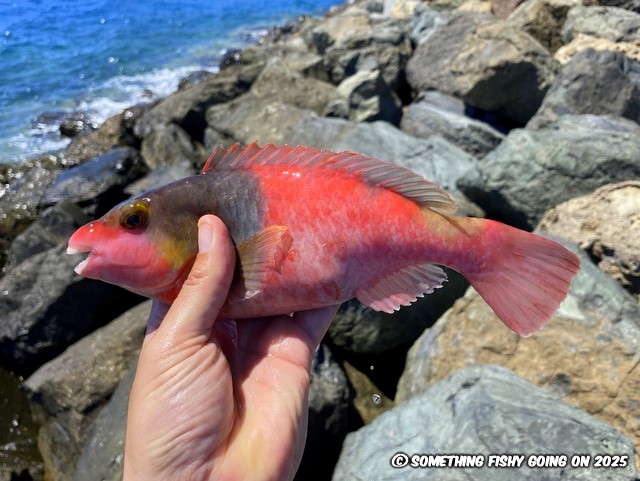
Nick caught the best fish of the session. A small Moroccan white seabream.

Before we left, Ryan was fishing with a small paddletail on a jighead down the inside of the harbour wall when a barracuda appeared from the shadows, grabbed it and charged off, taking him completely by surprise. Fishing with ultra light tackle, with only a 6lb fluorocarbon leader, the fish bit him off instantly. The three of us spent a while trying to catch using heavier tackle but had no luck. Every so often we heard a splash as a barracuda hit the small baitfish that they were hunting from just below the surface. Just before we left we also spotted a solitary and fairly large bright glasseye also taking a small baitfish right at the end of the breakwater. We switched to small straight lures on 2g jigheads to try and catch one of those, but again we had no luck, so we called it a night.

On our last full day on Tenerife, we headed to fish from the rocks to the left of Playa de la Arena. The fishing was pretty slow. Casting out onto a sandy area, I was hoping to add a lesser weever to our tally but the only sand dwelling species that I caught was a pearly razorfish. Closer in only produced a few Canary damselfish, too little reward to be balanced precariously on the uneven rocks we were perched on, so we made the decision to head to the breakwater at Playa de San Juan for the rest of the day.

Playa de la Arena is a popular black volcanic sand beach.
Ryan found an elevated position to fish from.
A female pearly razorfish exhibiting silver scales on the sides of its stomach.
 We quickly decided that it wasn't worth persisting with the mark just to catch even more Canary damselfish!

Arriving back at the end of the breakwater, thinking about it, I realised that it was the place where we’d probably caught the best variety of species during the trip. It was also a safe, comfortable venue making it easy to fish. I was hopeful that a few hours spent fishing there might throw up something we hadn’t caught during the trip, or perhaps even a new species for me. I saw an Atlantic trumpetfish there back in 2015 and African sergeant have also been caught there recently, so we knew that it could produce all sorts of species. We caught plenty of fish as we enjoyed fishing in the warmth of the afternoon sun one last time, but I didn’t catch any new species and none of the three of us caught anything that was a new addition to our trip tally.

I caught this deep red cardinalfish with black accents on its fin tips.
We also caught lots of Guinean puffer. Over the duration of the trip, we must have caught well over a hundred of these between us!

All too soon, our time on Tenerife was coming to an end, and as is sometimes the case, the best conditions of the trip were forecast to arrive as we were about to fly home! We went out for something to eat on the last night of the trip and packed our bags ready to fly home the following afternoon. None of us were particularly looking forward to arriving back in a freezing cold Edinburgh, where a nasty cold snap had plunged the temperatures to below zero. With a few hours to kill the next day before we had to be at the airport, we drove up to the north of the island, up into the hills to Mirador De Jardina where we enjoyed some amazing views.

The mountains of Gran Canaria poke up above the clouds in the distance.
One last look at the magnificent Mount Teide.

It had been great to get away with Nick and Ryan again, we'd all enjoyed the trip, and we had caught a lot of fish. The windy conditions had limited our choice of fishing venues a bit, and the heavy presence of four particular species had been very frustrating too.

Here’s a summary of the species I caught, with the three new ones highlighted by bold text…

  1. Atlantic Lizardfish
  2. Axillary Seabream
  3. Azores Chromis
  4. Bastard Grunt
  5. Bogue
  6. Canary Damselfish
  7. Cardinalfish
  8. Common Stingray
  9. Derbio
  10. Emerald Wrasse
  11. Golden Grey Mullet
  12. Greater Weever
  13. Guinean Puffer
  14. Keeltail Needlefish
  15. Macaronesian Sharpnose Puffer
  16. Madeira Goby
  17. Madeira Rockfish
  18. Ornate Wrasse
  19. Parrotfish
  20. Pearly Razorfish
  21. Planehead Filefish
  22. Redlip Blenny
  23. Rockpool Blenny
  24. Spiny Butterfly Ray
  25. Striped Seabream
  26. Wide Eyed Flounder
  27. Nick also caught...

  28. Moroccan White Seabream

It was nice to visit Tenerife again, it’s a beautiful place, but being honest, I think it’s perhaps my least favourite of the Canary Islands. A little bit too overdeveloped and the parking was a bit of a pain at times. The amount of Canary damselfish, ornate wrasse and puffer we encountered whilst fishing on Tenerife was ridiculous. It felt like there were much more there than I've encountered on any of the other main islands. I'd also like to visit the inhabited islands I haven't been to yet, La Palma, La Gomera, and El Hierro. That being said, plans are already under discussion for a fishing trip to Fuerteventura at the tail end of the year, so that'll most likely be where I visit next.

Tight lines, Scott.

Monday, March 31, 2025

Even more species hunting adventures on Gran Canaria: Part 1.

Only five weeks after visiting the Canary Islands, I flew back down there again for another fishing trip. Returning to Gran Canaria for a week, this time I was accompanied by my mate Ed, who also enjoys a spot of species hunting. He brought with him a handwritten list of thirty-five species that he’d never caught before that he was keen catch. His target for the trip was to catch ten new species, which I was very confident he'd achieve. As I've fished in the Canary Islands a lot over the years, I’ve caught many of the species found there already, but was still hopeful that I’d perhaps catch some new ones myself, so set myself a target of three, with a bright glasseye being my number one target new species for the trip. Perhaps that doesn’t sound very ambitious, but I felt it was important to be realistic. No point setting unachievable goals after all. As an additional challenge, we also decided to set an objective of catching forty species between the two of us over the duration of our trip. 

After arriving in the evening, and dropping off our luggage at our apartment in Arinaga, we headed down to the town’s pier for our first after dark session. This was the exact same spot I’d fished at the beginning of my trip last month with my mate Gordon, so a feeling of déjà vu quickly kicked in. Fishing small pieces of prawn down the side, we quickly caught four of the species I had caught the last time I fished there. We caught a few Canary damselfish close to the pier, as well as lots of Madeira rockfish from the rocky bottom. The two main targets for the session were bastard grunt and cardinalfish, as Ed had never caught either before. Before too long, he'd caught them both.

There were plenty of aggressive Madeira rockfish hard on the bottom.
We both caught plenty of cardinalfish.

The following morning, checking the weather forecast for the rest of our trip, strong winds from the north were predicted, so we decided to head south. Stopping in Maspalomas, we quickly visited a small pond and caught a few Mozambique tilapia, Ed's third new species of the trip. Walking around the venue before we left, I thought I spotted some very small convict cichlids, so we decided to return later in the trip to find out if I was correct.

We quickly got a few dozen of these Mozambique tilapia before leaving. Strictly speaking, I don't think fishing for the invasive species is allowed, although the signs around the venue aren't exactly clear.

Drivingfurther west to Puerto de Mogan, we headed to the rocks that make up its beach's breakwater and fished from them into the deep water out in front of it. Last month, my mate Gordon caught a red banded seabream there, so I was hoping to catch one of those myself. The action wasn't great, with some quiet spells, but we caught a few fish and in amongst them Ed caught his first ever derbio. I didn't get what I was after, but my morning efforts were rewarded with a lovely parrotfish.

I'm not a massive fan of brown damselfish generally. They can be a real pain to identify, but that can't be said about the Canary damselfish, with its intense violet accents.
It had been a while since I caught a female parrotfish. It would end up being the only one of the trip.

In the afternoon, we visited the eastern breakwater of Playa de Amadores. Again, the fishing wasn't anything spectacular, and the action was sporadic, but we ticked off a few more species before we moved on again.

There were plenty of rockpool blenny in the rockpools. Another new species for Ed.
Casting out into the deep water on the outside of the breakwater, I caught quite a few Azores chromis.

Our final stop for the day was the small harbour that has the resident bright glasseye population. Fishing isn't technically allowed, but when Gordon and I visited last month, the security on site saw us entering with our tackle and let us fish anyway. This time however, the guard on duty immediately approached and bluntly told us that fishing was not permitted. This was a bit of a blow. I really wanted to catch a bright glasseye. Their presence was sort of the inspiration for my return to the island! Heading to a small beach nearby, we had a few casts over the sandy bottom. I pulled out a few Atlantic lizardfish, a species Ed had never caught before, but he didn't manage to get one, sadly.

The Atlantic lizardfish prefers a sandy environment. It's cousin the diamond lizardfish is usually found over rocky ground.

In the evening, at exactly 18:00, the security guard left the site. We waited a while, to see if they would return, then entered once it began to get dark to see if we could see any bright glasseye. Due to the windy conditions, the water was slightly coloured up, and the surface had a lot of ripples on it. I shone my head torch around, trying to catch the reflection of the bright glasseye's huge eyes, but we didn't see any. Given the forecast for the rest of the trip was to get slightly worse, I was concerned we wouldn't get an opportunity to fish for them.

The next day, we decided to head all the way up to Sardina and Puerto de las Nieves located on the northwest coast of the island. With the wind coming from the northeast, I thought they might be slightly sheltered. Arriving in Sardina, a slow constant swell was rolling in, and making our way out onto the pier, a strong wind was howling through, so we headed to the small harbour further along the base of the cliffs. Fishing there provided us with a bit of shelter, but the action wasn't great, with ornate wrasse and Canary damselfish out in force. I did manage a nice parrotfish and a Moroccan white seabream.

In calmer conditions, the pier is a great spot that throws up lots of different species.
This male parrotfish almost broke me off when my line came into contact with the corner of one of the concrete cubes we were fishing from. I've started fishing with 11lb braid, previously I used 6lb, and this probably made a difference. My line was damaged, but it didn't fail.
This nice Moroccan white seabream also went straight for the refuge of the concrete blocks, but I managed to bully it away from them. 

Late in the afternoon, we headed further south to fish from the end of Puerto de las Nieves' ferry terminal. It was quite an effort to reach it, traversing rocks and concrete block for hundreds of yards. To be honest, other than getting a workout getting along there and enjoying the views of the cliffs to the south once we did, it was a very disappointing end to a pretty poor day's fishing. All we caught were ornate wrasse, Canary damselfish and Madera rockfish!

The impressive cliffs to the south of Puerto de las Nieves.

So, one evening session and two full days into our holiday, we had enjoyed some mixed results. Species wise we were into double figures and Ed had caught a few new ones, so that was promising. It was obvious that unless the weather forecast improved, our choice of venues would be restricted to those on the south coast, so that's exactly where we opted to fish the following day.

Tight lines, Scott.

Click here for the next part...

Thursday, February 20, 2025

More species hunting adventures on Gran Canaria & Fuerteventura: Part 3.

Arriving on Fuerteventura for the second half of our trip late in the morning, we couldn't check into our accommodation until 16:00, so we visited a supermarket to pick up some lunch and bait so we could go fishing. To begin with we spent a few hours targeting mullet. I knew there were at least two species in the area, thick lipped and golden grey, with a third, the flathead mullet also potentially present. This third species would be a new one for me. After hastily pulling out the tackle we needed from my suitcase in a car park, we headed to some rocks in Caleta de Fuste between the town's marina and beach. After having some lunch, we set up our gear, made up some groundbait, and began fishing.

Our chosen spot for the afternoon's session.

We did spot a couple of mullet cruising around, and float fishing bread flake, whilst continually spooning in small amounts of groundbait, we were hopeful we could attract a few more into the area in front of us. Over a few hours, we caught quite a lot of fish, but amazingly none of them were mullet! We did add six species to our tally for the trip, so whilst the mullet fishing was a complete failure, it still turned out to be a fantastic start to our time on the island. As well as the five species below, Gordon also caught a single common two banded seabream. 

First out for both of us were a few Moroccan white seabream.
We also caught quite a few of these Bermuda sea chub. They put up a great little scrap.
We also caught some small striped seabream.
I caught a solitary saddled seabream.
Finally, we caught a couple of small derbio.

With an hour or so left before we could get into our accommodation, we headed to a small man made pool of water situated on the upper shoreline behind the Elba Sara Resort. This long, narrow pond seems to be connected to the water features in the resort's grounds via some pipes at its top end. It was full of mullet, with the odd Madeira goby sitting motionless on the bottom. Much more interestingly, there were good numbers of sailfin molly around the edges! I also watched a common eel appear from one pipe and swim into another, so we didn’t know what else was in there! When we first arrived, there were a few people feeding the fish, but they soon all left, we had the pond to ourselves for a while, and set about catching some of the inhabitants. A few mullet were quickly landed and all were carefully identified.

All the fish we caught were thick lipped mullet. There may have been some golden grey mullet present but we didn’t catch any. I did see one flathead mullet in the pond, identifiable by a yellow edge on the bottom of the anal and tail fins. This sighting would lead us to return to the pond again a couple of times later in the trip.

Turning my attention to catching the sailfin molly, I tied on a tanago hook and lowered in a tiny piece of bread. A small group of them were soon eagerly nibbling away, but hooking them proved tricky as more often than not, they simply knocked the bread off. Switching to a tiny piece of raw prawn was a good choice, it stayed on the hook point longer, and I had quickly caught a few of them on it.

Such a cool little fish and my fifth new species of the trip too! Who would have thought you could catch them from a pool on a beach in the Canary Islands!?
Their colouration varied greatly, due to melanism I think, but I'm confident they are all the same species.
I caught this much plainer example.
The first three were all females. I then caught this colourful male with its huge dorsal fin!

After heading to our apartment up on the hill, right at the back of Caleta de Fuste, to check in, we immediately headed back down to the coast again to fish from the rocks just on the northern edge of the town.

We headed out to the tip of this rocky peninsula, where we got down close to the water's edge.

A few hours here produced a lot of Canary damselfish, ornate wrasse, both species of pufferfish and planehead filefish. In amongst those however, we sporadically managed to pull out a few species that were additions to our trip tally, and on that front, it was quite productive.

Gordon caught a single annular seabream,...
...and a solitary black seabream.
In close, I caught a parrotfish,...
...and a few Azores chromis. No incredibly striking colours on these, but they are still quite an attractive damselfish in my opinion.

So, our first day on Fuerteventura had unexpectedly seen us add a dozen species to our tally, taking it to thirty eight! With three full days left to fish, surely we'd have no problem hitting our target of forty? I was very confident, and we joked about trying to catch fifty, but you never know, we could equally struggle to add any more. That said, there were a few species I thought we could target, and I was also hopeful that I'd catch some more new species as well. If we fished into deep water, maybe I'd get lucky and catch a red banded seabream? I was also still keen to catch a glasseye, but could I find a spot holding them? I had a potential venue in mind, but would it hold them? Having confirmed the presence of flathead mullet in the area, maybe we could catch one of those? It had been a great trip up to that point, easily my most productive ever in the Canary Islands, and regardless of what number of species we'd end up on, we were both looking forward to visiting other areas of the island and catching a lot more fish before our time fishing in the sun was over!

Tight lines, Scott.

Click here for the next part.