Showing posts with label Nile Tilapia. Show all posts

Wednesday, December 03, 2025

More species hunting adventures on Okinawa: Part 4.

On our second full day on Okinawa, the forecast rain arrived. Driving north to Nago, with the windscreen wiper on full at times, we were hopeful that it might ease up enough that we could do some fishing. Arriving at the river we wanted to fish, it showed little sign of letting up though Getting out of the car, we grabbed umbrellas from the boot and had a quick look around. The rain finally eased up slightly and Ryan and I decided to get minimal tackle out of the car and just to get a bit wet. 

These colourful fish shaped kite artworks were all along the roadside by the river. 

Baiting our hooks with small shrimps that we’d picked up from a tackle shop in the morning, it didn’t take us long to catch a few Nile tilapia. Fishing from a bridge over the river, casting our baits downstream into a deep run in the middle flanked either side by flowing weeds, they were getting hit straight after entering the water. 

A slightly soggy Ryan with his first ever tilapia. 

Walking upstream a bit, we soon spotted some other fish in the river that definitely weren’t tilapia, so we stood in the rain and spent an hour or so trying to catch them. Getting through the tilapia proved to be very difficult. There were large shoals of them, and they were much more aggressive than the other fish, which hugged the bottom and moved much more slowly. Still, catching lots of tilapia was fun for a while.

Fishing in the rain. Just fishing in the rain.
The biggest Nile tilapia I caught. 

By the time we decided to leave, we were both pretty wet, but at least we weren’t cold as well. Our next destination, after stopping to have some lunch, was Heart Rock on the northern shore of Kouri Island. 

Heart Rock probably looks more picturesque when the conditions are nice! After professing my undying love for her to Lillian, we headed off to try to find somewhere sheltered where we could do some more fishing. What could be more romantic?

Driving back around to the south side of the island, we thought about fishing underneath one of the ends of Kouri Bridge, but the water there looked incredibly shallow, so instead we decided to fish in Kouri Island’s small port, where we could fish right next to the car. It rained most of the time, only letting up for short periods, and the fishing was very good, so we fished through the rain when I came on and before too long Ryan and I were pretty much soaked to the skin. To begin with, I cast out onto a sandy area. This produced a couple of sand dwelling species. 

First I caught this cylindrical sandperch.
Then this, my first ever, variegated lizardfish.

Turning my attention to fishing down the wall in front of us, we caught a few fish and added a few more species to our tally in the process. 

We both caught a blackstripe cardinalfish. 
Ryan caught this shorthead sabretooth blenny,..
…and a very pretty barred thicklip. 

As we fished away and dropped waste pieces of shrimp into the water right in front of us, more colourful fish began to arrive. They were quite small and were adept at stealing the bait from our #20 hooks, so we went even smaller, baiting them with tiny pieces of shrimp! This did the trick, and we caught a few more species as a result. 

These venomous barhead spinefoot were the most aggressive of the small, colourful fish that had gathered. We both caught a few of them, carefully unhooking them to avoid any painful accidents.
I spend a fair amount of time targeting a couple of pennant coralfish. Pulling my baited hook away from other species I'd already caught, I eventually caught one of them. One of the coolest fish I’ve ever caught. 

Towards the end of the session, the sky opened up and the rain started battering down. Lillian and Ryan sheltered in the hire car, but I doggedly carried on fishing. My effort was rewarded with another new species. 

Soaked right through already, I wasn't getting any wetter!
My reward for fishing in the heavy rain was this vermiculate angelfish. Not so rewarding was getting stabbed by the large spine on it's cheek which I didn’t notice until it was too late. Ouch!

The rain was still falling torrentially when I eventually decided I'd had enough. Throwing my tackle in the boot we turned the heating on full blast and made the drive back south to Chatan. We’d managed to do about four hours of fishing, getting properly soaked in the process, but had added another ten species to our tally. Lots of heavy rain was forecast for the coming days and after heading out to a yakiniku restaurant in the evening, I spent some time searching on Google Maps for some bridges we could fish under!

Tight lines, Scott.

Click here for the next part...

Tuesday, December 10, 2024

More species hunting adventures in Singapore: Part 3.

The last time I visited Singapore, with my mates Chris and Lee, Marina South Promenade was the first place that we fished. It wasn’t particularly productive, and even worse it was hellishly snaggy, so my expectations were understandably pretty low. The tall trees behind us provided us with some welcome shade, and as we wandered along we stopped at a couple of spots, so I could have a few casts. Sadly, my recollection of my previous session in the area proved to be quite good, I caught hardly any fish, nothing new, and spent more time tying up rigs to replace the ones I lost than I did actually fishing, so I threw in the towel fairly quickly, and we headed along to Marina South Pier for one last short session. 

Bottom fishing along Marina South Promenade is not a productive approach in my fairly limited experience.

By the time we got along to the railings just past Marina South Pier, the sun had set, and it was starting to get dark. Perfect for me to target some cardinalfish. The decision to fish after dark was a last minute one, and as a result, I didn’t have my headtorch with me, but we made do with the lights on our iPhones. Rig wise, I fished a drop shot rig but instead of tying on a weight, I squeezed on a couple of large split shot. The idea being that if they got snagged, I could apply a bit of pressure, and they would simply slide off the bottom of the rig. Lowering this rig down into gaps in the submerged boulders straight down the wall, it didn’t take too long for me to feel a few small taps. Before too long, I’d caught a couple of different species of cardinalfish. 

The first was a flame cardinalfish, my first ever. 
It was followed by a few candystripe cardinalfish. A species I have caught before in a few different places around Asia.
Just before I was about to finish fishing, I caught my first ever bigeye cusk. I’ve no idea why their English common name is bigeye cusk, their eyes are pretty tiny! 

The following day, we took the MRT to the HarbourFront station, then hiked up the Marang Trail through a forest to Mount Faber Station, so we could take the Singapore Cable Car over to Sentosa Island. There was a little bit of light rain falling as we made our way up, and off in the distance there were a few thunderstorms and what looked like a heavy downpour.

It’s usually raining somewhere in Singapore!
The cable car ride was very impressive, and I say that as someone who isn't really a big fan of heights!

Once safely over on Sentosa, we went for a walk around. I had my fishing gear with me, but fishing is not permitted anywhere on Sentosa Island sadly, at least not from the shore. Instead, to get a quick fix of fish, we visited the S.E.A. Aquarium. Lillian loves visiting a good aquarium, and with a 2 for 1 offer on admission tickets, it was an opportunity too good to miss!

Highlights were this bigeye soldierfish,...
...and the weedy sea dragons. Very cool looking fish!

Taking the cable car back over to the mainland, we caught the MRT and headed to a small park containing a pond. At a couple of places around it there were no fishing signs, but I was reliably informed that there was a small area where fishing was permitted. 

No fishing here. 
After a bit of searching, I found a spot deep in the undergrowth, where I could chance my luck.

Setting up my tanago rod and fishing a tiny piece of bread under a pole float, I quickly got started. I had two target species, both of them non-native to Singapore. Fortunately, both were present, and even better, both were also very receptive to my micro fishing approach, readily attacking the tiny fleck of bread as it fell through the water column. After a few failed attempts, I started hooking a few of them.

I caught a few blackline rasbora very quickly, but the fish I really wanted to catch,..
…was a tiger barb! What an awesome micro species!

After catching these two tiny fish species and popping one of each into my viewing tank, I was about to take some photos of them, when a small snakehead briefly entered the shallow water directly in front of me, no doubt attracted by the activity of the hooked fish and keen to investigate the possibility of a potential meal. It sat motionless for a brief moment, before it spotted me and quickly swam off again into heavy weed to my left. I’d have loved to set up my Rock Rover to have a go at catching one, but as I’d caught what I was after, and wasn’t totally sure about the legality of fishing where I was, I took photos of the two micro species, quickly packed up my tanago rod, and we headed back to take the Circle Line further north to our second fishing spot of the afternoon, a spot I’d fished at the last time I visited Singapore. After a bit of a walk, we arrived at a small stream that runs out of a jungle into an urban area. On first impressions, most people passing this small stream would find it hard to believe there were fish in it, let alone a wide variety of species. Fishing from a wooden bridge just inside the jungle to begin with, tiny pieces of bread on tango hooks quickly produced a few small fish. 

 
Indochinese spotted barb were present in large numbers. 
I was actually hoping to catch a danio, a fish that’s popular with beginner aquarists. After a while, the small shoal of Indochinese spotted barb seemed to lose interest and swam off downstream. It was at this point I caught this male Forest betta. 

The humidity under the canopy was oppressive, and in no time at all we were both sweating profusely as a result, so we decided to head out of it and for the rest of the session, I fished from a small concrete road bridge over the stream. Switching to my Rock Rover, I fished with a larger hook and was soon pulling out a few more species.

The predominant species was Mayan cichlid. 
There were a few Nile tilapia in amongst them. 

Then I spotted what I thought initially was a goldfish. Dropping a piece of prawn in its vicinity, it initially swam off. After I’d caught a few more Mayan cichlid, it reappeared from underneath the bridge. Slowly lowering my bait down a little further upstream from it, the colourful fish took it eagerly before charging off. After a short scrap, I landed the fish, at that point realising it was in fact a colourful tilapia.

A hybrid, known as a red tilapia, I would later discover. 

After taking a few photos, I released the colourful fish slightly downstream. Returning to the bridge, I was surprised to see a couple of snakehead poking out from the darkness of the bridge’s shadow. I knew I probably only had one chance to catch one, so I moved back from the water, quickly tied on a stronger, slightly larger hook, and baited it up with a large chunk of prawn. Creeping back to the edge of the bridge, the two snakeheads were still sitting there motionless. Slowly lowering my bait down about a foot away from them, I wasn’t too surprised when they both lurched forward and attempted to quickly swallow it. Of course, only one of them succeeded, and firmly setting the hook, all hell broke loose! The hooked fish swam off strongly downstream and put a fair old bend into my rod, almost forcing it against the structure of the bridge. Thankfully, the angry fish was able to take some line, as had my drag been set any tighter, I’m fairly confident my ultralight rod might have come to a nasty end. After its initial surging run, I was able to play the fish slowly back upstream from underneath the bridge and then through some weed before pulling it up onto the grassy bank.

My first striped snakehead. A powerful fish!
Armed with a large mouth and powerful jaws, they are a super aggressive predator. 

Putting the fish back, I fished on for a short while, but the commotion caused by the thrashing snakehead seemed to have caused all the other fish to flee the area. Anyway, light was beginning to fade, and we were both feeling pretty hungry, so we headed off to catch the MRT back to Geylang where we planned to get freshened up before going out for a Chinese meal! The following day we were leaving the mainland in search of more species, and Lillian had declared she was going to fish with me!

Tight lines, Scott.

Click here for the next part...

Friday, April 12, 2024

Species hunting adventures in Florida: Part 2.

On the morning of our second day, I wasn't feeling too great. I put it down to all the travelling, a full day out fishing in the glorious Florida sunshine, and probably not drinking as much water as I should have. In the back of my mind however was the fact that a couple of my workmates had been ill the week before we flew out, and I was hoping that I hadn't picked up whatever virus they had been suffering with, as what they had was quite nasty.

Anyway, keen to open my freshwater account, we visited a Walmart Supercenter to grab a large sandwich sub to share for lunch and a tub of redworms from the fishing section. We then drove to the first spot, a large pond surrounded by various office and business buildings. The target species here was a member of the sunfish family, the warmouth. After struggling to find a parking spot that didn't risk the hire car being towed away, we walked around the pond and found a gap in the trees where we could access the water.

A fairly nondescript, reasonably sized, semicircular pond. Florida has hundreds, if not thousands, of water features like this!

Fishing a small section of redworm on a small hook, and casting my helicopter rig just out beyond the lily pads, I got lots of bites straight away and had soon caught a few small bluegill.

My first bluegill from its native range. I've caught them before in Japan.

After a while, Lillian pointed out some small groups of diminutive, but colourful fish, swimming around in the submerged lily stalks a few feet out. I wound in and quickly tied on a smaller hook and squeezed a small split shot a few inches above it. Lowering a tiny piece of redworm into their midst proved irresistible, and I quickly caught a few of them. 

This, I believe, is an African jewelfish. Although there is some controversy around exactly what species of these are present in the water systems of Florida.
This specimen with the deep red markings is the same species I think. Possibly a male in breeding colouration?

After catching a dozen or so, I switched back to my original rig and fished out past the lily pads and also in the gaps between them, to try and catch a warmouth. Sadly, all I managed to catch were more small bluegill. After a while, we decided to have a break for a few hours and headed to the Morikami Museum and Japanese Gardens. The gardens were beautiful and there were lots of interesting birds, insects, lizards and fish to see as we enjoyed a relaxing stroll.

We weren't the only people chilling out in the gardens. 
It may look like this Iguana was also relaxing, but being cold-blooded, it was no doubt warming itself up on this rock!

Having seen a few of Mayan cichlid in the various ponds as we had strolled around the Japanese gardens, I was keen to get back to fishing again. Our next stop to do just that was a small pond next to a retail park. The target species there was an oddly named and very colourful cichlid, the Eastern happy. Another species that has been released into the freshwater bodies of Florida by the State’s aquarium owners. Whilst trying to locate one of these, I caught two other species, one of which has only recently been recognised as a species in its own right.

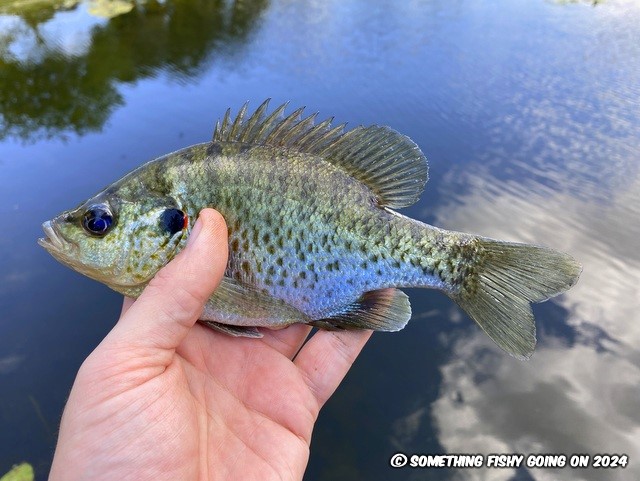
At first glance I thought this was a bluegill, but actually it's the bluegill's cousin, the redear sunfish.

Freelining my worm down in amongst some vegetation whilst searching for an Eastern happy, letting it sink slowly, my rod was pulled over quite abruptly by what turned out to be a small bass. It managed to swim through, and get itself tangled up in some lily stems, but applying gentle force I managed to eventually pull it free.

This is a Florida bass. Only recently recognised as a distinct species. Beforehand, it was considered a subspecies of largemouth bass. They grow much faster than the largemouth and much bigger too. Obviously, this one has some growing still to do!

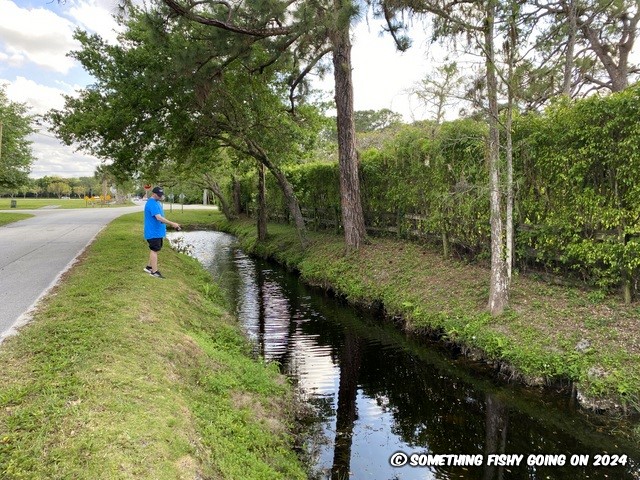
We spent a bit of time exploring the pond but couldn't locate any Eastern Happy, so we decided to drive to another spot in search of one. The third and final spot for the day’s fishing was a small, relatively shallow ditch by the side of a small road. To look at it, you would not imagine it held many fish if any, but the amount of fish in there and the variety was incredible, taking me somewhat by surprise. 

From this small roadside ditch, my freelined worms caught a ridiculous amount of fish.
As well as bluegill and redear sunfish, I caught lots of super aggressive Mayan cichlids,..
...spotted tilapia,...
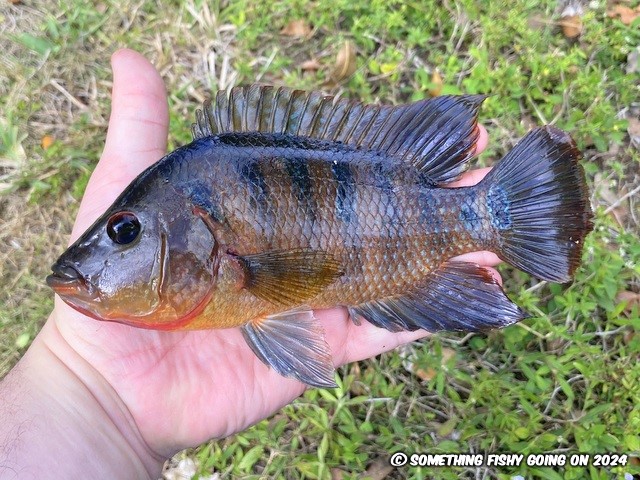
...some very cool looking jaguar cichlid,...
...and a nile tilapia too.

In addition, I also managed to catch a couple of Eastern mosquitofish. Dropping my whole worm into the margins, where there were a lot of them, they immeadiately started eagerly attacking it. Two of them biting onto the end of it and holding on while I lifted them out!

An Eastern mosquitofish. Turns out they are ravenous little swines and not too clever either!

By now, some grey clouds had started to roll overhead. Rain was on the way and thunderstorms were forecast the following evening. Whilst I was having lots of fun raiding the roadside ditch and catching lots of new species in the process, I was also aware that I was feeling a little under the weather myself. My nose was beginning to turn into a water feature, my eyes were itchy, and a headache was developing. At that point, I was pretty certain the lads at work had given me a parting gift. We called it a day on the fishing front and headed to a pharmacy to get something that would hopefully alleviate my steadily worsening symptoms.

Tight lines, Scott.

Click here for the next part.

Thursday, July 20, 2023

Species hunting adventures in Singapore: Day 5.

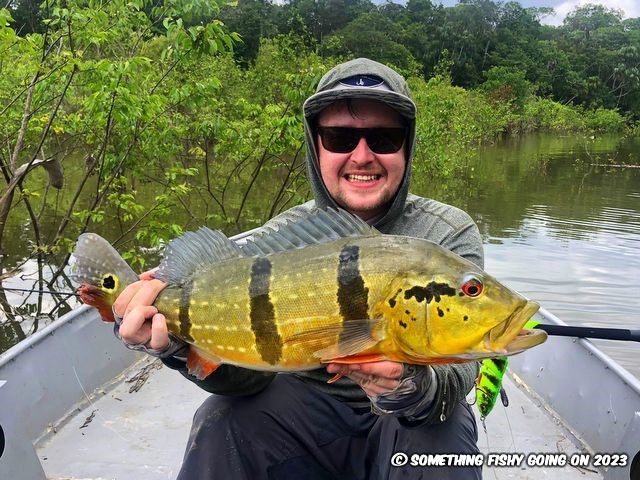
Having failed to catch any freshwater species two days earlier, we opted to have another attempt on the fifth day of our trip. The three of us headed up to Kranji Reservoir on the north coast of Singapore to try and catch peacock bass. There are three species found in Singapore, speckled peacock bass, butterfly peacock bass and azul peacock bass. Chris had caught speckled peacock bass before, whilst Lee and I were keen to catch any species of peacock bass for the first time.

Chris caught this lump whilst in Columbia recently.

I was quite excited about the session, but given our experiences in the other legal fishing areas, my expectations weren't too high if I’m honest. Kranji Reservoir is huge, and the two legal fishing areas either side of its dam are tiny in comparison. Any fish that regularly frequent these areas are also heavily pressured. When we arrived, there were lots of other anglers fishing already. We were expecting that. What we weren’t expecting were crocodiles!

I don't know if I was more amazed that there were crocodiles or that there wasn't a fine for being near the water's edge! The authorities in Singapore really do love a fine!

Getting quickly set up right at the bottom of the fishing area, we started fishing, all trying different lures, changing them occasionally, but nothing we cast in resulted in any takes. We did see the odd very small peacock bass feeding on tiny fry in the margins, but even trying small soft plastics in those areas failed to tempt the predators responsible.

Lee and Chris join the crocodiles in the long grasses of Kranji Reservoir Fishing Ground A. They dam is at the top of the reservoir and the tall buildings beyond are actually in Malaysia.

We persevered, fishing away for about three hours, trying various lures at different spots, but sadly none of us had any joy. We decided that it was time for Plan B, so we made the short walk up out of the fishing area and over the road to the seaward side of the reservoir’s dam. The water there was surprisingly dirty, the bottom was very snaggy, and despite throwing out a piece of prawn I got no interest whatsoever. There was also no cover and to make matters worse it was extremely hot too. Did I mention how hot and humid Singapore is? It didn’t take long for us to realise that it was probably time to switch to Plan C. The slight problem with Plan C was that there was no Plan C, it had to be formulated, so we sought some shade and drank some water while I came up with it.

After looking at the places I had saved on Google Maps, I suggested we visit an area where we could fish for small freshwater species in a tiny stream that ran through a jungle and then came out of it continuing its journey along a roadside channel. This would be Phase One of Plan C. A taxi ride and short walk later, we were standing on a small wooden bridge in a lush green and very noisy area surrounded by dense foliage and tall trees. There were lots of small fish in the water flowing underneath the bridge, but there were also lots of insects in the air, some of them were biting varieties. Chris and I decided to soldier on and began fishing, whilst Lee, who wasn't really interested in catching such small fish, decided to keep exploring the jungle’s paths to avoid being eaten alive, and he also wanted to see what wildlife he could spot. When he returned a short time later, Chris and I had caught a couple of the little fish and Lee had seen some cool creatures, so we were all quite happy.

I caught this forest betta from the stream running under the wooden bridge.
Whilst exploring the jungle, Lee spotted this strange creature clinging to a tree. He thinks it was a flying lemur.

Leaving the jungle I had thirty minutes fishing in the roadside channel. Chris and Lee were happy just to watch me catch a few more species before we headed back to the hotel. While I was fishing I also watched a small catfish quickly swim past and into a small pipe. I dangled some prawn next to the pipe to try and tempt it, but couldn't entice it out.

You’d be forgiven for failing to see this small stream as it was so overgrown! There were plenty of small fish in it though!

I caught a few of these small Nile tilapia,..
...and some Indochinese spotted barb too.

It was still very early in the evening when we got back and went out for some food. Afterwards, Phase Two of Plan C began, our first evening session of the trip. We had intended to fish from a spot near the Marina Bay Cruise Terminal for a few hours, but when we got there and started fishing the action was pretty much non existent and the seabed was a tackle hungry beast. It’s not much fun repeatedly tying up drop shot rigs using the light of a head torch just to lose them after a cast or two, and Lee lost a few jigs as well. A move to another venue was discussed.

The cool night scene was the only good thing about the spot we tried.

It's fair to say we were all by that point feeling a bit frustrated with the way the day’s fishing had not gone to any of the plans. I suggested we get a taxi and head along to Bedok Jetty. It was lit up, comfortable and wasn’t a tackle graveyard. So that’s what we did. Sadly, the fishing there was also very slow. There were lots of small baitfish around and lots of squid in the water too, sporadically attacking the baitfish. We caught a few cardinalfish at least, and I added one new species to my tally, so it wasn't a total waste of time. Chris also caught a cardinalfish neither of us had caught during the trip.

There were a few of these rib bar cardinalfish out hunting.
My only new species of the evening was this small saddled grunt.
Chris caught this greedy whitelined cardinalfish on a fairly large chunk of prawn.

So, all things considered it had not been a great day fishing wise. The following morning we were going to catch a ferry over to Pulau Ubin where we were hoping to catch barramundi in its mangroves. At least that was the plan! There would no doubt be new species to catch from the brackish water and I was particularly looking forward to hopefully not only seeing, but also catching some mudskipper!

Tight lines, Scott.

Click here for the next part.