Showing posts with label Leopard Spotted Goby. Show all posts

Sunday, July 27, 2025

Stuck in a rut.

Since returning from the Isle of Lewis at the end of May, I haven't been feeling very good. In fact, my symptoms have probably gotten worse: Constantly feeling fatigued, and having aching arms and legs isn’t much fun. As a result, I’ve been out fishing less than I normally would over the start of the summer months, usually choosing to stay fairly local when I have ventured out. A trip down to Torness Power Station midway through June didn’t produce that many fish, but a few leopard spotted goby and a butterfish were in amongst those I managed to catch, bringing a smile to my face. 

If pushed, I’d probably say that the leopard spotted goby is the coolest of all the UK goby species.
Butterfish are cool, and it's always fun to catch them!

Before heading back up the road, I quickly visited the sea defence boulders around at the station’s hot water outlet. My objective there, was to catch my first common blenny of the year. It didn't take long at all!

This shanny eagerly munched a small piece of prawn. 

Later in June, I also met up with a young American species hunter named Dominik, who was in Edinburgh for a few days before he and his family headed north on a Scottish road trip. We spent a few hours fishing beneath the lighthouse at Newhaven Harbour. It was a very productive session, during which, Dominik added a few new species to his lifelist, including butterfish, which we caught lots of. In amongst the more common species found there, all of which were new to Dominik, we also caught about a dozen grey gurnard, and towards the end of the session, I caught my first viviparous blenny of the year.

Dominik’s first ever butterfish. One of seven we caught between the two of us!
We also caught lots of juvenile grey gurnard.
My first viviparous blenny of the year. Another mini species I really enjoy catching!

So, I only went fishing a couple of times in June, but on both occasions, whilst the sessions may have been fairly short, they were very enjoyable! I might not have been feeling great, but getting out had cheered me a bit. I really enjoyed meeting up with Dominik and helping another species hunter successfully catch a few new species is always very satisfying.

Tight lines, Scott.

Tuesday, May 27, 2025

A spot of maggot drowning.

I popped down to East Lothian earlier this month for a short session at the lifeboat station at Torness Power Station. It had been quite windy for a while and the sea was fairly coloured up as a result. I had almost a full pint of maggots left over from my stickleback hunting a few days earlier, so decided to fish with those. They’re a fantastic bait for targeting mini species, believe it or not! Three hours only produced a few nibbles, and apart from a few velvet swimmer crab, one fish was my only reward for being persistent. 

My first leopard spotted goby of the year. Caught on double maggot!

On the way back up the A1, I visited the Biel Water, to see if I could catch a minnow. The river was down to its bare bones. Hardly surprising, given how little we’ve had, but I was still shocked by how incredibly low the water level was and struggled to locate any of my preferred target. Slowly approaching a deep pool, I spotted a few small brown trout, so I got as low as I could and crept closer to the bank, hiding as best I could behind some long grass. There were three small trout moving around and also a single larger specimen, about twice the size of the others.  Flicking a single maggot upstream, the bigger fish immediately surged forwards and took it. After a short scrap, I landed my second spotty species of the day. 

A nice looking little brown trout, also my first of the year. 

All the commotion it made spooked the other trout in the pool and they quickly shot off upstream. I spent a little longer trying to locate some minnow, but didn’t manage to find any sadly. I still had plenty of maggots left though, and decided to visit the Water of Leith a couple of days later to try and catch some there as well as perhaps some bullhead.  

Tight lines, Scott.

Sunday, September 22, 2024

My patience is now wearing a little thin.

Topknot. My new nemesis. I've put in a serious amount of time over the last few months trying to catch one. Slightly annoyingly, they keep popping up on my Instagram feed too, caught by anglers on the south coast of England.  Earlier this week, I had yet another couple of sessions after dark, dropping live prawns down the walls and into cracks in and around St Abbs Harbour trying to catch a highly elusive, rock dwelling flatfish. On the first trip I was joined by my mate Ryan. It was nice to have some company, creeping around in the dark on your own can be a little lonely, especially when the fishing is slow, which it was during both trips! We both caught a few fish, although Ryan trounced me on the species front, catching four I didn't in the shape of a ballan wrasse, a flounder, a shore rockling and a leopard spotted goby. 
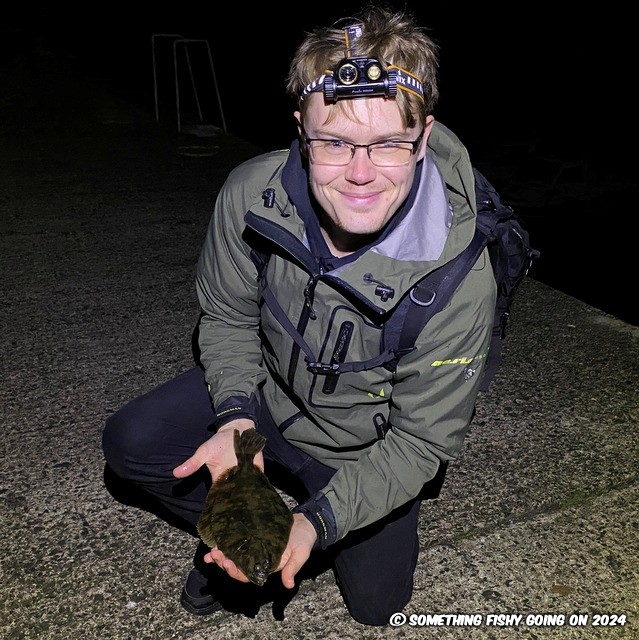
Scanning the bottom with our headtorches, we saw this darkly coloured flounder moving around over sand, but it swam over some weed, disappearing. Ryan cast his rig over the area a few times and the fish eventually took his ragworm section.
Ryan pulled this shore rockling out from the base of a wall inside the harbour. Normally associated with mixed to rough ground in the open sea, it must have been inside the harbour under the cover of darkness to scavenge.

Returning a couple of nights later on my own, I again failed to catch my intended target and after several hours trying, I decided to try to catch a leopard spotted goby. Ryan's the session before was the first one I'd seen caught from the venue, and I wanted to replicate the feat! Shining my headtorch straight down the harbour wall close to where Ryan had caught his, I couldn't believe my luck when I saw one sitting motionless on a concrete shelf. Dropping a small chunk of prawn down, the fish ignored it to begin with, but after a brief pause I gave my bait a twitch and watched the goby spring to life and my bait quickly vanished.

It was the same size as Ryan's fish. I compared our photos a few days later out of curiosity. It was in fact the exact same fish!

By the end of a pretty tough evening, I was feeling just ever so slightly frustrated at my repeated failures on the topknot front. Keen to go fishing as the weather was glorious, the other day I opted to spend a few hours targetting mullet at the outflow of Torness Power Station. In particular, I wanted to catch a golden grey mullet, as I hadn't caught one yet this year. Donning my polarized sunglasses to eliminate the surface glare, below the surface I couldn't see any mullet swimming about, but decided to have a go anyway. Tearing up some bread into small pieces and throwing it in to try and draw in some mullet, eventually I spotted a few small fish swimming up the current into a pocket of slack water and taking the free offerings. Fishing a very small piece of flake on a #16 hook and using a few split shot to get my bait down, I felt the odd nibble and eventually caught a couple of fish in quick succession.

The first fish I caught was this thick lipped mullet. Easily identifiable from the rows of papillae on the lower section of its thick upper lip.

The second mullet was the one I was hoping to catch, a golden grey mullet. With a much thinner upper lip and a bright, well defined golden spot on its gill plate it was very straightforward to identify.

About thirty minutes later, I hooked a third mullet. It was small and having already added a golden grey mullet to my 2024 species tally, I didn't even bother using my net to land it. Swinging it up to hand however, it looked a little odd. Curious, I popped it into a bucket of water, so I could carry out further examination and take some photos.

The fish in question. It had a thin upper lip, but only a very faint golden marking on its gill plate. It was not as slender as a golden grey mullet either, being much heavier in the body. Furthermore, it also had a black spot at the base of its pectoral fin and an orange/gold shade to parts of the iris, both are features of a thin lipped mullet!
The shape of its head didn't look right for a golden grey either. The snout was stubbier and flatter across the top. The maxillary bone at the corner of the mouth was also larger than that of a golden grey mullet. In the golden grey mullet, this structure is very small.

Had I caught my first Scottish thin lipped mullet? In the back of my mind, I seemed to recall a simple test that I had read about that could be used to positively identify UK mullet species. Doing a quick Google search on my phone, I found details of the method in question. Folding the pectoral fin forward, it will not reach the posterior edge of the eye or at most will just reach the posterior edge of the eye on a thin lipped mullet. On a golden grey mullet, the pectoral fin when folded forward will reach well past the posterior edge of the eye, sometimes as far as the centre of the eye.

The pectoral fin folded forward didn't reach the eye! Along with the other features, did this mean my fish was indeed a thin lipped mullet?! It would be a new Scottish species for me if it was!

Returning home, I consulted the numerous species identification books that I own. Some, including the excellent "The Fishes of The British Isles & N.W. Europe" by Alwyne Wheeler, which has detailed dichotomous keys that can be used to positively identify fish within a known group to species level, also specified the pectoral "fin test" as the means of distinguishing between the golden grey mullet and the thin lipped mullet. At this point, I sent my pictures to a few fellow species hunting anglers and also to the National Mullet Club, asking for their opinions on the identity of my fish. The consensus was that I have indeed caught a thin lipped mullet! 

Curious to carry out the pectoral fin test on a golden grey mullet, I returned the other day to try and catch one. The session turned out to be quite a frustrating one. The wind had changed direction and a swell was running directly up the outflow. It didn't look promising, but I had a go anyway, this time fishing a two hook presentation to increase my chances. Feeding small pieces of bread, I eventually spotted one or two fish, so I persevered. After about three hours, this paid off when I finally hooked a few fish, three taking my hook bait in a fairly short period. All three somehow managed to eject my hook though, after being on for a brief period. They felt like bigger fish, too big to be golden grey mullet I felt, so I wasn't too annoyed. Another couple of hours later, I’d had no more action, and I was about to admit defeat and head off when I hooked a fourth, smaller fish. This time the fish was well hooked, and I had it in the net fairly quickly. It was the golden grey mullet I was after.

Time to put the pectoral fin test to the test!
As predicted! The pectoral fin when folded forward reached the centre of the golden grey mullet's eye.

Personally, I'm now extremely confident that I have indeed caught a thin lipped mullet, a quite unexpected and very welcome bonus catch that I'm happy to add to my lifetime Scottish species tally, taking it to ninety eight. With only two species now required to reach my goal of one hundred, and as the colder months approach, I don't want to take my foot off the gas just yet, but conditions will play a huge part in the fishing I can do, and the species I can target. Regardless of how my fishing plans develop over the coming months, I really need a break from topknot hunting! I’ve taken the opportunity to get just that with an impromptu, very last minute, week long trip to Malta with my mate Gordon this Saturday, and there's zero chance of catching one there!

Tight lines, Scott.

Thursday, August 01, 2024

Scratching around.

I’ve had a few short sessions over the last week, trying to catch larger sandeel species and my first topknot. The inlet area of Torness Power Station was the first venue and after collecting some bait in the shape of a handful of dog whelks, I tied on a small metal to try and tempt any large sandeel species that might have been present. A few years ago, I caught a sandeel there that I suspect may have been a Corbin’s sandeel. I took photos of it at the time, but really I should have kept it, so I could have carried out a thorough inspection to confirm its identity as either a Corbin’s sandeel or a greater sandeel. 

Matching the hatch in fly fishing terms. Large sandeel species eat small sandeel species. 

After an hour or so, I hadn't caught any sandeel, instead catching quite a few reasonably sized coalfish that were good fun on my ultra light setup. 

These plump coalfish put up a spirited fight. 

After a while the incoming tide forced me from the concrete platform where I was fishing, so I scrambled back up the sea defence boulders where I spent some time dropping pink isome down into the gaps between them. I was hoping to catch a topknot, but after trying several deep holes, all I’d caught were a couple of long spined sea scorpion. I then switched my attention to fishing over a rocky area at the edge of a large kelp bed. Baiting up small hooks with the flesh from the dog whelks was quite productive, with several mini species falling for their strong scent. 

This leopard spotted goby was first to munch a chunk of shellfish. Looks like popcorn but tastes a bit fishy. 
This blenny also took a liking to the small bait. 
As did this long spined sea scorpion. 

A few days later, I decided to visit the end of Granton Breakwater at low tide, to fish in the rocky bottom between the end of the breakwater and the rotten remains of the old wooden pier that used to be there. Fishing small pieces of ragworm I was expecting to maybe catch a few wrasse, but instead all I caught were some tiny poor cod, and I had to go down to tiny hooks to discover what was tapping away. 

There were lots of these, my first poor cod of the year, but sadly nothing else. 

The following day I headed to Newhaven Harbour to use up a small amount of maggots that I had left in my fridge that had started to turn. The juvenile whiting were loving them, hitting them as soon as my rig settled at the bottom of the wall I was fishing down.

Maggot proving once again to be a very effective bait for saltwater targets.

After a while, a piper turned up and began playing his pipes for the passengers arriving from a cruise ship that was moored out in the Forth. It was quite cool catching a few fish as he played his instrument behind me!

What's more Scottish than a red-headed, red-faced young man playing the bagpipes!

The juvenile whiting were numerous and equally ravenous, but eventually a viviparous blenny managed to get my wriggling little baits in its mouth first and was quickly hoisted up.

I've caught a few of these lately, but on maggot was a first for me.

All good fun, and my expectation of catching anything new during these types of sessions is minimal, but you never know. I just got back from a two-day trip down to Dumfries & Galloway with my mate Ryan, and on Saturday I'm heading back down there again with my mate Nick. Ryan and I had a good time, although the fishing was challenging at times. We caught a few fish, but we didn't get the one species that we went for. I have no expectation of encountering anything unusual on Saturday evening, having already ticked off a Dover sole, but I'm looking forward to hopefully another action packed session. I might spend some time trying to catch a starry smoothound during the session, fingers crossed one can get to a peeler crab bait before the hordes of thornback ray do.

Tight lines, Scott.

Thursday, July 18, 2024

Three new Scottish species in one day!

I’m off to Norway at the end of August with two of my mates, Nick and Ryan. We met up yesterday down at the outflow area of Torness Power Station to catch up, discuss our upcoming Scandinavian adventure and hopefully catch some mullet on freelined bread flake. Despite there being lots of mullet around it proved to be incredibly frustrating trying to catch them. Even more so than usual! After a couple of hours, a few had been hooked, but most hadn’t stayed hooked for very long, and the few that had, threw the hook at the net. Nick got a dog earlier this year, so he had to head off to take it out for a walk. Ryan and I carried on fishing and eventually a small mullet took his bread, was well hooked, and I netted it for him after a short fight. 

Ryan was over the moon to catch his first Scottish thick lipped mullet.

We fished on for a bit longer, but eventually I admitted defeat, and the two of us headed around to the inlet area to fish for a few more hours. There we fished small pieces of ragworm, black lug and prawns to see what mini species we could catch. The bites came sporadically, but when they did come, we were steadily racking up a few different species.

I’ve caught a few goldsinny wrasse down at Torness Power Station now. They seem to be fairly localised in only a few specific spots.
I’ve caught way more than my fair share of butterfish lately, and added another to my tally, this being number eight!
We both also caught a few leopard spotted goby.

After a short quiet period, Ryan hooked a fish, and as he wound it up I looked down from our elevated position to see what it was? As it reached the surface, I could see that it was a Yarrell’s blenny. I knew this was a species that Ryan really wanted to catch, so I told him to lift it up from the water and over the fence in front of us quickly, without actually telling him what it was. Luckily, the fish was well hooked and made it up onto the platform. Ryan was ecstatic when he saw what he’d caught!

Ryan was thrilled to catch his first Yarrell's blenny.
Ever since he witnessed me catch one last year, Yarrell's blenny has been top of his mini species wish list!

Before we left, we decided to clamber down the defence boulders to have a few casts with metal jigs to see if there were any mackerel around. This turned out to be a waste of time. 

I search the deep inlet channel with a 10g metal jig. 

There may have been no mackerel around, but Ryan did catch a greater sandeel just before we left. This was his third new species of the day, but didn’t seem to excite him quite the same way as the first two had. He didn’t even bother taking a photo of it, instead just quickly unhooking it and throwing it back. All in all an enjoyable session, and it was great to see someone else getting a new species adrenaline rush a couple of times! 

Tight lines, Scott.

Monday, July 15, 2024

So glad I went fishing.

Some days you go fishing when the conditions are less than ideal. Yesterday was one of those days. Overcast, rain forecast, and an onshore wind. Not great and a continuation of the poor summer we’ve had this year. Despite this weather, I drove down to St Abbs to use up some ragworm I had left over from my sessions at Newhaven Harbour the two previous days. As I expected, the sea was quite rough, so I focused my efforts initially inside the harbour, dropping fairly generous sections of ragworm down tight against the inside of its walls. 

Outside the harbour, the slowly undulating sea was breaking violently over the rocks.

This approach proved too tempting for the long spined sea scorpion hiding out on the vertical surfaces. Moving along and trying different spots, I soon caught about a dozen of the aggressive little ambush predators. One of them was a bit of an old warrior. It looked pretty beat up, and its spines were curled round at the tips. I’ve never seen one like that before.

This long spined sea scorpion had ragged, misshapen fins and its spines were blunt. Its right one noticeably curled right round at the tip.

Having covered a good portion of the harbour’s walls, I moved around to the harbour’s mouth where I was hoping to catch a flounder, but didn’t have any joy. The sandy area where they normally hang out was covered by loose sea weed that had been washed in by the swell. Turning my attention to the fringes of the kelp beds at the right hand side of the harbour’s entrance, I caught about half a dozen corkwing wrasse. All males, one of them had some very colourful markings.

The vivid colours on this corkwing wrasse were lovely, particularly the blues and greens on its fins.

At this point, I noticed that the weed covering the sandy area had been partially washed away from it, so I had a few more casts onto it to see if any flounder were lurking there. After a working my rig slowly across the sand back towards me a few times, a nice coalfish took my ragworm as I recast, and my rig dropped through the water column.

A nice chunky coalfish that put a bit of a bend into my ultra light rod as it tried to get into the kelp.

Things went quiet for a while and as the tide picked up a fair amount of suspended weed appeared, so I took the decision to head up the A1 to continue fishing at the inlet area of Torness Power Station, a spot I knew would afford some shelter from the northerly wind and accompanying swell. Walking back up the hill to where I had parked the car, I noticed a sticker on a rubbish bin and, curious about what it said, stopped to read it to find out.

Having recently taken the decision to quit my own job, I’m not working at the moment. I can relate to some aspects of the message conveyed in this sticker. I’m taking some time off to carefully consider what I want to do for a living going forward.

Arriving at my chosen spot, that produced lots of butterfish and leopard spotted goby during a visit last week, I soon caught a few tiny cod and a couple of small corkwing wrasse. The water was a little coloured up however, bites came intermittently, and I was struggling to connect with some of them. When I finally hooked another fish, it was a fairly large leopard spotted goby. I had my little photo tank with me and popped the fish into it for a photo.

All the details of the leopard spotted goby shown in their full glory.  The mini species tank really is a great thing for examining a fish's features fully!

After catching a few tiny coalfish and cod, the bites dried up almost completely. Persevering through a fairly long period with nothing showing any interest in my ragworm, I then had a very subtle knock that I slowly lifted into. Feeling the weight of a fish that wasn’t fighting particularly hard, I slowly wound it up in case it was something odd. When it appeared on the surface I initially thought it was a butterfish due to its brown and pink colouration, but as I lifted it up, and it got closer, I realised that it was in fact a Yarrell’s blenny!

One of my favourite UK blenny species! Its coolest features were laying limply on its forehead though. Time to put my photo tank to use again!
The fish just fit inside, but its impressive bushy eyebrows were on display in all their funky glory!

Many years ago, my mate Nick caught a Yarrell's blenny, not too far from where I caught this one, so I always hoped there was a potential resident population. I have over the years tried numerous times to catch one there myself and had kind of given up, so I was over the moon to finally get one at this venue. Shortly afterwards, I used up the last of my ragworm and called an end to a most enjoyable day’s fishing, during which I had been rewarded with some odd, colourful and interesting species. The Yarrell’s blenny in particular being a real highlight. They’re such a strange looking fish!

Being honest, I was pretty close to not going fishing at all due to the poor conditions. It just goes to show that sometimes you never know how a fishing trip will turn out. Even when the weather is poor, the fishing might not be!

Tight lines, Scott.

Wednesday, July 10, 2024

Tails of the unexpected.

Well, it looks like the glorious weather we’ve all been enjoying so far this “summer” shows no sign of improving! Faced with strong easterly winds and miserable wet conditions this afternoon, I decided to yet again head to the inlet at Torness Power Station.

Back again. Not the most scenic place to fish but needs must sometimes!

This time however, I put all thoughts of catching a topknot to one side, mainly because there was no way I was clambering about on the slippery wet sea defence boulders. Making a brief visit to the outflow area, I collected some live prawns and headed around to fish them down the side of the lifeboat platform, where I was afforded a bit of protection from the cold easterly wind. Bites came from the first drop and I soon caught a few small ballan wrasse.

A nice dark green ballan wrasse. 

In amongst the initial onslaught of ballan wrasse, a single goldsinny wrasse took my live bait. After a while, the wrasse stopped biting, and things went quiet for a short spell. The next species to eagerly munch a prawn and get itself hooked was a leopard spotted goby, which was a pleasant surprise. I’ve caught them from rockpools on the east coast before, but this was the first time I’d caught one from the open sea on this side of the country.

In my experience, leopard spotted goby are much more common on the west coast of Scotland.

Next up was a procession of tiny cod. I've no idea how they managed to get the little prawns into their tiny mouths, but somehow they did! After the wave of tiny cod I caught another unexpected species in the long slippery shape of a butterfish. I was over the moon to catch one!

One of my favourite UK mini species.

After another slow period, there was another increase in activity. I caught a few more ballan wrasse, and much to my delight, I caught two further butterfish and another five leopard spotted goby. Clearly, I had located a small area that held a good number of both these mini species.

Ballan wrasse come in a plethora of colours!

After unhooking this butterfish, the largest of the three, the slippery devil didn’t want to cooperate and have its photo taken in my palm. They’re called butterfish for a reason. 

After a few hours, I had used up all the prawns I’d collected, and whilst I had some dehydrated ragworm and a packet of mini isome with me, I was pretty wet and cold so I called it a day. I'd caught over twenty fish from a very concentrated area, probably no larger than a square metre of the rocky sea bed. Catching the butterfish was a real highlight of the session. They are such a cool fish! I'm very pleased that I seem to have located a fantastic spot to target them in the future. Well worth venturing out in the poor conditions for!

Tight lines, Scott.

Friday, August 25, 2023

Well spotted.

Whilst waiting for the tide to drop, so I could access an Atlantic horse mackerel mark on Monday evening, I spent an hour or so searching some rockpools with my headtorch to see what I might find. Nothing unusual turned up, but I did locate one rockpool that had a couple of leopard spotted goby just sitting motionless out in the open on the bottom, their markings ensuring that they stood out like a pair of sore thumbs! Pretty unusual behaviour for this species, during daylight hours they’re normally hiding in shady areas, but perhaps unlike me, they regularly venture out at night? Dropping a small bait in front of them resulted in the smaller one gobbling it up. 

A fine example of the colourful little fish. 

Sadly, I didn’t enjoy any success fishing for scad, so after a couple of hours I headed back up the A1. I’ll definitely be out hunting in rockpoools with my headtorch after dark again. Seeing fish that would normally be too shy to come into the open was food for thought. I also caught a few blenny and spotted a butterfish as it snaked its way through some small rocks before disappearing out of sight. There were also lots of very colourful squat lobsters out sitting on rocks too. Hopefully if I visit often enough I'll get lucky and something rare will turn up. Something I’ve never caught in Scotland before would be even better!

Tight lines, Scott.

Saturday, June 17, 2023

Too hot to fish?

I headed west with my mate Ryan on Tuesday for a couple of days species hunting. The weather was glorious. Probably too hot if the truth be told, but we decided to smear ourselves in sun cream and go anyway. Discussing our plan of attack during the drive there, and the potential species we could catch, we set a target of twenty species between the two of us for the trip. Our first stop was Loch Creran Head, where we fished scaled down three hook flapper rigs baited up with small sections of ragworm. We fished from some bladderwrack covered rocks exposed by the tide to begin with before moving to some steep rocks above the high tide mark further east once the tide began to flood. Several unusual mini species that I’ve never caught before inhabit the sea floor in this area, so I had my fingers crossed. From our first cast we caught plenty of fish but nothing unusual, unfortunately.

Loch Creran Head on a hot sunny day.
As I’ve discovered during recent sessions there, the loch contains a very health black goby population. This makes it very difficult to catch rarer, less aggressive species. Ryan had never caught a black goby before but the novelty soon wore off and he got bored of catching them.
We also caught a few common dragonet. Another new species for Ryan.

After a few hours we’d more than had our fill of catching black goby, so we packed up and drove north to fish from the old stone pier in Kentallen. Fishing wasn’t non stop action, no doubt due to the midday sun blazing down, but a few wrasse and goby species bumped up our trip tally. Ryan also caught a butterfish and I caught a Connemarra clingfish which spiced things up. Then out of nowhere it started raining pretty heavily, so we hastily packed up and hit the road again.

Loch Linnhe on a hot sunny day.
Only my second ever Connemarra clingfish. The first addition to my personal 2023 species hunt of the trip.

An hour or so, a ferry crossing and twenty odd miles of single track road later, we arrived in Lochaline. After grabbing some food we self checked into the bunkhouse there where we'd be spending the night, and then headed down to the village’s West Pier to fish for a few more hours. Again, we caught lots of wrasse and goby as well as lots of poor cod and a few pollock. In the process I added three more species to my 2023 tally.

Small but perfectly formed, my first cuckoo wrasse of 2023.
Dozens of leopard spotted goby were caught. Another species added to my 2023 tally.
We caught a few rock goby too. My first of 2023 also.
We caught lots of goldsinny wrasse.
Some very colourful rock cook wrasse as well.
I also caught what would turn out to be the only short spined sea scorpion of the trip. My second in a week.
The Sound of Mull on a... Wait a minute! Is that rain coming or a swarm of midgies?

It turned out to be rain followed by swarms of midgies. Thankfully I had a can of Smidge in the car!

As the sun began to get very low in the sky we decided to call it a night. We’d caught fifteen species between us by the end of the first day, which I felt was a pretty good effort. Having left Edinburgh at 05:30 we were both feeling a little bit tired. Back at the bunkhouse we both had a much needed shower. The scent of sun cream, ragworm juice and Smidge isn’t a pleasant combination!

In the morning we were up early again and were down at Lochaline’s ferry terminal fishing by 06:00. We headed there because I knew it was a good spot to catch a certain diminutive species and after catching lots of them, we decided to head to a new spot.

Several two spotted goby in my photo tank.

I wasn’t sure if fishing was permitted out on the pontoons of Lochaline Harbour, but there were no signs saying it wasn’t and none of the people who had their vessels moored there seemed to mind us fishing, some even showing an interest in what we were trying to catch, which was mainly sand goby. I did see what I think might have been a tiny clingfish, but it disappeared underneath a scallop shell and I couldn’t tempt it out. Through the crystal clear water we also saw some trout cruising about and a solitary flounder moving along the bottom, but we failed to catch any of them. Before we left I did manage to add a painted goby to our tally, taking it to eighteen. With the plenty of time left before we had to head home we only had two species left to catch to reach our target!

Lochaline Harbour on a hot sunny morning. Surely this should be called Lochaline Marina?
I lost count of the number of sand goby I caught. Ryan caught his first ever sand goby too.
Ryan tries to tempt a trout on small metals.
I pinched his spot and sat relaxing in the sun waiting for mini species to bite. After catching even more sand goby and a couple of common dragonet I managed to add a painted goby to our tally.

Before we left Lochaline we decided to head back to the West Pier for a couple of hours. I was hoping we’d get lucky and pull out a Yarrell’s blenny but all we caught were wrasse, goby and some poor cod. The next stop on our adventure was a new mark I'd spotted on Google Maps. Heading north from Lochaline we took a right turn onto a winding B road, driving through some amazing scenery before ending up on a slipway next to a small stone pier on the northern shore of Loch a’ Choire.

What a beautiful view!

Three hook flapper rigs were cast out, but these didn’t produce any fish. I then spotted a common blenny down the side of the slipway and Ryan dropped a bait down in front of it. Species number nineteen caught we jumped back in the car and headed to Fort William to fish Loch Linnhe again from the town 's West End Car Park. I was confident we’d get a dab or a grey gurnard there, but the water was a bit coloured up, and we caught neither. Ryan managed a couple of pollock before we decided to head off to try the Linnhe Picnic Area a few miles south of Fort William. The water there was also coloured up a bit and there was a fair amount of suspended weed to contend with as well. We soldiered on and after several fishless casts I wound in my three hook flapper to put fresh bait on and was pleasantly surprised to discover a Yarrell’s blenny on the bottom hook!

My first Yarrell’s blenny of the year.
A cool twentieth species of the trip for us.
Holding the fish in a rock pool I got this great photo of the fish's funky "eyebrows"!

After that things remained slow, but we fished on for a while and Ryan eventually caught a nice dab before we finally called it a day and began the three hour drive home.

The last fish of the trip.

So it had been a great little trip in very hot weather. We’d done very well, catching twenty one species in total. Not bad considering just how hot it had been. I’d added five species to my 2023 species total and taken it up to ninety nine. I think I’ll pop out and try to make it one hundred before I fly out to Singapore on Tuesday. It’ll be even hotter there, but will that stop me fishing for an incredible variety of new species? Not a chance!

Tight lines, Scott.