Showing posts with label Cod. Show all posts

Thursday, June 04, 2026

Nine out of ten.

I made the most of some nice weather last week, heading down to St Abbs Harbour for a session with fellow species hunter Luke. We set ourselves a target of ten species just after we started fishing and ended up catching nine.

Some juvenile pollock were the first species of the day. 
Working a small piece of ragworm over the bottom produced a few long spined sea scorpion. 
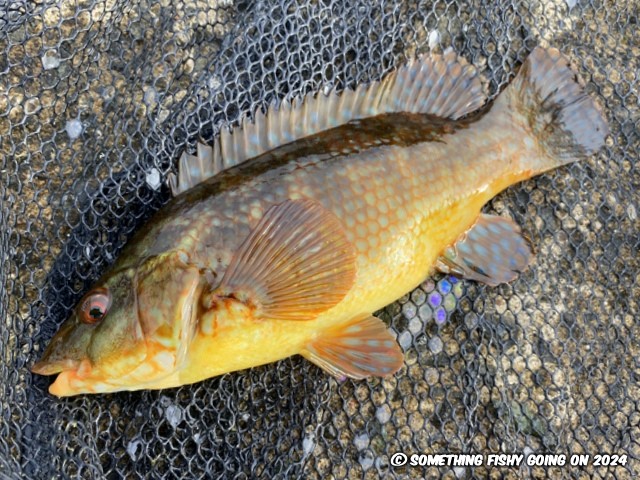
Dropping my rig close to the edge of a kelp bed by the harbour mouth produced my first ballan wrasse of the year. 
Heading around the harbour, I caught this flounder. 
Whilst trying to catch a corkwing from a gully this chunky blenny appeared and munched my bait. 
We spent a bit of time fishing over a clean sandy patch, sight fishing for this nice plaice which we both ended up catching!
Tying on tanago hooks, we both caught some painted goby from a shallow sandy patch.
Back at the mouth of the harbour, Luke caught a few corkwing wrasse before I finally caught this nice colourful male.
Not long before we called it a day, we both caught some codling.  

During the session, we spotted quite a lot of fifteen spined stickleback and tried to catch them, but only one briefly showed any interest in a tiny piece of ragworm. I also spent some time sight fishing for a solitary dragonet, but despite repeatedly twitching a bait past it, it just couldn’t be tempted. Two sea trout also swam into the harbour just before we left, so whilst we didn’t reach our little goal, it was achievable. Regardless, it had still been an enjoyable day down in the sun-kissed Scottish Borders. 

Tight lines, Scott.

Friday, April 10, 2026

It's grim up north.

The fishing is usually pretty tough locally at this time of year and the weather so far in 2026 has been nothing short of dreadful, especially the wind. As a result, I've not been out that much. Before my mate Ben came up to Scotland at the end of last month, I had a second session at Newhaven Harbour. One of his target species whilst up here was a viviparous blenny and after catching a small cod, I caught a small one, but the session was very slow apart from those two fish and a few tiny whiting.

This juvenile cod hovered up a tiny piece of ragworm. 
My second viviparous blenny of the year.

When Ben did come up, he visited Hartlepool on his way from Wales and caught his first ever viviparous blenny there, so there was no need for him to visit Edinburgh. Instead, he drove up to the Scottish Highlands and spent a week fishing there in some pretty terrible, wet and windy conditions. Keen to try and meet up towards the end of his trip, we discussed a session in Dundee to target smelt on the Tay Estuary, but the conditions were poor, so sadly we didn't end up fishing together. In the end, Ben's first ever viviparous blenny, his 80th saltwater species in a calander year, was enough to see him crowned champion of the Angling Trust's year long species hunt again, so his trip north and a week of tough fishing had been worth the effort!

On Wednesday, I headed down to Torness Power Station, where I spent a couple of hours fishing with two of my mates, Nick and Ryan. A neap tide and coloured water made for a very slow session, but the sun was out, and with little wind for a change it was a nice day, quite a contrast from the severe gales, rain and snow that Storm Dave brought over the weekend! Nothing was biting as we chatted away, but eventually something ate my piece of ragworm and I wound in a small dab which ended up being the only fish from our time at the lifeboat station platform.    

The only fish we caught for the first couple of hours!

None of us were that surprised to be honest, but hoping to catch a few more fish, the three of us headed around to the hot water outflow area. Things weren't much better there sadly. Nick and I managed to catch a couple of blenny from the water between the sea defence boulders, whilst Ryan fished a soft plastic mounted on a jighead for a while hoping a bass would grab it, but he didn't get any takers. We discussed staying for a bit longer so that we could fish bread for mullet once the tide came in, but decided against it.

My second fish of the day!

So, despite the arrival of spring, the fishing locally remains pretty tough and the constantly changing weather certainly isn't helping either. Thankfully, I've got a week on Gran Canaria coming up soon, and I’m really looking forward to that! Hopefully when I return, the fishing here will be better and the weather will have improved a bit too! 

Tight lines, Scott.

Monday, January 12, 2026

Starting again from scratch.

Another year has begun, and for us species hunters, it's time to reset our annual species tallies. Last year, I caught one hundred and ninety one different species of fish, including forty three new ones. Not too shabby, all things considered! On Saturday evening, I headed back down to Cove Harbour with my mate Ryan to spend a few hours in the freezing cold targeting rockling. A bit of a swell was still running following the latest storm, which made fishing with light tackle fairly testing, but before too long I had pulled out my first fish of 2026.

The five bearded rockling was also my last species of 2025.

As the night progressed, we caught a few coalfish and the odd small cod on our small black lug baits. Despite the conditions, the fishing was enjoyable, and in between bites we chatted away. We mainly talked about our recent trip to Japan and all the things we were missing about it. We also discussed some potential destinations for trips this coming year.     

There were plenty of these reasonably sized coalfish around...

...as well as some small cod.

Towards the end of the session, we both caught a shore rockling each. These are easily distinguished from their five bearded cousin as they possess two fewer "beards". They also grow a bit bigger too.

The shore rockling has three beards. So does the three bearded rockling, but in my opinion the two species look nothing alike due to their very different colourations!

Before we knew it, the time had come to head back up the path to the car and drive back up the A1 to Edinburgh. It had been another enjoyable winter session and I think Ryan and I will be out again for more of the same over the next few weeks, although we may fish more locally.

Tight lines, Scott.

Friday, October 18, 2024

Short, but sweet.

Back in August, I was contacted by fellow species hunter, Luke Ovgard, about fishing around Edinburgh, as he was going to be spending a weekend in the Scottish capital with his two brothers in October. Not a particularly great time of the year to go fishing, I warned him, but I agreed to meet up with him when he was here to try and help him catch something new. Luke has travelled all over the world and caught over 1350 species along the way, including many of those found around the coast of this part of Scotland, so he sent me a spreadsheet containing all the species he’s ever caught. Having a look through it, I spotted a few species he hadn't caught that we could try to catch. If the conditions were favourable, I felt that we could possibly encounter ballan wrasse, butterfish, leopard spotted goby, pollock, poor cod and Yarrell’s blenny. Luke arrived from Stuttgart, where he currently lives and works, last Thursday evening, and spent the weekend sightseeing in Edinburgh and exploring further afield, making it as far north as Fort William. I had a couple of sessions last week in preparation for ours, just to see what was around. For the first session, I collected some live prawns to use as bait. Netting them out, I found a couple of tiny fish in my net with them.

Probably the smallest wrasse I’ve ever seen. I believe it’s a corkwing wrasse.
In amongst the prawns was also a tiny sand smelt.

Over the two sessions prior to meeting up with Luke, I caught a few fish, but the conditions were far from ideal. The temperature had dropped, and it was very windy too, making fishing quite unpleasant. The sea was pretty rough too and was coloured up as a result. Given the effort required to catch hardly any fish, I was concerned that we might struggle.

At St Abbs I did catch a few coalfish, but it's a species Luke had caught already, on the other side of the Atlantic, in Maine.
At the inlet area at Torness Power Station, I caught a few juvenile cod. Luke had caught this species already as well.
Trying to catch a ballan wrasse proved to be a bit of a waste of time, with only this solitary long spined sea scorpion taking my ragworm section. Another species that Luke had already ticked off.
During the second session, I caught a solitary poor cod. The only fish I caught over the two trips that Luke hadn’t caught before!

We had originally planned to meet up on Sunday evening, but the highland road trip Luke's brothers had organised that day ruled that out. In the end, we met up early on Monday morning, only fishing together for just over two hours, the only time available before Luke had to head to the airport. Arriving at the inlet area of Torness Power Station, the wind had dropped off, had also changed direction and the sea was pretty flat. Whilst it was still very cold, we were pleasantly surprised by the amount of fish we caught. In amongst them, Luke caught his first ever poor cod and pollock, which he was over the moon about.

Luke's first ever pollock.

I was really enjoying his company, and while we fished away we had a great conversation about some of the species we’ve caught, some of the places we’d fished and some of our future species hunting plans. Before we knew it though, it was time to pack up. Focusing on the fishing and our discussion, I hadn’t even taken any photos during the session. It had been great to meet up and when I dropped Luke off, he surprised me with a parting gift, a copy of his book “Fishing across America”, which I am currently reading. I really hope our paths cross again in the future. If he visits Scotland again, which I've suggested he does and next time during the summer months, I’m sure we could travel around Scotland for a few days catching lots of fish! It would be a pleasure to fish together again, and hopefully I could help him add a few more species to his already very impress tally!

Tight lines, Scott.

Friday, September 06, 2024

Packing for Norway.

Two weeks ago, when I really should have been packing my bags for a one week trip to Norway, I put doing that off until the last minute and crammed several fishing sessions in hunting for a topknot. With the summer coming to an end, I guess I figured I had better make the most of what was left of it. By the time I got back from Scandinavia it would be Autumn after all.

The weather wasn’t great when I visited Torness Power Station for my first session, but I tucked myself away down in the sea defence boulders and dropped live prawn down into the deepest holes I could find.

This nice deep hole didn’t produce a topknot,..
…only this solitary blenny.

After a few pretty fruitless hours, scrambling around the rocks and not catching much, I drove down to St Abbs to try my luck there. The fishing there was much more productive, and there were lots of ballan wrasse around that were more than happy to munch a live prawn. A few long spined sea scorpion found them tempting as well. I’m sure a topknot would eagerly eat one too. I suppose I just didn’t manage to put my bait near one.

The rocky areas surrounding the outside of St Abbs harbour held plenty of ballan wrasse.
They're home to a few long spined sea scorpions too.

A couple of days later, I headed back to St Abbs again, this time to fish Starney Bay from the rocks on its right hand side.

Only accessible at low tide, I hadn’t visited the rocks on the right of Starney Bay for a long time.

It was a beautiful day when I made my way down from the coastal path, scrambled over the rocks and finally got out onto the point, and I was soon catching a few fish. Dropping sections of ragworm and live prawns down close to the vertical rock surfaces produced a couple of ballan wrasse, which were followed by a succession of coalfish.

Coalfish give a great account of themselves on ultralight tackle.

I did intend to stay on the rocks for several hours, but a change in the weather forced me to alter my plans. Thankfully, I made it back across the gully that fills up as the tide rises just in time, otherwise I would have been stuck out on the point for a few hours in the rain. By the time I made it to St Abbs Harbour, the blue sky had been replaced by dark grey rain clouds passing overhead, and I did end up getting slightly wet a few times as rain sporadically fell. I focused my efforts on lowering live prawns down the vertical concrete surfaces, exploring as much of them as I could. I may have been slightly damp, but the fishing was pretty good, and I was also rewarded with some pretty spectacular rainbows.

Somewhere over the rainbow, topknot lie.
Live prawn has become one of my favourite baits this year. Fish love them, collecting them is easy, and best of all they are free!
One of several chunky ballan wrasse I caught.

I carried on fishing into darkness, working over the same areas I’d covered earlier in the session. Eventually, I ran out of prawns, so I switched to sections of ragworm. This produced a couple of long spined sea scorpion and a small lobster.

A bizarre creature, but sadly not the one I’ve been after for weeks!

Two days later, Lillian and I went for a walk around Butterdean Wood in East Lothian. Afterwards, we visited the inlet area at Torness Power Station where I was permitted to fish for a couple of hours to use up some ragworm I had left over from my previous session. This produced a few wrasse, and a couple of other species, but once again no funky flatfish, unfortunately.

Yet another ballan wrasse over 40cm on ultralight tackle,..
...a colourful corkwing wrasse,..
...a nicely coloured small codling,..
...and a couple of butterfish. I think those take me into double digits of butterfish caught this year!

Just as we were about to leave, another angler who was heading off offered me some cracking, freshly dug ragworm. At that point, I had no intention of fishing the following day as I still had to pack for Norway, but this generous offer was too good to turn down, so I gratefully accepted the free bait.

So, the day before I flew out to Norway, and with most of my packing still to do, I headed west to Gourock, to use my newly acquired supply of fantastic quality worms for one final pre holiday topknot session. At the first spot, rather unsurprisingly, all I caught was endless wrasse and a few tompot blenny and long spined sea scorpion.

If I never catch another goldsinny wrasse again...

Three tompot blenny made a nice change from the endless wrasse!

My mate Andrew popped down to fish with me on his lunch hour, and as we caught more of the same species I'd been pulling out all morning, we had a good chat about topknot. Just after he left to go back to work, I headed along to a try a second spot in Greenock that I know has produced several topknot this year. I only had a small amount of ragworm left, and the resident goldsinny and corkwing wrasse rapidly set about depleting that. Almost out of bait completely, a fairly gentle take resulted in all hell breaking loose when I lifted into it. A large fish started stripping line from my reel at a worrying rate. Luckily, the fish didn’t dive into the submerged rocks, instead charging off, swimming furiously away from me horizontally just above them. It made a few of these surging runs before I eventually got it up to the surface. Extending my net down, a large ballan wrasse was drawn into it and lifted up onto the venue's distinctive cobbled brick.

43cm of very chunky ballan wrasse. I didn't bother weighing it, but I'm confident it was my heaviest one of the year on ultralight gear. A real test of the tackle I was using!

I had a last few drops after catching the large ballan wrasse and caught a few more goldsinny wrasse, but it was soon time to head back to Edinburgh to do what I had been putting off all week, pack my suitcase full of fishing tackle! Sadly, a fishing session packed week in the lead up to my Norwegian adventure had not produced a topknot. I’m back from Norway now, and I’ll keep trying to catch a topknot in the coming weeks. The days will be gettting shorter soon, so I’ll be out after dark more often too I think. The wrasse should be less of an obstacle once the sun has vanished below the horizon and topknot are supposed to be more active at night as well.

Tight lines, Scott.

Sunday, August 18, 2024

Mind the gap.

I've been out a couple of times this week to continue my ongoing search for a topknot. On Tuesday I headed down to Torness Power Station for a few hours at the inlet area. Once again, I opted to drop live prawns down into gaps in the rocks and kelp. I believe prawns make up a large part of the topknot’s diet along with small fish so should in theory give me the best chance to tempt one. It was a very small neap tide, and as a result, the session wasn’t the most action packed. I did catch a few fish and my mate Nick joined me for a few hours. It was good to catch up with him and we discussed our up coming fishing trip to Norway at the end of this month. 

My first fish of the session was this colourful corkwing wrasse. 
There were lots of juvenile cod around too that were happy to munch a prawn. 
From the gaps in the rocks and kelp I also pulled out a few long spined sea scorpion. 

After Nick left, the tide had come in a bit and I headed down to carefully clamber around on the large sea defence boulders. Again, dropping a prawn down into the deepest holes I could find, I patiently sat waiting for bites. 

Any second now.

Surprisingly, my efforts only produced one fish. The bite felt a little odd, and was followed by a slow steady pull down of my rod tip. Was it a topknot?

Nope! It was a very small ballan wrasse and the final fish of a pretty poor session. 

The following day I met up with my mate Ryan, who’s also going to Norway with Nick and I, and we headed west to fish for topknot at spots in Greenock and Gourock. We fished artificials at the first spot, but things were pretty slow so after a couple of hours we headed west to the second mark in Gourock. Once there, we climbed down the rocks and collected a few shellfish to use as bait. Fishing small pieces on small hooks down in deep gaps in the weed covered rocks had fairly predictable results. Lots of goldsinny wrasse! Probably Ryan’s least favourite species to catch. 

Goldsinny wrasse on a dog whelk. 

After a few dozen goldsinny wrasse, I caught a tompot blenny. My fourth in a week, but I always love catching them. 

Big, chunky and colourful with tons of character. The king of blennies in my opinion!

A lot more goldsinny wrasse later, I hooked a fish that felt very small and was delighted when a Connemarra clingfish appeared. Clingfish are such a weird group of fish. 

I’ve caught a few clingfish over the last few years, but every time I catch one I’m reminded just how bizarre they are. For a small fish they have a large mouth. They’re also incredibly slimy.
Their head is very large in proportion to their overall size and the structures on their underside produce amazingly strong suction on any surface, including your hands.  
Basically if they’re not on the move they’re stuck down. The candy striped eyes of the Connemarra clingfish are amazing and they have some colourful red and purple markings too.

Whilst not the species I was hoping for, I was nevertheless on a bit of a high after catching this fish. It’s a reasonably rarely caught species after all and a very cool one at that. Ryan meanwhile, was pretty much catching only goldsinny wrasse. Having seen me catch these other two species, he was keen to catch either a tompot blenny or a Connemarra clingfish himself, so I swapped spots with him. Sadly, he didn’t catch either, and to make matters worse I caught another two tompot blenny from the spot he had been fishing originally! Eventually, the tide began to rise up over the area we were fishing and would soon force us from the rocks we were standing on. Shortly before we left to get some cold drinks and head to a third spot, we both caught a small rock goby each. Thinking I’d already caught one this year, I didn’t take a photo of mine. Checking my records later, I realised it had been my first of 2024. I’m sure I’ll catch another one before the year is out.

Before heading home we stopped off at another spot in Greenock to try to catch a grey gurnard. Casting further out past the rocks and weed onto cleaner ground, we didn’t have any joy locating any of them, so we had a few drops down the side. A few dozen goldsinny wrasse, a few corkwing wrasse and a couple of long spined sea scorpion later, I caught a small rock cook wrasse.

So colourful and rather cute. Look at that minuscule mouth!

We were almost about to leave when Ryan pointed out a massive dense shoal of small herring congregated in a corner to the left of us. I had literally just remarked that it was probably mackerel corralling them in there, when the surface began to erupt violently in a feeding frenzy. I’m not too fussy about targeting mackerel if I’m honest, but on ultralight tackle they offer fantastic sport, so this was too good an opportunity to miss! We both quickly tied on small metal jigs and had some fun catching a few of the frantically feeding fish. 

Little rockets on ultralight tackle.

It was a unexpected and fun way to end a fairly long day’s fishing. It was also Ryan’s first experience of catching mackerel on ultralight tackle and I’m pretty sure it won’t be his last! Yet again no sign of a topknot, but I’m pretty determined to keep trying until I get lucky and catch one, no matter how long it takes!

Tight lines, Scott.