After a short flight, we arrived in Jeju Airport and decided to take our chances with the hire car we had booked. Handing over my documents, the staff did seem to take a good look at my international driving permit but decided we were good to proceed with the rental. Result!
 |
| Our funky little hire car. |
We didn’t get to our hotel until fairly late in the evening, and it was raining when we arrived. After a trip to the local supermarket for some food and to stock up on prawns and squid for bait, we relaxed in our room and enjoyed a soak in its large whirlpool bath.
It was still raining in the morning, so we decided to visit Moomin Land, a museum dedicated to the Moomin characters and the universe they live in created by Finnish author Tove Jansson. Lillian loves Moomins, so there’s no way we weren’t visiting Moomin Land! On the way there, we made a slight detour to check out a river not too far from the hotel. After catching the bonus jungle perch and snakehead gudgeon in the small stream on Okinawa, I wanted to see if fishing it was an option.
 |
| We did see carp in this stretch of river, but access was not great, and besides I wasn’t overly fussed about catching one. |
 |
| Moomin Land! Lillian was very excited. |
 |
| Lillian loved the full size Moomin house! |
 |
| I'm not sure what species of fish are featured in this picture. |
I must confess, I was quite impressed by Moomin Land. I remember the cartoons from when I was a child, but I’m not really a fan. The museum was very well done however, and it was interesting to learn about the author's background and her creations. It was still raining when we left Moomin Land, so we decided to drive east and headed to Aqua Planet Jeju, South Korea's largest aquarium.
 |
| I thought the coolest fish in Aqua Planet was this yellow leaf scorpionfish. |
 |
| The mackerel were in too! |
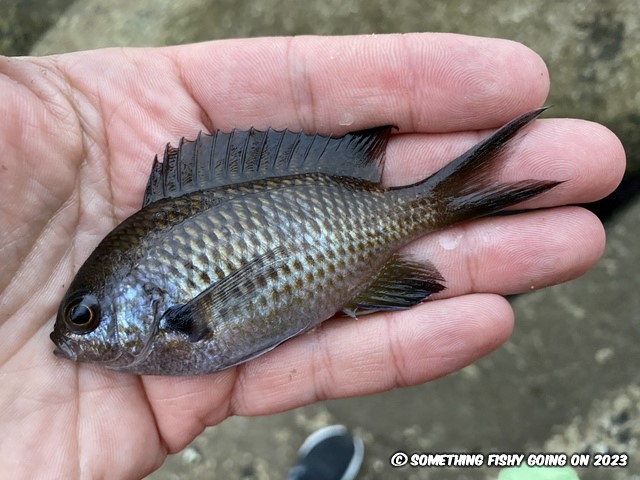
Afterwards, we headed back west along the south coast of the island and visited Wimihang Port so that I could wet a line. I fished on the inside of the outer breakwater. The first few spots didn't produce anything which was ominous, but by wandering along the rocks I eventually found a section that had deeper water in front of it that produced a few red naped wrasse to small prawn and squid baits. As light began to fade, some pearl spot chromis appeared and lots of spotnape cardinalfish came up out of the rocks as well, no doubt attracted by the scent from my bait. By switching to smaller hooks and freelining tiny baits on a two hook rig to get enough weight to cast, I caught a few of both. I'd caught all three species before in Japan.
 |
One of the juvenile red naped wrasse I caught.
|
 |
| Spotnape cardinalfish, as their name suggests, have two spots up behind their head. |
 |
| Pearl spot chromis have quite small mouths, so small hooks are required. |
The following day, we decided to fish from the outside of the inner breakwater of Hwasunhang Port, which was very close to our hotel. The bottom was clean and sandy, and I was hoping to catch a bartail flathead, but was unsure if they were around in March. After trying some paddletail lures for a while with no results, I dragged baits along the bottom. Things were quite slow close to the shore, but walking out further away from it, the water was deeper, and eventually I started getting some small bites and catching a few of the culprits. They were all the same and whilst I recognised them as belonging to the dragonet family, I'd have to do some research later on to identify them as whitespotted dragonet. They were my first new species on Jeju.
 |
| Patiently, I wait for a bite with great views of Sanbangsan. |
 |
I knew these were dragonets, but initially I didn't know which species.
|
 |
| I caught mainly females, but this slightly more colourful one with orange markings is a male. |
Before we left, I had a few casts from the beach, and I also went onto a rock ledge to the right of it to try my luck there. Neither spot produced any fish however, so we jumped in the car and headed east along the south coast again.
 |
| I had a flick around the rocks from a ledge. |
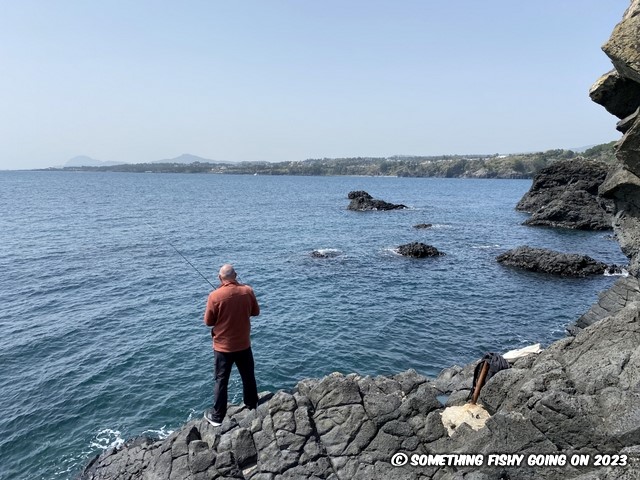
Our next stop was the Daepo Jusangjeolli Cliff to see some interesting rock formations. They are similar in appearance to the Giant's Causeway, Northern Ireland. Formed when lava ran into the Sea of Jungmun when Hallasan Mountain erupted. I also fancied fishing nearby if possible but we couldn't figure out how to get down to the sea.
 |
| We could see the basalt columns, but not how to get down to them. |
I wasn't worried as I had a backup plan. We drove to the tiny harbour of Wolpyeong Port and I had a couple of hours fishing from the rocks to the right of its entrance. It was a great little spot and I had lots of fun catching dozens of wrasse on squid tentacles. I caught four different species that I was already familiar with having caught them all before in Japan.
 |
| On the rocks catching plenty of fish. |
 |
| I caught a few Bleeker’s wrasse. |
 |
I also caught a few of these funky looking Ohagurobera, it has no English name nor does it have a Korean name.
|
 |
This would be the only star bambooleaf wrasse I caught on Jeju. Notice the solid line under the eye doesn't reach the pectoral fin. They can look similar to the red naped wrasse.
|
 |
Red naped wrasse seemed to be the much more dominant species in the area. Notice the solid line under the eye does extend back to the pectoral fin.
|
On our last full day on Jeju we headed to Saeseom Island. It is reached via a footbridge and the rocks on the south coast of the small island drop off into very deep water. I tried fishing with metal jigs here but had no joy, so switched to fishing bait close to the bottom. This produced dozens of wrasse and a few marbled rockfish too.
At this point I should probably explain the lotus flower headband I'm wearing in the next few photos. When my workmate Ryan, a big Karate Kid fan, found out I was visiting Okinawa he was quite jealous. It's the birthplace of the character Mr Miyagi, and I'd promised him I'd get some Karate Kid style photos whilst there and had forgotten to get them, so I took the opportunity to don suitable headwear during my session on Saeseom Island and get the photos there instead.
 |
Crane style. Very effective. Cast out bait. Wind in fish.
|
 |
A small ohagurobera. I like the red colouration of this one.
|
 |
These marbled rockfish fight real dirty, trying to get into snags at every opportunity.
|
After a couple of hours, we crossed back over the footbridge and went for a walk around the nearby harbour. Having seen a few cruising about in the various harbours we'd visited, I wanted to try and catch a mullet so we headed right up to the top where the Yeonoecheon Stream ran into it. On the way we passed a fleet of squid boats.
 |
| The squid boats were fitted out with rows of huge lightbulbs, these bright lights are used to attract the squid up from the depths after dark. |
When we arrived at the top end and found a corner that we could fish, the amount of flathead mullet that were congregated there was incredible. There were literally hundreds of them! Could I get them interested in a bit of bread though? Not in the slightest. I asked Lillian to quickly search the internet on her phone to find out what they ate and when she told me the bulk of their diet was mosquito larvae, I knew I had virtually no chance of catching them on bread. Fortunately a solitary grass puffer arrived and started eagerly hoovering up all the small pieces of bread. He was much easier to tempt and a piece of prawn flicked out in his vicinity was quickly hoovered up too.
 |
| This greedy little grass puffer did a party trick whilst being unhooked. |
 |
One that I've seen too many times.
|
I'd given up hope of catching a flathead mullet but Lillian then spotted some gobies relaxing on rocks in a shallow area and I quickly tied on a smaller hook to catch one. I caught a few of them and recognised them straight away, another species I'd caught in Japan before.
 |
A dusky tripletooth goby. It has yellow bands at the base of its pectoral fins and...
|
 |
| ...males have these elongated rays on their first dorsal fin. |
We then drove north to get some food, and before returning to the south coast we briefly had a walk around Hyeopjae Port and I fished for thirty minutes but did not catch anything at all. Whilst there Lillian noticed the handle cap was missing from my reel so we visited a tackle shop in Jeju City where I bought a reel stand and a small box of ragworm.
In the evening, I popped down to Hwasunhang Port and had an hour or so fishing after dark. The wind had switched direction though and it was very cold. The action was slow and I only caught two Doederlien's cardinalfish. Yet again, a species I'd caught before whilst in Japan.
 |
Unlike some of its cousins, which tend to be smaller, Doederlien’s cardinalfish can grow relatively large.
|
The last day of our trip had arrived and the wind had dropped right off, so after we packed up, checked out of our hotel and loaded our cases into the hire car, I was able to fish on the inside of Hwasunhang Port's outer breakwater. I tried fishing on the bottom and at closer range over the rocks using float tactics. The area was teaming with ravenous pearl spot chromis however, and as soon as I cast my bait in, they were swarming all over it and stripping my hook bare. Eventually, I caught a nice marbled rockfish out in deeper water that managed to get into the rocks a couple of times. Giving it slack line saw it swimming out into open water again though. With persistance I caught a few red naped wrasse and Bleeker's wrasse as well as a couple of Doederlien's cardinalfish that obviously didn't realise they were supposed to be nocturnal!
 |
| I love catching marbled rockfish. They are such dirty fighters! |
 |
| A few Doederlien’s cardinalfish came out of their hiding places to see why the pearl spot chromis were in a feeding frenzy. |
Before we left, we fished from a flat platform and walking over to the end we looked down the side to discover there was a shocking amount of rubbish discarded there. Glad to say that this wasn't indicative of most of the fishing spots we had visited but regardless it's not great to see this anywhere in the world.
 |
| There’s no excuse for this disgusting behaviour. |
We then drove up to the north coast and had lunch. With a couple of hours to kill before we had to return the hire car, we visited a small pier nearby. There were lots of anglers fishing on its small breakwater, but we found a spot on the inside next to some steps and I had one last go at adding species to my trip tally.
 |
| Clearly a popular spot with local anglers. |
I started off fishing down the side in the rocks and caught lots of Bleeker's wrasse, red naped wrasse and ohagurobera on small ragworm sections. After a while, I switched to fishing out onto a sandy area which produced a whitespotted dragonet virtually every cast, until I managed to catch a single goby which I knew straight away was a species I'd never caught before.
 |
| Battling through endless whitespotted dragonet, a Campbell’s goby eventually got to my bait first. This would be my last new species of the trip. |
Sitting on the edge of the breakwater we spotted a sea slug on the rocks, slowly crawling along. I scooped it out with my net for a closer look. A totally bizarre creature indeed, and I thought crustaceans were weird!
 |
I believe this is called a sea hare. Pretty gross!
|
Time was ticking away and the end of our trip had almost arrived. I caught a hairchin goby and an ohagurobera before it was time to return the hire car and go to the airport to begin our long journey home.
 |
My second hairchin goby of the trip. I wish I'd got a photo of the barbules on its chin. I need to get a small acrylic tank really.
|

|
The final fish of the trip was this funky ohagurobera.
|
Travelling home is always tinged with sadness but sitting in Jeju Airport waiting to catch the first of three flights to get home, there was a huge LED art installation hanging from the ceiling that brought a smile to our faces.
 |
We both agreed that we'd had a whale of a time!
|
We'd thoroughly enjoyed another epic Asian adventure, our third trip there. Lillian and I both love that part of the world and will be back there exploring more of it in the future for sure. We've already talked about visiting Vietnam, Cambodia and Thailand. Exploring more of Japan is also on the cards as we both love visiting there. It won't be long at all before I'm going back to Asia though. I'll be visiting in June when I go to Singapore for a week's fishing with two of my mates and I'm really looking forward to that!
The fishing on this trip had been mixed to say the least. The fishing around Seoul and Busan was very dissapointing, but Okinawa and Jeju made up for that. I caught forty six species including thirty five new ones which to be fair was in the ball park of my expectations before we went, so I was happy enough.
Here's what I caught over the three weeks, with new species in bold.
- Bleeker’s Wrasse
- Black Damsel
- Blackbelly Triggerfish
- Blackstripe Cardinalfish
- Blue Barred Parrotfish
- Bluefin Trevally
- Brackish Damsel
- Campbell’s Goby
- Common Ponyfish
- Cook’s Cardinalfish
- Crested Grunter
- Crimsontip Longfin
- Cylindrical Sandperch
- Doederlein’s Cardinalfish
- Dusky Tripletooth Goby
- Freshwater Demoiselle
- Grass Puffer
- Grey Demoiselle
- Hairchin Goby
- Jungle Perch
- Korean Rockfish
- Korean Rockfish
- Kupang Cardinalfish
- Manybar Goatfish
- Marbled Rockfish
- Nagasaki Damsel
- Ohagurobera
- Pacific Gregory
- Pearl Spot Chromis
- Pink-Speckled Shrimpgoby
- Red Naped Wrasse
- Sapphire Devil
- Scissortail Sergeant
- Snakehead Gudgeon
- Spangled Emperor
- Spotnape Cardinalfish
- Star Bambooleaf Wrasse
- Sunrise
- Threadfin Butterflyfish
- Two Spot Demoiselle
- Vagabond Butterflyfish
- Whitebanded Triggerfish
- Whitespotted Devil
- Whitespotted Dragonet
- Whitetail Damsel
- Yogorehebiginpo
Still, my best catch by far isn't a fish. Lillian and I have been together for almost twenty three years and in that time she's been incredibly supportive of some of my passions, including of course, my fishing obsession! I'm very lucky to have such a wonderful partner. She's also not too shabby with a net and will be at my side when we return to Crete together in September.
Tight lines, Scott.