Showing posts with label Florida. Show all posts

Saturday, April 27, 2024

Species hunting adventures in Florida: Part 7.

With trying to catch some saltwater predators in mind, we headed to the canal that runs through the University of Miami. Despite being over two miles from the coast, the water there is tidal and as a consequence there is a great deal of diversity in the species found there. Saltwater and freshwater species coexist, and as soon as we arrived this became apparent when we spotted a small group of jacks and a large barracuda in the same area as various species of tilapia. I started fishing with a heavier rod, but the jacks and barracuda were not impressed with my efforts, and soon took off down the canal. Switching to lighter tackle, I freelined chunks of shrimp to the tilapia and they readily devoured my bait. I didn't think there were any species present that I hadn't caught already, but they were a decent size and good fun on my Rock Rover, so I spent an hour or so catching a few Mayan and zebra tilapia.

This section of the canal that runs through the University of Miami grounds. Not very deep but full of fish!
This chunky zebra ended up being the biggest tilapia I caught during the trip.

After a while, we headed to a second section of canal just to the south of the University. We didn't see any freshwater fish at this spot. In fact, to begin with, we didn't see any fish at all! A few blind casts saw me hook a fairly big needlefish, but it quickly threw the hook in acrobatic fashion. Moving to an elevated position above the canal, I was able to sight fish for a while over a shallow patch of fine gravel. There were a lot of mojarra, a few puffer, small mangrove snapper and some very small barracuda hanging around in this area. I managed to catch lots of mojarra and a few puffers before we decided to head elsewhere. The small predators just weren’t interested.

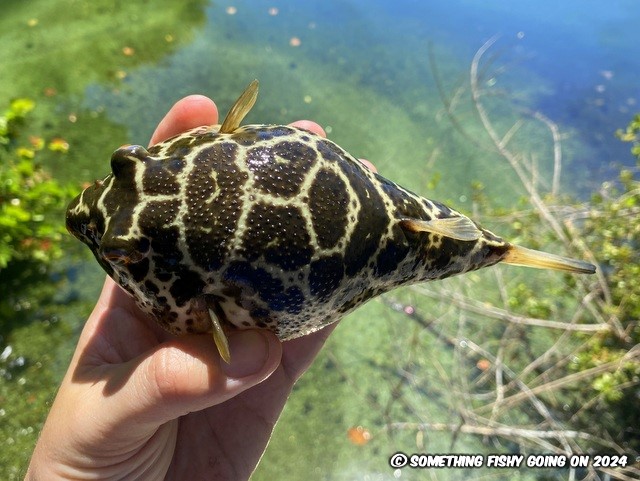
An inflated checkered puffer.
I may have mentioned it in the past, but just to be clear, I’m not a fan of puffers. The patterns on this one were pretty nice.
Unlike the other mojarra species I caught, I'm confident this is a yellowfin mojarra.

Our second fishing session of the day saw us visiting the Matheson Hammock Park & Marina. The fishing area there was pretty limited and already had several anglers fishing from it, so I was a bit naughty and spent half an hour sight fishing in a couple of areas where I shouldn’t have. It was a worthwhile endeavour as I caught a few more species.

A small Atlantic needlefish,…
…a few crested goby,…
…a solitary frillfin goby,…
…and this female hairy blenny.

The following day, our last full one of the trip, we visited the Old Rickenbacker Causeway fishing pier. This venue is the only fishing pier in the City of Miami and is almost eighty years old. It’s named after a WWII pilot who shot down more than his fair share of enemy planes. It was another venue recommended to me by several people, and spending a few hours there turned out to be a great choice, rivalling the productivity of our session on day one of the trip at Phil Foster Park. The average size of the fish was good too and fishing around the concrete bases of the New Rickenbacker Bridge that runs parallel to the fishing pier, I initially caught a few parrotfish and lots of planehead filefish. Then I hooked into something bigger that gave a great account of itself. When a grey triggerfish came to the surface, Lillian was there with the net making sure we landed it. What a team!

As well as a few initial phase redtail parrotfish,...
...a colourful stoplight parrotfish,...
...and a couple of stunning blue parrotfish,...
...I was over the moon when I caught my first grey triggerfish.

After a while, we decided to begin moving along the pier, so I could try fishing in a few different spots. Just before we left the first spot though, a couple of manatee swam past just under the surface, which Lillian was very excited about.

The best photo we got of the manatee as they slowly swam by.

The other spots we tried didn't produce as many fish, but they did throw up some new species that I hadn't caught before.

A bluestriped grunt,...
...a few mangrove snapper,
...a solitary whitebone porgy,...
...this small initial phase princess parrotfish,
...and a few mojarra.

The following day was our last in Florida, so we got up relatively early, packed our suitcases and loaded them into the car. We didn't have to be at the airport until late in the afternoon, so I squeezed in one last fishing session at the Haulover Inlet. There, I spent a bit of time hunting small species in gaps amongst the rocks. My efforts didn't produce anything new, all I caught were lots of dusky damselfish and a hairy blenny.

Searching for unusual species that might have been hiding down in deep, dark holes between the rocks.
This was my first ever male hairy blenny. They're a bit more colourful than the females.

Next, I focused my efforts fishing into deeper water. Something was continually stripping all the shrimp from my hook as soon as my bait hit the bottom, but I couldn’t hook any of the culprits. Just before we left, I dropped my rig straight down the side. The amount of ravenous sergeant major was ridiculous, but eventually I caught a nice parrotfish. Putting the fish back, it was time to drive to the airport and the species hunt was over.

I thought the last fish of the trip was a new species, but it’s actually a redtail parrotfish almost in its terminal phase.

So, our first trip to the United States had been great and there’s no doubt in my mind that we’ll be going back in the future. To which parts, I don't know. We'd both love to visit Hawaii, so that's high up on the list of possible destinations, the west coast too. I may even go back to Florida.

My species hunting went very well, and I caught about sixty species. The vast majority were new ones too, which is always exciting. A few standouts from saltwater were the French angelfish, the scrawled filefish, the scrawled cowfish and the grey triggerfish. From freshwater, the jaguar cichlid, the oscar, and the golden topminnow were probably my favourite catches.

Here's a list of what I caught, new species are in bold. Tentative identifications have an asterisk.

  1. African Jewelfish
  2. Atlantic Needlefish
  3. Ballyhoo
  4. Bandtail Puffer
  5. Beaugregory Damselfish*
  6. Bermuda Sea Chub
  7. Black Acara
  8. Blackear Wrasse
  9. Blue Parrotfish
  10. Coppernose Bluegill (Strictly speaking, a subspecies of bluegill. For now...)
  11. Bluestriped Grunt
  12. Checkered Puffer
  13. Cocoa Damselfish
  14. Crested Goby
  15. Dusky Damselfish
  16. Dusky Flounder
  17. Dwarf Sand Perch
  18. Eastern Moquitofish
  19. Florida Bass
  20. French Angelfish
  21. French Grunt
  22. Frillfin Goby
  23. Golden Topminnow
  24. Grey Triggerfish
  25. Hairy Blenny
  26. Jaguar Cichlid
  27. Lane Snapper
  28. Mangrove Snapper
  29. Masquerader Hairy Blenny
  30. Mayan Cichlid
  31. Mottled Mojarra*
  32. Nile Tilapia
  33. Oscar
  34. Pinfish
  35. Planehead Filefish
  36. Porkfish
  37. Princess Parrotfish
  38. Redear Sunfish
  39. Redtail Parrotfish
  40. Sailor’s Grunt
  41. Salvini Cichlid
  42. Scrawled Cowfish
  43. Scrawled Filefish
  44. Sergeant Major
  45. Silver Porgy
  46. Slender Mojarra*
  47. Slippery Dick
  48. Southern Puffer
  49. Spottail Pinfish
  50. Spotted Sunfish
  51. Spotted Tilapia
  52. Stoplight Parrotfish
  53. Tidewater Mojarra*
  54. Tomtate Grunt
  55. Warmouth
  56. White Grunt
  57. Whitebone Porgy
  58. Yellowfin Mojarra
  59. Yellowtail Snapper
  60. Zebra Tilapia

I should acknowledge that before the trip I amassed an incredible amount of information and this played a massive part in the success of the fishing I did. Many people helped me out with this, far too many to name here, but I'm so grateful for all the advice that was generously given. If you helped me out, thank you!

Tight lines, Scott.

Monday, April 22, 2024

Species hunting adventures in Florida: Part 6.

After spending a couple of days fishing for freshwater targets, I was keen to get to the coast to catch a few fish from saltwater, so we headed to South Pointe Park Pier. This relatively small pier is located at the southern end of Miami Beach and when I was doing my pre trip research several people recommended paying it a visit as it’s a good multi species venue.

Miami Beach from the South Pointe Park Pier.

We hit some horrendous traffic on the drive into Miami but got there eventually. It was a nice day, if a little windy, and after a short walk through the park we soon arrived at the pier. Straight away, I spotted a large shoal of ballyhoo siting in an area of slack water near the beginning of the pier. A chunk of shrimp was lowered down, and I watched one of them swim up to it and eat it greedily. Once the bait disappeared into the fish’s “hatch”, I set the hook, quickly winched the halfbeak up, took a quick photo and dropped it back down to join his mates.

A member of the halfbeak family, the ballyhoo is a popular live bait used to target larger predatory fish. 

Heading further along the pier, we picked a shaded spot under one of the small covered areas. I fished down between the pier and the rocky breakwater at the end of Miami Beach. This produced a few different species, including my first parrotfish of the trip.

This is a redtail parrotfish in its initial phase. The terminal phase is much more colourful.

It proved very difficult to get through the hordes of sergeant major, slippery dick and various grunt species that were fighting over my shrimp chunks. After a while, I tried fishing on the other side of the pier, casting out into open water, this produced a few yellowtail snapper and some mojarra.

Mojarra are difficult to identify if you don't know what to look for. I'm still not 100% on this species. I think this might be a slender mojarra.

Later in the afternoon, we took a stroll along the boardwalk behind Miami Beach and then cut inland onto Ocean Drive. We paid a brief visit to the apartment block where the infamous chainsaw scene in the film "Scarface" was filmed.

There were lots of cool buildings along Ocean Drive. 

On the way back to our hotel later in the day, we stopped off briefly at a small ditch out near the Miami-Homestead Speedway racetrack. It was down a dirt track off the main road and was infested with insects, so I was glad it only took me five minutes to catch a couple of the target species.

 This overgrown ditch certainly wasn't the most picturesque fishing spot!
It produced another new species, so I was happy enough. The black acara is, you’ve guessed it, a non-native species.

The following day we drove down to the Florida Keys. I was very excited about fishing there, as the number of species an angler can encounter while fishing down there is quite incredible. Plus, it’s such a cool place, endless islands connected by bridges, and so many places to fish. Leaving Homestead fairly early, the traffic was pretty bad until we reached Key Largo, but after that it was fine. After a two and a half hour drive we arrived at the first spot, a place I was told there was an above average chance of catching a scrawled cowfish, a strange looking fish that I was really keen to catch. Walking down from the car, we were greeted by a large sign.

Just a tiny fraction of the fish that can be caught.

Unfortunately, and much to my surprise, the fishing was very tough and despite trying a few spots in the area, all I caught was a few slippery dick. There were a few other people fishing too, and I didn't see them catching anything either. Not a great start.

The old Flagler Railway Bridge. At least what is left of it.
Apologies for a second dick pic! This will be the last one.

After a while, we headed back to the car and drove to a second spot near Vaca Cut Bridge. It was very busy with other anglers though, and there was lots of litter strewn around too, which is never nice to see, so we didn’t stay for long. On the way back to the car, a local saw my fishing rod and recommended a spot called Oceanfront Park, assuring us there were lots of fish to catch there. Despite already having lots of places marked in Google Maps, we decided to give it a go. Sadly, there didn’t seem to be many fish biting. I did catch a few pinfish, but that was all I caught.

By this point, I was feeling a little bit frustrated.
My first ever pinfish. At least I had added another new species to my tally.

After a while, we headed to the famous Channel #5 Fishing Pier. The sun was beating down, so to get in the shade for a while, we headed down underneath the road bridge that the fishing pier runs parallel to. Fishing there, things were pretty frantic, and I quickly caught a few grunt, a load of slippery dick and my third puffer species of the trip. I then caught a couple of scrawled cowfish which cheered me up considerably. A I already mentioned, I really wanted to catch one of those.

This Southern puffer was my third puffer species of the trip. 
The bizarre looking scrawled cowfish is a member of the boxfish family. They’re very weird looking things, with a rigid body and horns pointing off in various directions. Only their mouth, fins and tail can move. Despite this, they can swim very quickly.

After a while the tidal flow changed, and it went a bit quiet under the road bridge, so we moved up onto the fishing pier. It was very busy with lots of people fishing, and we tried a few different spots, but it soon became apparent that the predominant fish species below the pier were grunt. Dropping my rig down, my shrimp was being hammered instantly.

White grunt were the most numerous.
There were a few French grunt down there too.
The inside of most grunt species’ mouth is bright red. Not sure what purpose that serves!

After walking along the pier, fishing at a few different places and catching nothing but grunt, I decided to call it a day. It had been a slightly disappointing day in terms of the number of species caught if I'm honest. Heading back towards Florida, we stopped off at Robbie’s of Islamorada, to hand feed the tarpon that hang out in the docks there. We had to be careful not to give the gathered pelicans an opportunity to steal our sardines.

Weird looking greedy birds!

The following day we returned to the pond where I caught my first zebra tilapia, so I could have a second try at catching a Salvini cichlid. This time I tried fishing near some tree roots, as I’d read that’s where they like to hang out. Sure enough, after catching a few other fish and getting snagged on the roots a couple of times, I caught one.

Yet another aquarium trade release, the Salvini cichlid is quite a colourful little chap.

Just as we were leaving the park, I spotted what was probably the largest iguana of the trip. These lizards are everywhere in Florida, but are usually pretty shy, running away into the nearest grasses or up a tree when you get too close to them, but this one seemed a little less intimidated by our presence, and we managed to get a good photo of it.

Invasive species aren’t restricted to the waterways of Florida.

Later that day we visited a pond in Tropical Park. The target there was a tiny fish called a golden topminnow. There were lots of Eastern mosquito fish around, and they were super aggressive, attacking the tiny piece of worm I had baited my tanago hook with. This meant I caught dozens of them properly, not them just biting and holding on to the end of my worm and being lifted out! Eventually, I caught a few golden topminnow, popping them in my little photo tank for a closer look.

The golden topminnow is quite an attractive micro species. I believe this is a male and a female. The male is the one with the red spots.

For the third fishing session that day, we headed back to the canal with the Midas cichlid in it. This time armed with a loaf of bread. Fishing flake on a running ledger, I was hoping a Midas cichlid deeper out in the canal out of sight might be confident enough to pick it up, or perhaps a grass carp would take the bait. It was another tough session though, watching my brightly coloured target swimming slowly around closer in up in the water column, whilst nothing touched my submerged bait on the bottom. In the end, I switched to freelining a worm and caught a solitary Mayan cichlid.

The colours on this Mayan cichlid were stunning, particularly the hues of bright blue on its fins.

The part of the holiday had arrived where I was starting to think about the fact that the end of the holiday was fast approaching! With only a few days left to fish, I decided I’d focus my remaining efforts on saltwater species. I felt I had barely scratched the surface with them, and hopefully if we visited some new venues, I could still add a few more species to my tally.

Tight lines, Scott.

Click her for the final part.

Saturday, April 20, 2024

Species hunting adventures in Florida: Part 5.

The halfway point of the holiday had arrived and we headed south from our accommodation in Boca Raton down to a hotel in Homestead. For our first day out from our new base camp we headed west and drove along the Tamiami Trail into the Everglades National Park. We were soon fishing at a spot where I was hoping to catch an oscar. I flicked my red worm out as close as I could to some overhanging branches. After catching a few Mayan cichlid I hooked something bigger that tried its best to get right in under the trees. Applying a bit of pressure I was pleased when an Oscar eventually came out into open water and was soon drawn over my net. 

I concentrated on catching fish whilst Lillian took photos and kept her eyes out for alligators!
I was over the moon to catch my first oscar, a very cool looking fish with its vivid orange markings. 

With lots of spots to visit along the Tamiami Trail, and having caught my intended target at the first, we decided to head off. When we reached the section of road that forms the boundary between the Everglades National Park and the Big Cypress Wildlife Management Area, we stopped at several spots. However, On that stretch of road you have to park on the hard shoulder, and it felt a little bit risky being so close to the road with vehicles flying past at high speeds. We didn’t see many fish either, apart from some that I think were large pleco. They eat algae from rocks, so I knew catching one of them would be virtually impossible. I did try casting a piece of worm in the path of a few of them, but they were very skittish and swam away when disturbed. Keen to get off the side of the road out of harm’s way, we headed further west to a spot where we could safely park the car away from the main road and where there was a small river I could fish that was tucked away from the traffic too. 

While trying different spots next to the main road, we spotted this funky grasshopper. 

Arriving at the next spot, we got quite a surprise when we drove past a very large alligator sitting by the side of the road. It was sunning itself on the bank of the small river I was about to start fishing! Luckily we were going to fish from a small bridge so even if it got back into the river and came upstream towards us, we would be up above it and not in any danger!

It was quite surreal to see such an incredible creature up close. The toothy reptile must have been well over two metres long!

To begin with, I fished from the side of the bridge facing upstream. I caught a few small bluegill, some Mayan cichlid, a warmouth and another small dark fish that I initially misidentified due to its colouration and elongated fins. 

I thought this might be a black acara at first, but it is in fact a male spotted tilapia.
My second warmouth of the trip.

After a while I began fishing from the other side of the bridge. After catching a few more fish, our new cold blooded friend arrived. I didn't even see it approaching and was unhooking a fish with my back partially turned towards the water when I caught it moving out of the corner of my eye. It didn't make any sound at all and just appeared from under the cover of some overhanging trees on the right hand side of the river!

Sneaky devil! Up close and personal and even closer than when we first spotted it relaxing on the bank. Too close for comfort if we hadn't been on the bridge!

After a few minutes, it stopped moving its enormous tail and slowly drifted back down the river, where it held its position.

After I caught a few more fish, including another oscar, the associated noise drew its attention again and back up the river it came, no doubt expecting an easy meal. At this point, Lillian seemed to be a bit freaked out, so we packed up and left.

This oscar was successfully released, much to the disgust of the alligator, who thought it was going to get a fishy snack.

The following day we visited a small park where fishing was permitted in a few small areas. The main target species there was zebra tilapia, which I caught fairly quickly after catching a few bluegill and spotted tilapia. I also caught a terrapin! We did see two of them when we arrived, but both vanished below the surface. A few minutes later, I lifted my rod after a subtle bite, only to feel a dead weight. I guessed immediately what had gobbled my worm! Thankfully, I managed to wind it in without too much trouble, it was successfully netted by Lillian, and I was able to easily unhook and released it again. I fished on for a while, hoping to catch a Salvini cichlid, another exotic non-native species found in the pond, but didn't have any luck.

Another nice example of the coppernose bluegill.

I also caught this spotted tilapia. This one doesn't have spots, as it is in between its juvenile and adult colouration.
A small zebra tilapia. Mission accomplished. 

We then headed to another spot, a canal running through a large park, where I was hoping to catch a Midas cichlid. We did see a few of the bright orange fish slowly cruising around, but I could not get them interested in my freelined worm. They were incredibly shy, a lot of the time they just swam off when my bait hit the water or got close to them. It was a very tough, frustrating session. There's nothing worse than being able to see fish but not being able to catch them. In fact, I only caught one fish during the time I spent fishing there.

Match the catch! Angler in bright orange T-shirt stalks bright orange Midas cichlid. 
The only fish caught during several hours stalking along the banks was this zebra tilapia. 

So, another couple of days focussing on freshwater fish with mixed results. Having seen a few Midas cichlid, I really wanted to catch one and decided I'd return later in the trip for another go. That said, I was keen to visit the sea again for some saltwater species hunting. The wind was due to drop off the following day, so we decided to head into Miami to visit a well known fishing spot on the coast there.

Tight lines, Scott.

Click her for the next part.