Showing posts with label Blow Lug. Show all posts

Sunday, August 11, 2024

Thorn in my side.

Last weekend, I headed back down to the Solway Firth with my mate Nick. Having caught my first Scottish Dover sole there recently, I wasn’t really expecting to be returning so soon, but the conditions and tides looked good for an evening session. Nick hadn’t caught a ray for a while, and as I’ve discovered, they’re pretty much a guaranteed catch down there. After driving down and digging some lugworm to add to our supply of ragworm, we headed to our chosen spot, got set up, and started fishing. As expected, our first few casts all produced a thornback ray. 

The channel we were fishing was once again full of these spiky flat sharks.

As the session continued, the thornback ray kept coming, but eventually I also started to catch a few lesser spotted dogfish as well, a welcome change!

How exciting?!

Both fishing two rods, we were kept busy well into darkness but eventually, as it always does, the tide got to the point where it was ebbing strongly and weed became a major problem. With a couple of hours of driving for Nick to do and having enjoyed another action packed session, we packed up and headed home. A pity we didn’t catch any other species, but at least we caught plenty of fish!

Tight lines, Scott.

Friday, August 02, 2024

A little too late to the party?

On Tuesday I headed down to Dumfries & Galloway with my mate Ryan for a couple of days to do some mixed species fishing. Ryan also wanted to try for a shore caught tope, so our first stop was the remaining old military pier in Cairnryan where amongst other species we were pretty confident that we could catch some mackerel to use as bait for our tope fishing session later in the day.  

Several sections of the pier have collapsed, rendering it an unsafe structure. Efforts have been made to keep people off of it. These don’t stop risk taking anglers though. Climbing through large holes in a couple of fences isn’t difficult. 
Enter at your own risk. One of many collapsed areas where the reinforced concrete has failed, and the deck has fallen into the sea below. 

There were lots of small baitfish around the pier, so I started off fishing with a set of tiny sabiki, jigging them vertically. This produced lots of juvenile herring. I was hoping that there might be some sprat present too, but carefully checking each fish, every one I caught was indeed a tiny herring. 

I’ve never caught a sprat. They look similar to juvenile herring but have sharp scutes on their stomach, their scales don’t come off as easily, the origin of the pelvic fins is in line with the origin of the dorsal fin, the eyes are slightly smaller and the lower jaw protrudes less than it does on a juvenile herring. 

As I wound up the juvenile herring, now and then a large sandeel would follow them up to investigate the commotion. Eventually, I caught one of them. It didn’t have an obvious dark spot on the side of its snout, so I was hopeful it might be a Corbin’s sandeel. After examining a few other features of the fish however, I positively identified it as a greater sandeel, also known as a launce. 

Fifty-six dorsal fin rays and a belly skin fold that only reached the first third of the anal fin, where it lost its continuity, made this a greater sandeel. The Corbin’s sandeel has 59-62 dorsal fin rays, and the belly skin fold is continuously unbroken all the way to its tail. 

After catching and closely examining a few dozen juvenile herring, I switched over to a drop shot rig and fished various heavily scented small lures. Lowering these flavourful baits down to the bottom produced lots of black goby. Ryan caught lots of these aggressive little fish too using similar tactics. 

Green Mini Isome with its blueberry taste proved popular. 
As did the less pleasant smelling Gulp! Hellgrammite in natural. 

I was expecting us both to catch a few wrasse as well, but incredibly neither of us caught any! Definitely a surprise as the pier's structure normally holds lots of them. After a few hours, and with our evening tope session in mind, we switched our attention to catching a few mackerel to use as bait. Once they turned up, we quickly caught what we needed and headed off to our tope mark. 

After driving an hour or so east, we made our way down onto our chosen rock mark and got setup. Big baits on long pulley rigs were cast out as far as we could at regular intervals, to hopefully create a strong enough scent trail to draw in any nearby tope. Sadly, after several hours of patiently waiting for a run, neither of us got one. A little disappointed, we drove back west to Stranraer, where we were staying for the night. 

In the morning we decided to forget about catching tope and instead headed south to Portpatrick where we clambered onto the rocks there to try and catch some wrasse on heavily scented artificial baits. 

The rocky shoreline to the north of the harbour village of Portpatrick looked like the perfect wrasse holding habitat. 
Ryan decided to fish with some Gulp! Sandworm, whilst I opted to fish with Mini Isome. I tried a couple of different presentations. 
Very simply, hooked once through the “head”.
When this produced no bites, I switched colour and tried wacky rigging it. 
This corkwing wrasse fell to the wacky rigging style. 

I expected us to catch a few more wrasse after this, but it was a real struggle to get any more bites, so we moved around and tried a few more gullies. 

Ryan clambered down to the edge to fish in close, but his efforts weren’t rewarded. 

Feeling a little frustrated, we decided to head further south to Port Logan where we could dig some small lugworm and then spend a little time fishing for small flatfish in the breaking waves on the beach there.  

Port Logan, a popular beach for relaxing, dog walking and where boat anglers launch their vessels.

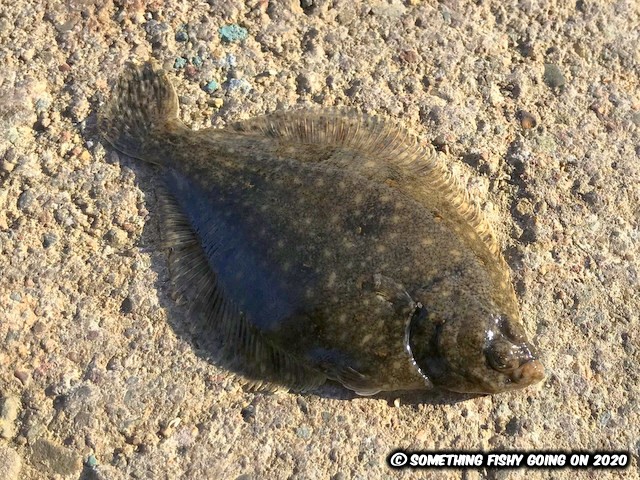
Fishing a simple running ledger rig baited with a small blowlug produced a small turbot for me fairly quickly, but after that we didn’t get any more bites. With some fresh bait to use, we decided to head all the way down to the Mull of Galloway to fish from the rocks on its northern side. 

Only my second fish of the day. Not exactly epic fishing, but I love mini turbot, so was happy to catch this one. They’re such perfectly formed versions of their adult counterparts. 

Arriving at the Mull of Galloway, walking down the steep grassy slope, and then carefully climbing down onto the rocks, our decision to dig some lugworms was very quickly paying off. Casting out beyond the heavy kelp bed in front of us, the resident ballan wrasse were hammering them pretty much as soon as our rigs hit the bottom. 

Small blowlug, the perfect size bait for small ballan wrasse. 
Also readily taken by bigger specimens too! This one was a real test of my Rock Rover with a heavy kelp bed directly in front of us, but I managed to bully it through. 

While we had a supply of small juicy worm baits, we caught a few other species too. Ryan caught some pouting and poor cod, whilst strangely I caught only pollock.

This small pollock came up and grabbed my bait as I wound it in. 

Eventually, we ran out of worms however, and switched over to fishing with Gulp! Sandworm. The drop-off in interest was noticeable, as you would probably expect, so Ryan suggested we collect a few limpets and use them as bait. This was a good idea, and we were soon catching a few fish again.

Ryan into one of many limpet caught fish. 
He caught a few cuckoo wrasse. 
Hidden in this lump of weed was a goldsinny wrasse Ryan also caught on a piece of limpet. 
I caught a few more ballan wrasse on limpet slivers as well.  

As the tide rose, and we retreated up the rocks, I spotted a few blenny moving around on the bottom of a newly formed rock pool and dropped a tiny piece of limpet down in their vicinity. They immediately began fighting over it, and one quickly got hooked. 

Another lover of limpet. 

A tough day’s fishing had turned into a fairly action packed session, and before we knew it, it was time to call it a day, climb back up to the car park and make the drive back to Edinburgh. It had been a trip of mixed results, but in the end a quite enjoyable one, even if we spent four fruitless hours targeting tope. The toothy shark will probably have to wait until 2025, when I think we’ll go a bit earlier in the year when there are more tope around to be caught. I’m heading back down the Solway Firth tomorrow evening with my mate Nick. I’ve enjoyed my sessions down there this year, but I’ve not caught a starry smoothhound yet. Armed with some peeler crab, my fingers are crossed that they won’t be as elusive as the late season tope!

Tight lines, Scott.

Sunday, July 28, 2024

Putting my heart and sole into it.

Whilst checking the tides and weather conditions recently, I noticed that there was an opportunity to head down to the Solway Firth again for another go at adding a Dover sole to my Scottish species list. Between deciding to go and making the drive down there, I was sent an email by a fellow species hunter asking for my assistance identifying some fish he’d caught during a holiday to Lanzarote. During our conversation, he told me he was one of the anglers that I’d heard had caught a topknot whilst fishing in Greenock. He also told me that a week later, his friend had also caught one there at pretty much exactly the same spot, that by examining their photos they knew it was two different fish, and he also confirmed that I had been fishing in the right area when I had been trying to catch one myself. This was all the encouragement I needed to turn an evening sole session into a full day flatfish mission!

Leaving early, so I could avoid the morning rush and get the right spot before lots of feather flinging mackerel bashers turned up, I arrived in Greenock at about 08:30 and set up two 10ft feeder rods. Dropping small sections of ragworm down into the area where the topknot had been caught had predictable results. Wrasse, after wrasse, after wrasse, after wrasse!

Goldsinny made up the majority of the wrasse I caught.
Corkwing wrasse also chipping in to munch all my bait in rapid fashion!.

I was hopeful that perhaps a topknot would somehow muscle its way past the ravenous wrasse, but after over six hours of fairly frantic, non-stop action, the only other species I had caught was a solitary pollock, and I only caught that because I cast a bait just out past the rocks away from the area that the topknot had been caught from!

This pollock was a reasonable size and put a nice bent in my feeder rod!

By the middle of the afternoon, I had used up fifty percent of my ragworm, and had long since lost count of the number of wrasse I had caught. Admitting defeat and packing up my gear, I got back into my car and made the drive south to begin phase two of "Operation Odd Flatfish". Before starting my evening session, I spent almost two hours digging some blow lug, ensuring that, along with my remaining ragworm, I had enough worms to fish two rods for four hours at least. 

Armed with quality bait and using a baiting needle to improve their presentation would hopefully improve my chances of success!

I began fishing just after halfway into the flooding tide, just after the current begins to ease off. Rather predictably, the first fish that found one of my baits on the muddy bottom was a thornback ray. In my limited experience of fishing there, they are easily the most common fish in the area, or at least the most active feeders!

No surprises really. This was the first of many thornback ray.

It was an overcast night anyway, but as the sun got lower on the horizon, and it began to get a little darker, I was hopeful that any sole in the vicinity might begin feeding too and be drawn to the scent of the juices slowly leaking from my worm baits. The thornback ray kept coming though, interspersed with a few lesser spotted dogfish. 

A nice change from the endless thornback ray.

The action was pretty hectic, with most casts producing a bite, if not a fish. After just over an hour, I’d lost count of the number of thornback ray I’d caught, including a double shot of thornback ray and a double shot of a thornback ray and a bass. Eventually my rod tip rattled and lifting it and winding in I felt something a little lighter that came in relatively easily. Definitely not a thornback ray or a lesser spotted dogfish I thought, but what was it? As it came to the surface I realised that it was a flatfish, when it rolled over flashing a bright white underside. It was also a good size for a flatfish too, but as it came closer I knew it wasn’t a sole due to its rounder shape. It turned out to be a very nice flounder. Normally I’d have been thrilled but given it wasn’t my target species I wasn’t as excited as perhaps I should have been. 

Despite this being a new personal best flounder of 40cm, I was slightly underwhelmed. It was a sole I was desperate to catch!

More thornback ray followed, but as high tide approached, the bites dropped off a bit. By this point it was almost pitch black, such was the amount of cloud cover. After winding in and rebaiting, I cast out both rods again. One at distance and one closer in. I got an aggressive bite on the closer in rod and lifting it and winding in I felt something putting up a decent fight. Again, I thought to myself this definitely doesn't feel like a thornback ray or a lesser spotted dogfish, but also it didn't feel like another flounder either. Shining my headtorch out into the dark, I waited to see what species would appear. I wanted to get the fish in quickly but also didn’t want to pull the hook, so I just wound it in steadily. When the elongated shape of a sole did appear, I felt my heart rate increase dramatically, and I don’t think I’ve ever been so nervous pulling a flatfish up onto a beach in my life, especially when it started wriggling around like crazy! Quickly putting my rod down, I grabbed the fish firmly by its head. I needn't have worried about it escaping, as my super sharp Sakuma Manta hook had done its job and the fish was well hooked. I’d done it! My first Scottish Dover sole! One more step taken towards catching one hundred species in Scotland! 

My first Scottish sole was a reasonable size. They are a very strong flatfish making them tricky to handle but I took it well away from the water's edge before unhooking it and taking some photos.
What a weirdly simple mouth they have, with virtually no articulation.

Popping the fish back, it swam off strongly, disappearing into the murky water with a few thrashes of its long body. I was standing there in disbelief, but absolutely buzzing. Even though it wasn’t my first ever Dover sole, as I've caught one on the south coast of England many years ago, it almost felt like it was! I was pretty tired from a long day, but with worms left to use up and adrenaline still pumping through my body, I fished on for another couple of hours until I had exhausted all of my bait. I didn’t get home until 04:00 and was absolutely shattered the next day. Driving, fishing and digging bait for twenty-two hours straight, I think that’s the longest and most intense solo fishing trip I’ve ever done! Catching one of my target flatfish species meant it was well worth the effort!

Tight lines, Scott.

Friday, July 12, 2024

More sole searching.

On Monday I spent a couple of hours digging some lugworm. It’s been a few years since I’ve done so, and doing it again was a reminder of why I hadn’t dug any for so long! It’s not an easy task! Especially if you're not as young and fit as you used to be!

After two hours of digging I was fed up looking at these!

My efforts produced over sixty worms and wrapped in newspaper in my bait bag, I drove down to Dumfries & Galloway again on Wednesday to use them in another attempt at catching a Dover sole. I arrived early, so rather than head straight to the spot I planned to fish, I took the opportunity to head further south to take look at a second stretch of the coast for future trips. Walking along the shoreline I eventually arrived at a strange arch in the rocks at the top of the beach. 

This quite odd feature went right through the limestone rocks. It probably started as a crack and water and time have opened it up into an arch. 

Having got an idea about where I would fish should I return to that part of the estuary, I jumped back into the car and made the short drive north, unloaded my tackle and was soon setup and fishing on the rocky shore. It didn’t take too long for fish to locate the scent trail coming from my juicy worms and after missing a couple of bites, a small thornback ray was hooked, landed, unhooked and returned to the murky water. 

A promising start. 
I love watching them as they slowly beat their wings and gracefully glide off. 

In the hours that followed the tide came in and I repeatedly moved up the beach. The action was pretty steady, with perhaps fifty percent of my casts seeing my rod tip rattle eventually when a fish found my flapper rig. Thornback ray was the only species I caught until a nice bass picked up a lugworm and charged off, hooking itself against my 6oz grip lead and almost pulling my rod and tripod over. 

Spiky. A welcome change from thorny. 

As high tide came and went there was a lull in the action and I was expecting weed to become a problem, but it didn’t, so I carried on fishing until my lugworm were all used up. Once the tide began to ebb I caught a couple more thornback ray and lost a starry smoothhound a few metres from the shore when it thrashed violently and bent out my #6 Sakuma Manta hook. Having cast out my final three lugworm I hooked something that was a lot smaller. Was it the Dover sole I was hoping for? Winding it in carefully, so as not to pull the hook, a flatfish came to the surface and I was briefly excited, but as it got closer I realised that it was just a dab. 

The last and smallest thornback ray of the session. 
Not the flatfish I was hoping to catch!

So, another sole pun has been used up. Fingers crossed I manage to actually catch one before I run out of awful puns to use in my post titles! I’ll be heading back down to Dumfries & Galloway soon to try again, although next time I might try my luck at a different venue. 

Tight lines, Scott.

Wednesday, October 14, 2020

In before the lock?

I popped down the A1 a couple of times a fortnight ago with two of my workmates. The first trip to St Abbs Head with Callum was all about catching some ballan wrasse and Callum had his heart set on catching "A big one." having already caught a few smaller ballan wrasse on previous outings he'd had. After walking up to the cliffs from the village we started the session by trying a new mark that proved to be a little tricky to access due to the slightly damp underfoot conditions. Clambering about on damp rocks isn't a great idea down there and the new spot turned out to be fairly shallow and hellishly snaggy, so we headed back up to the path and I took Callum to another mark where I've caught a few decent ballan wrasse in the past. After making our way down a grassy slope and hopping down a few rocks, we found a fairly flat ledge, got comfortable and set up our gear. Fishing light tackle was the approach taken with plan A being dropping blow lug down the side at close range on one hook paternoster rigs. I had my bait in the water first and before Callum had even finished getting setting up I was asking him to net the first ballan wrasse of the day, a nice fish just over a couple of pounds.

As well as their colourful markings and eyes, I love their big juicy lips.

I've never really fished for ballan wrasse on the east coast so late in the year so catching one straight away was a most welcome and pleasant surprise, and made me reasonably confident that we'd catch more. About twenty minutes later Callum got an aggressive bite and hooked the culprit. A big fish quickly had his rod bent over, his drag clicker screaming and his heart pounding. After a few spirited runs towards the kelp the fish was beaten and when it came to the surface I was in position with the net to help Callum land a new personal best ballan wrasse. 

"A big one!" We didn't have scales with us but at 46.5 cm Callum's new PB ballan wrasse was probably just over 4lb.
A cracking fish with some beautiful markings. A fantastic capture on a light rod rated 3-18g as well!

Having accomplished my guiding objective for the day I left Callum to target wrasse and turned my attention to scratching around on the bottom using small hooks baited with chunks of raw prawn to see if I could pick up something unusual. All I managed were about a dozen small coalfish however before a pod of dolphins swam by and after that all action, unsurprisingly, ground to a halt. After a couple of hours with nothing further being caught we headed back to the car. On our way back up the road we decided to pop into Torness Power Station's outflow to target bass and mullet, species Callum had never caught before. The water was pretty coloured up however, and sadly we didn't have any joy ledgering lug worm for bass or free lining bread flake for mullet.

The following day I headed to Coldingham Bay, St Abbs Harbour and then Torness Power Station's outflow with another workmate, Ruaridh. To begin with we scratched around using light gear and small hooks baited with raw prawn but at the first two venues things were pretty slow. At Coldingham Bay we didn't catch anything at all but when we visited St Abbs Harbour we did eventually manage to catch a few fish in the shape of some coalfish, a small cod and also Ruaridh's first ever blenny.

Ruaridh patiently fishing away.
Ruaridh's first ever blenny! I remember catching mine and whilst I've caught hundreds since it still seems like it was yesterday.

After trying a few different areas around the various parts of the harbour we switched to working lures along the bottom in an attempt to catch some flounders but this didn't produce any bites. I then decided to scale down and catch some sand gobies using tanago hooks and after catching a few I also caught a couple of tiny plaice as well on the tiny baits I was slowly twitching along the harbour's sandy floor.

The distinctive orange markings of an adult were absent on this tiny juvenile plaice but the bony nodules running along the head were not.

To finish the day we visited Torness Power Station's outflow. The water clarity had improved a lot over the previous twenty-four hours, and we decided to focus our efforts on catching mullet on freelined bread flake. This method was new to Ruaridh along with the frustrations of using it to try to catch our target. Things were made more difficult by the fact that neither of us had a pair of polarized sunglasses with us but eventually I managed to catch two thick lipped mullet that took my bread and pulled my rod tip over as they felt my hook and swam off into the current.

Frustrating and full of fight. Mullet are great fun.

Sadly, despite his perseverance Ruaridh didn't manage to catch one before it started to get dark, so we called it a day. To his credit he took the constant baiting up only for the fish to steal his bread pretty well and is keen to go back again for another attempt at catching his first mullet so a return trip will be made. Last week the weather wasn’t great for that but the mullet are there all year round so hopefully we'll get back down there at some point. That being said I'm not sure what fishing I'll be doing in the weeks ahead. I’ll have to do any fishing "locally" until the end of October due to the recent travel restrictions introduced in Scotland’s central belt but I have a horrible feeling that before too long some stricter travel restrictions may be put in place that will really  limit my opportunities. I really, really hope I’m wrong.

Tight lines, Scott.

Saturday, September 19, 2020

Golden opportunity.

Over the last month or so I’ve had quite a few sessions down at Torness Power Station. The main reason for these visits was so that I could make an attempt at catching a gilthead seabream, a species that believe it or not does get caught there on the rare occasion. The first such session sadly was pretty poor, my chosen approach of ledgering small chunks of prawn on light tackle in the outflow only produced a solitary fish but it was a nice chunky corkwing wrasse, so despite the lack of any other action I left reasonably happy.

The inlet area of the power station produces large corkwing wrasse but this was my first one from the outflow area.

Another session, this time at the power station's inlet area, fishing light game metals for mackerel, produced a bonus large sandeel. Lacking the prominent dark spots on either side of its snout that the greater sandeel has and having a noticeably dark chin I suspect that it may have been a Corbin's sandeel.

Dark chins matter. Especially as they are a key distinguishing feature of the Corbin's sandeel.

I’m still not 100% sure about the identity of this large sandeel and having purchased a rather old species identification book I'm still doing further research into the differences between the greater sandeel and Corbin’s sandeel, so I can hopefully reach a conclusion. In hindsight, I perhaps should have kept the fish for further, more detailed examination, but instead opted to take lots of photos so those will have to do.

A few days later I returned to have another go for gilthead seabream. When I arrived at the outflow however there were over half a dozen other anglers already fishing, targetting bass using controller floats and Redgill eels, so I decided to fish from the area directly above the outflow. Ledgering small chunks of prawn I quickly had a take and couldn’t believe my eyes, or luck for that matter, when a reasonably sized gilthead seabream eventually came to the surface after putting a spirited scrap. My heart was pounding as I cautiously played the fish out in the current but my excitement was short-lived as it quickly dawned on me that landing it on the ultra light gear I was using and from my elevated position would prove very difficult especially as I did not have a net with me. My hook set seemed good though and after tiring the fish out I made the decision to try and lift it up. This proved to be a mistake and when the fish thrashed around my braid came into contact with the edge of the overhanging concrete shelf in front of me as a result and parted. To say I was absolutely gutted to lose what would have been my first Scottish gilthead seabream would be a massive understatement. I carried on fishing for a while and caught a few small bass, which ironically I did manage to land, but left the venue kicking myself at my decision to leave home without a net of any kind. It’s not the first time that being without a net has cost me a fish but this time it felt so much worse. The only positive to be taken was that I had discovered that there were indeed gilthead seabream present to be caught and where there is one there are usually more!

Determined to hook another and to land it successfully I dug a large drop net out of the back of my cupboard and returned several times with heavier tackle to try and do so. I tried several types of bait and also gave small live crabs a go, which I quickly discovered to be a very productive method for catching bass.

It turns out bass love small live hardback crabs.

A drop net wasn't the only thing I dug out for use during my sessions. My mate Ross told me that in his experience blow lug and peeler crab had been the best baits for catching gilthead seabream in the UK so several trips to Portobello Beach to dig worms were undertaken in the hope that some top quality freshly dug worms might increase my chances. The following photo of me digging away was taken by a passing female who was out for a walk. Not taken with my permission I might add, I turned around to find she had sneaked up behind me and was crouching down to compose her shot. Once caught she offered to email me the photos she'd taken and assured me she wanted to capture the sight of a large sweaty man bending over for artistic purposes only.

Worth making the effort to reduce the odds even just a little.

Armed with fresh lug worm, raw prawns and some peeler crab, generously given to me by my workmate Gordon from his winter cod supply, I was quietly confident that if I put the time in I'd catch another if the conditions were right. By the end of August however I'd had a few more unsuccessful sessions and was beginning to get concerned that as the end of the summer approached my window of opportunity may close. My mate Nick joined me for a few more sessions at the start of this month but all we caught were bass and, much to our amusement, several thick lipped mullet that after nibbling away at our baits on the bottom eventually hooked themselves. I also took a some bread along with me for one of the sessions and using smaller hooks managed to catch a golden grey mullet on small pieces of freelined flake too.

Another species that has golden markings but not the one I really wanted to catch.

Last Tuesday I was off work and the forecast conditions looked great with mostly clear sunny skies, an offshore wind and reasonably big tides too. The timing of the tides also meant the chance to fish over high water twice as well during daylight, just after sunrise and just before it set again, so I made a full day of it.

The start of a glorious summer day.

My session began just after sunrise but things were very slow to start with. A few hours went by before I eventually got a few bites and caught a couple of small bass in quick succession. After another long lull my rod started registering little knocks, so I wound in to see what it was. It turned out to be a rather ravenous blenny that had tried to eat a lug worm a little longer than itself and had somehow squeezed my chinu hook into its mouth. 

Something greedy going on!

Over low water things went very quiet again and as it was also very hot I put my reel into freespool and tried to take shelter from the midday sun by sitting down in the shadow cast by the railings behind me.

Strangely I had the place all to myself. The rocks to the right of the outflow are normally lined with anglers trying to catch bass.

Once the tide started flooding I was hopeful that I'd catch a few more fish but another couple of hours went by and with not much happening I decided to try swapping out my hook for a smaller one, so I could fish small chunks of raw prawn for a while, after all that's what I'd hooked the gilthead on several weeks ago that I'd failed to land. A short time passed and then I had a very aggressive take that had my rod tip thumping away and line being jerked from my reel. Quickly lifting the rod an engaging the drag it didn’t feel big but when the fish came into view my heart immediately started racing. It was my target species, this one perhaps half the size of the one I'd lost weeks before but after playing it out I still had to land it from my elevated position with no assistance. Decision time! Whilst I did have my large drop net with me I figured trying to get it, lowering it down over the ledge and then manoeuvring it in the current below whilst still holding my rod was perhaps just as risky as simply lifting the fish up. In the end I just went for the lift. I had tied on an extra long rubbing leader so didn't have to worry about braid touching the ledge and my 9ft extra heavy lure rod had the required strength to do the job. It was still nerve racking as I hastily hoisted it up but the fish was soon safely up on the platform with me being unhooked for a quick photo.    

My first ever (successfully landed) Scottish gilthead seabream.

Once the fish was returned I did a bit of celebratory fist pumping and shouting having successfully added another species to my lifetime Scottish tally. I fished on for a while but having accomplished my goal I ended up leaving earlier than I had originally planned. All the time and effort I'd put into the sessions had been worth it in the end. It was great to capture one of these in Scottish waters and I only know two other anglers who have done the same so it was a really special capture. As sea temperatures continue to rise it's predicted that this species will move further north so who knows, they may become a much more common catch for us anglers north of the border.

Tight lines, Scott.