Showing posts with label Live Prawn. Show all posts

Wednesday, August 27, 2025

The species hunting bug.

I’ve been species hunting for over a decade, setting myself targets, both short and long term, and having lots of fun working towards trying to achieve them. It seems to be a branch of angling that is gaining popularity, whether that be individual anglers doing their own thing like me, or people taking part in species hunting competitions, either with friends or taking part in sponsored events where there are prizes to be won. 

My mate Ryan has caught the species hunting bug this year. For a bit of fun, he’s doing a saltwater species hunt with a few of his mates, and they're now exploring new ways to fish in places they've never fished before, targeting as many different species as they can. 

Earlier this month, after spending a day with him locally during which he added lesser weever, short spined sea scorpion and three spined stickleback to his tally, we drove across the country to Stranraer, to see if we could add a few more species to his tally. I wanted to see if I could catch a new species too while we were there. Inspired by another species hunting friend of mine Mike, I planned to spend some time fishing with tiny sabiki to target juvenile herring, hoping that, like he did last year, I’d perhaps get lucky and catch my first ever sprat in amongst them. To begin with though, we targeted sand goby straight down the harbour wall using small hooks baited with tiny pieces of ragworm. We quickly caught a few of them, another addition to Ryan's 2025 species hunting tally.

This is a sand goby. There are two other closely related species that can be found in the UK, out in deeper water usually. They are the Lozano’s goby and the Norway goby. I’ve been reading up on them recently, trying to get a handle on identification methods for both, but I'm very confident I’ve ever caught either of them. I really enjoy learning about new fish species and building up my knowledge.

After initially catching dozens of them from the cleaner areas on the bottom, we started moving around, dropping our rigs closer to some structure. This produced some small wrasse and two additional goby species, but Ryan had already caught all the species we caught earlier in the year.

Fishing close to rocky patches produced a few fairly large black goby,…
…and the odd rock goby too. 

At this point in the session, we got a slight surprise when we turned around to discover we had been joined by a third fisherman, who had decided to get rather close to us. A rather friendly juvenile European shag had landed nearby and had slowly made its way over to where we were fishing. I've been doing a spot of birdwatching this year, so I took a break from fishing to take a few pictures of the bird.

Even efficient predators appreciate a free meal!

Shifting my attention back to fishing, I then switched over to a slightly heavier setup and a set of sabiki. Casting them around in different directions and working them back towards me to try to locate any herring shoals, I didn't get that many bites initially, but eventually I did manage to catch a couple of juvenile herring. They're not a species I particularly enjoy catching if I'm honest, as they don't react well to being handled, their scales being very delicate and coming off very easily. I quickly did the necessary checks to confirm that they were indeed herring and put them back. Ryan hadn't caught a herring this year, so I let him use my sabiki rod for a while, but he didn't manage to catch one, so we decided to move to a second spot. 

We were unsure if the area we wanted to get to would be accessible, but after a quick drive and a short walk, we discovered the long man-made structure was and started fishing from it. Ryan dropped tiny pieces of ragworm down the side to begin with, whilst I focused on catching a sprat again. I managed to catch another couple of juvenile herring, and as Ryan wasn't having much luck down the side, he had a go at slowly jigging the sabiki again. After a bit of patience, he eventually got a couple of juvenile herring, his first of the year.

Then as we were chatting, Ryan spotted a strange fish and pointed it out to me. I realised almost straight away that it was a pipefish! It was quite small and was swimming around slowly in an upright position just underneath the surface of the water. Sadly, it didn't hang around for long before disappearing out of sight. That's the first time I've seen a pipefish in the UK. There are six species of them found here, and I'd love to catch any of them. Next month I plan to go hunting for them!

Before we left, we moved along to the end of the pier and tried our luck there. My sabiki didn't produce anything, so I switched back to fishing down the side again. In amongst lots of black goby, rock goby and goldsinny wrasse both of us pulled out a few small pouting.    

Yet another addition to both our species tallies for this year.

It had been quite an enjoyable day trip to Stranraer and worth the long drive to get there. We'd caught some interesting species, made a feathered friend and seen a pipefish! Next month Ryan and I are hoping to head down south to fish Dorset, Devon and Cornwall. If we go, I'm confident we can both catch some new additions to this year's tally, and I might hopefully catch a new species too!

A week or so later, I met up with another convert to species hunting, welsh angler Ben Price. For years Ben was a specimen angler, targeting large fish around the Pembrokeshire coast, where he lives. A few years ago, he decided to give species hunting a go, and it's safe to say he's now addicted! A reader of this blog, he was so inspired by some of my posts about the fishing around Scotland that last year he decided to visit and had a very successful trip. Some of the fish he caught up here helped him to win the Angling Trust's 24/25 Elite Species Hunt with an incredible total of seventy six species! 

Spending a week up in Scotland again, after spending several days on his own up in the highlands, where he added butterfish, coalfish, cod, flapper skate, sea trout, tadpole fish, and two spotted goby to his tally for the 25/26 competition, he headed down to Edinburgh. It was good to meet up with Ben again, and the two of us spent a couple of days fishing around Edinburgh and East Lothian, trying to catch reticulated dragonet, short spined sea scorpion, topknot, viviparous blenny and Yarrell's blenny.

One of the venues we fished was St Abbs Harbour. Ben was blown away with the place and we caught quite a few fish. Whilst fishing with tiny hooks trying to catch a reticulated dragonet, we caught quite a lot of small flatfish.  

St Abbs Harbour has a health population of tiny plaice in it.
In amongst all the juvenile plaice and flounder, I also caught this tiny dab.

After catching several long spined sea scorpion, Ben caught a short spined sea scorpion, which was one of his target species. He then spotted a small group of dragonet in close, and we both managed to catch quite a few of them. Carefully inspecting each one, they all sadly turned out to be common dragonet. Still, this was a first time capture for me on the east coast of Scotland. Whilst targeting them, I also caught a painted goby, also a first time capture for me on the east coast of Scotland.

My painted goby with its distinctive dorsal fin markings and pale saddles.

Casting out into the middle of the harbour again, we caught a few more tiny flatfish, and then I caught another dragonet. This one turned out to be the one Ben was after, a reticulated dragonet. Sadly, like a lot of fish in the area, it was riddled with black spot disease. Its eyes in particular were badly scarred because of this.

My second Scottish reticulated dragonet. Not the most photogenic example of the species.

I was hopeful that Ben would catch one too, but after a while we threw in the towel and turned our attention to the area where I caught a topknot earlier this year. We both knew that it was a long shot and predictably, even if there was one down there, the resident wrasse had other ideas, our ragworm didn't stay down there very long before being munched by one.

A nice male corkwing wrasse. One of several wrasse we caught.

Soon it was time to head back up the road to Edinburgh, Ben had one last late evening session targeting viviparous blenny before making the drive back down to Wales the following morning. Next week I'm heading down to Pembrokeshire to meet up with him again. He's going to hopefully help me catch my first grey triggerfish in the UK, something I'm really looking forward to!

On Saturday morning, I received a message from Ryan, telling me that his mate had caught a striped red mullet. A few hours later, I received a message from Ben, telling me that someone in Scotland had caught a juvenile lumpsucker. Inspired by these captures, on Monday, I headed down to where the striped red mullet had been caught. Having caught the species a few times in the past in both the Mediterranean and also from Swanage Pier in Dorset, I'd love to add one to my Scottish species tally. Collecting some live prawns on my way to the venue, I found a tiny fish in my net with the prawns after scooping them out of a rockpool.

The tiniest corkwing wrasse I've ever seen!

Armed with my bucket of live bait, I had a pretty slow session fishing two rods and only caught a few dab and whiting. Unsurprisingly, no striped red mullet were around or if they were, they weren't tempted by the prawns. I think perhaps they'll be more partial to a nice worm bait, which is what Ryan's mate caught his on, so I'll be baiting up with them during future attempts.

I might be a dab hand at this species hunting lark, but sometimes persistence and luck are what's required!

So, I'm well aware that catching a striped red mullet in Scotland is a real long shot, but as I know about two that have been caught this year fairly locally and also that two were caught last year as well, they're clearly around, so I'm going to keep trying to catch one throughout September. Anyway, I just can't help myself. It's obvious that I too still have the species hunting bug, and I don't think there's a cure!

Tight lines, Scott.

Sunday, July 27, 2025

Persevered.

I’d not seen my mate Ryan for quite a while, mainly due to poor weather conditions repeatedly ruining our plans, so at the beginning of July, when the latest heatwave began, we headed down to St Abbs Harbour to wet a line together. Still not feeling great, I had no expectations for the fishing, and really just wanted to catch up with my mate and enjoy the nice weather. Any fish caught would be a bonus really. Ryan was keen to catch a sand goby, so we fished tiny pieces of ragworm on the bottom over a sandy area I’d caught them from in the past. Sadly, this didn’t produce any, but we did catch a lot of small flounder instead. 

Small but perfectly formed. My first flounder of the year. 

Heading around to the mouth of the harbour, we caught a few small coalfish and pollock. Dropping a live prawn down close in amongst the kelp straight down the harbour wall, I caught a chunky corkwing wrasse. 

Wrasse don’t mess about when a live prawn appears in their vicinity!

Next up, we headed around to fish straight down the wall of the harbour’s large outer section. This produced several long spined sea scorpions, a few leopard spotted goby, a butterfish, a coalfish and several ballan wrasse. 

I had three chunky ballan wrasse in fairly quick succession. Live prawn presented close to the bottom doing the business again. 

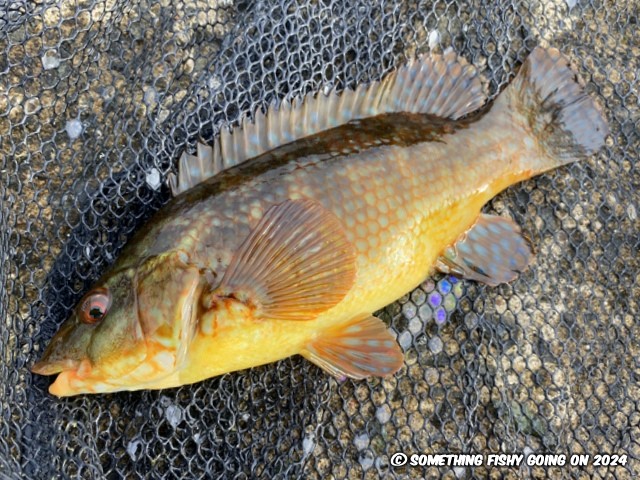
To finish the session, we headed out onto the wall connecting the harbour to some of the rocks outside of it. I fished into an area I knew had produced a topknot in the past. After catching a couple of wrasse and a long spined sea scorpion on live prawn, I rigged up another, dropping my rig again, I felt a fish take my bait almost straight away. Lifting into it, it felt like my lead had got stuck, but I could also occasionally feel a small fish on my line too, occasionally shaking its head. After a while, trying to free my rig from the bottom, I was about to pull for a break when suddenly it came free. Winding up, it wasn’t fighting too much and felt a little odd. I couldn’t believe my eyes when the unmistakable shape of a small topknot came into view. I've seen a few people lose topknot lifting them out of the water, but without thinking, I quickly swung it up the wall and into my waiting net. Luckily it was well hooked! I’ve been after one of these rarely caught rock dwelling flatfish from a Scottish venue for quite some time, visiting three particular venues dozens of times over the last couple of years, so I was over the moon to finally get one!

I caught one over a decade ago on the Channel Island of Jersey, but this was my first ever Scottish topknot. 
What a cool fish! I love the way their markings make them look like a little masked bandit!

What a great way to end what had been a very enjoyable session. It was great to catch up with Ryan again as well. Since we started fishing together, he’s been by my side as I’ve caught quite a few species in Scotland for the first time.  Often wearing a very faded baseball cap, celebrating Hibernian’s 2016 Scottish Cup win. “Persevered” is embroidered on it, a reference to the 114 years since they last won the trophy, way back in 1902! I had certainly persevered too with my Scottish topknot hunt! I may not have been feeling great, but catching my one hundred and first Scottish species certainly gave me a much needed lift!

Tight lines, Scott.

Friday, October 18, 2024

Short, but sweet.

Back in August, I was contacted by fellow species hunter, Luke Ovgard, about fishing around Edinburgh, as he was going to be spending a weekend in the Scottish capital with his two brothers in October. Not a particularly great time of the year to go fishing, I warned him, but I agreed to meet up with him when he was here to try and help him catch something new. Luke has travelled all over the world and caught over 1350 species along the way, including many of those found around the coast of this part of Scotland, so he sent me a spreadsheet containing all the species he’s ever caught. Having a look through it, I spotted a few species he hadn't caught that we could try to catch. If the conditions were favourable, I felt that we could possibly encounter ballan wrasse, butterfish, leopard spotted goby, pollock, poor cod and Yarrell’s blenny. Luke arrived from Stuttgart, where he currently lives and works, last Thursday evening, and spent the weekend sightseeing in Edinburgh and exploring further afield, making it as far north as Fort William. I had a couple of sessions last week in preparation for ours, just to see what was around. For the first session, I collected some live prawns to use as bait. Netting them out, I found a couple of tiny fish in my net with them.

Probably the smallest wrasse I’ve ever seen. I believe it’s a corkwing wrasse.
In amongst the prawns was also a tiny sand smelt.

Over the two sessions prior to meeting up with Luke, I caught a few fish, but the conditions were far from ideal. The temperature had dropped, and it was very windy too, making fishing quite unpleasant. The sea was pretty rough too and was coloured up as a result. Given the effort required to catch hardly any fish, I was concerned that we might struggle.

At St Abbs I did catch a few coalfish, but it's a species Luke had caught already, on the other side of the Atlantic, in Maine.
At the inlet area at Torness Power Station, I caught a few juvenile cod. Luke had caught this species already as well.
Trying to catch a ballan wrasse proved to be a bit of a waste of time, with only this solitary long spined sea scorpion taking my ragworm section. Another species that Luke had already ticked off.
During the second session, I caught a solitary poor cod. The only fish I caught over the two trips that Luke hadn’t caught before!

We had originally planned to meet up on Sunday evening, but the highland road trip Luke's brothers had organised that day ruled that out. In the end, we met up early on Monday morning, only fishing together for just over two hours, the only time available before Luke had to head to the airport. Arriving at the inlet area of Torness Power Station, the wind had dropped off, had also changed direction and the sea was pretty flat. Whilst it was still very cold, we were pleasantly surprised by the amount of fish we caught. In amongst them, Luke caught his first ever poor cod and pollock, which he was over the moon about.

Luke's first ever pollock.

I was really enjoying his company, and while we fished away we had a great conversation about some of the species we’ve caught, some of the places we’d fished and some of our future species hunting plans. Before we knew it though, it was time to pack up. Focusing on the fishing and our discussion, I hadn’t even taken any photos during the session. It had been great to meet up and when I dropped Luke off, he surprised me with a parting gift, a copy of his book “Fishing across America”, which I am currently reading. I really hope our paths cross again in the future. If he visits Scotland again, which I've suggested he does and next time during the summer months, I’m sure we could travel around Scotland for a few days catching lots of fish! It would be a pleasure to fish together again, and hopefully I could help him add a few more species to his already very impress tally!

Tight lines, Scott.

Friday, September 06, 2024

Packing for Norway.

Two weeks ago, when I really should have been packing my bags for a one week trip to Norway, I put doing that off until the last minute and crammed several fishing sessions in hunting for a topknot. With the summer coming to an end, I guess I figured I had better make the most of what was left of it. By the time I got back from Scandinavia it would be Autumn after all.

The weather wasn’t great when I visited Torness Power Station for my first session, but I tucked myself away down in the sea defence boulders and dropped live prawn down into the deepest holes I could find.

This nice deep hole didn’t produce a topknot,..
…only this solitary blenny.

After a few pretty fruitless hours, scrambling around the rocks and not catching much, I drove down to St Abbs to try my luck there. The fishing there was much more productive, and there were lots of ballan wrasse around that were more than happy to munch a live prawn. A few long spined sea scorpion found them tempting as well. I’m sure a topknot would eagerly eat one too. I suppose I just didn’t manage to put my bait near one.

The rocky areas surrounding the outside of St Abbs harbour held plenty of ballan wrasse.
They're home to a few long spined sea scorpions too.

A couple of days later, I headed back to St Abbs again, this time to fish Starney Bay from the rocks on its right hand side.

Only accessible at low tide, I hadn’t visited the rocks on the right of Starney Bay for a long time.

It was a beautiful day when I made my way down from the coastal path, scrambled over the rocks and finally got out onto the point, and I was soon catching a few fish. Dropping sections of ragworm and live prawns down close to the vertical rock surfaces produced a couple of ballan wrasse, which were followed by a succession of coalfish.

Coalfish give a great account of themselves on ultralight tackle.

I did intend to stay on the rocks for several hours, but a change in the weather forced me to alter my plans. Thankfully, I made it back across the gully that fills up as the tide rises just in time, otherwise I would have been stuck out on the point for a few hours in the rain. By the time I made it to St Abbs Harbour, the blue sky had been replaced by dark grey rain clouds passing overhead, and I did end up getting slightly wet a few times as rain sporadically fell. I focused my efforts on lowering live prawns down the vertical concrete surfaces, exploring as much of them as I could. I may have been slightly damp, but the fishing was pretty good, and I was also rewarded with some pretty spectacular rainbows.

Somewhere over the rainbow, topknot lie.
Live prawn has become one of my favourite baits this year. Fish love them, collecting them is easy, and best of all they are free!
One of several chunky ballan wrasse I caught.

I carried on fishing into darkness, working over the same areas I’d covered earlier in the session. Eventually, I ran out of prawns, so I switched to sections of ragworm. This produced a couple of long spined sea scorpion and a small lobster.

A bizarre creature, but sadly not the one I’ve been after for weeks!

Two days later, Lillian and I went for a walk around Butterdean Wood in East Lothian. Afterwards, we visited the inlet area at Torness Power Station where I was permitted to fish for a couple of hours to use up some ragworm I had left over from my previous session. This produced a few wrasse, and a couple of other species, but once again no funky flatfish, unfortunately.

Yet another ballan wrasse over 40cm on ultralight tackle,..
...a colourful corkwing wrasse,..
...a nicely coloured small codling,..
...and a couple of butterfish. I think those take me into double digits of butterfish caught this year!

Just as we were about to leave, another angler who was heading off offered me some cracking, freshly dug ragworm. At that point, I had no intention of fishing the following day as I still had to pack for Norway, but this generous offer was too good to turn down, so I gratefully accepted the free bait.

So, the day before I flew out to Norway, and with most of my packing still to do, I headed west to Gourock, to use my newly acquired supply of fantastic quality worms for one final pre holiday topknot session. At the first spot, rather unsurprisingly, all I caught was endless wrasse and a few tompot blenny and long spined sea scorpion.

If I never catch another goldsinny wrasse again...

Three tompot blenny made a nice change from the endless wrasse!

My mate Andrew popped down to fish with me on his lunch hour, and as we caught more of the same species I'd been pulling out all morning, we had a good chat about topknot. Just after he left to go back to work, I headed along to a try a second spot in Greenock that I know has produced several topknot this year. I only had a small amount of ragworm left, and the resident goldsinny and corkwing wrasse rapidly set about depleting that. Almost out of bait completely, a fairly gentle take resulted in all hell breaking loose when I lifted into it. A large fish started stripping line from my reel at a worrying rate. Luckily, the fish didn’t dive into the submerged rocks, instead charging off, swimming furiously away from me horizontally just above them. It made a few of these surging runs before I eventually got it up to the surface. Extending my net down, a large ballan wrasse was drawn into it and lifted up onto the venue's distinctive cobbled brick.

43cm of very chunky ballan wrasse. I didn't bother weighing it, but I'm confident it was my heaviest one of the year on ultralight gear. A real test of the tackle I was using!

I had a last few drops after catching the large ballan wrasse and caught a few more goldsinny wrasse, but it was soon time to head back to Edinburgh to do what I had been putting off all week, pack my suitcase full of fishing tackle! Sadly, a fishing session packed week in the lead up to my Norwegian adventure had not produced a topknot. I’m back from Norway now, and I’ll keep trying to catch a topknot in the coming weeks. The days will be gettting shorter soon, so I’ll be out after dark more often too I think. The wrasse should be less of an obstacle once the sun has vanished below the horizon and topknot are supposed to be more active at night as well.

Tight lines, Scott.

Tuesday, August 20, 2024

Dodgy dolos and a historic harbour.

I had another couple of short sessions at the weekend targeting topknot, visiting two new spots. A very strong westerly wind posed a problem, so I visited a couple of sheltered venues. On Saturday at Torness Power Station, I spend a few hours in the afternoon fishing down through the concrete dolos blocks, lowering live prawns down into the gaps between them into the water below. This produced a few small ballan wrasse to begin with, but then for some reason the bites dried up. Carefully moving about on the blocks was making me slightly nervous, one false move on those things and you could have a very nasty accident. No fish is worth that and the fact I had stopped catching any fish made my decision to climb back up out off of the huge tetrapods and call it a day a pretty easy one. I’m not sure I’d risk fishing on them again in a hurry. 

One of the small ballan wrasse I caught from down in the blocks.

On Sunday, I spent the afternoon down in the Scottish Borders with my girlfriend Lillian. We visited a few places, including the picturesque Cove Harbour, which lies tucked away at the bottom of huge sandstone cliffs. It’s been there for hundreds of years and to this day it’s still a working harbour. At the top of the cliff, next to the beginning of the path that takes you down to the harbour, there is a sculpture that offers a reminder of how dangerous the occupation of a commercial fisherman is. 

"Commemorating the widows and children left by the fishing disaster of 14th October 1881 when 189 fishermen were lost off this coast. Cove lost 11 out of 21 fishermen."

After making our way down the slowly sloping path to the harbour, I spend some time fishing Mini Isome down the inside of its walls, hoping a topknot that was stuck to the wall or sat in a crack would grab my little pink worm imitation as I twitched it around. 

I patiently worked my way along, hoping to catch a weird looking, rocky surface loving flatfish. 

My endeavours had fairly predictable results. So predictable in fact that Lillian successfully guessed which species would be first to take my brightly coloured, peach scented lure. A couple of long spined sea scorpion were first to scoff it, followed by three common blenny. 

Peach flavoured Mini Isome, one of your five a day!

After about an hour, I’d caught a few more small fish but my allotted fishing time was up and permission to extend it wasn’t granted. During the short window of opportunity, I also caught a couple of juvenile cod, but unsurprisingly, no topknot. I’m still confident that eventually my persistence will pay off and each time I visit an old harbour or some likely looking boulders I’ll keep trying. Sooner or later I may get lucky. 

Tight lines, Scott.

Friday, August 16, 2024

Finding the right hole.

On Sunday, I visited a rocky shore mark in Gourock to spend a few hours targeting topknot. I was given detailed information by my friend and fellow species hunter Andrew on exactly where he caught one himself recently.

Here's one I didn't catch earlier. Such a cool little fish. I particularly love the banding that runs from their eyes. Makes them look like a little bandit!

Andrew, for the time being anyway, fishes mainly ultra light tackle and does so exclusively using lures. Although, he's told me in the future he wants to broaden his horizons into the smelly world of bait fishing, mainly so that he can catch a few different shark species. Years ago, I went through a similar phase, so I decided to spend the session fishing only with artificial baits. Knowing that topknot sit flush on rocky surfaces, I decided to use a 3g cheburashka weight to present these.

A Gulp! Hellgrammite rigged up, ready to get eaten...
...which it soon was by this tompot blenny.

This combination was getting hammered by what I suspect were goldsinny wrasse, but the hook I had on was a little too big for them to get into their mouths, so I decided to try a few unscented lures in an attempt to actually catch my target. Unsurprisingly, these got less attention, but eventually a long spined sea scorpion took a liking to a bright pink straight tail as I twitched it down inside a gap in the boulders.

Greedy little swine!

After a while, a seal arrived and hung around just out in front of me. Obviously expecting the opportunity to steal mackerel from a set of feathers, it sat up in the water staring at me for a short period. Eventually, it realised that my fishing activity didn't involve mackerel and swam off again.

Looking for an easy meal.

Getting back to my topknot hunting, I switched back to Gulp! again and after missing quite a lot of bites I caught a small corkwing wrasse that did a decent job of getting down into the rocks, but with a little gentle pressure and also by giving it some slack line I managed to coax it out.

Yummy! Hellgrammite.

The non-stop little taps kept coming though, tugging my hellgrammite around the bend of my hook, ruining the nice straight presentation, so eventually I gave in and rigged up a small hook on a stinger. Tying this onto my cheburashka weight and threading a Mini Isome up onto it so that the hook was placed near the bottom, soon had a few of the culprits caught.


Peck, peck, pecking away. Got you!

For the last couple of hours, I stuck with this presentation and caught dozens of goldsinny wrasse. If there was a topknot lurking down there, getting through the goldsinny wrasse was going to be a huge problem. I also caught a few long spined sea scorpion and another two tompot blenny as well though, so I guess it's a numbers game. A huge slice of good fortune will be required also, being lucky enough to drop your rig down into the right hole, at the right time, with a topknot in the rig's vicinity when it hits the bottom.

I'd forgotten how good Isome is for close quarter mini species fishing. I've got loads of it too, so will probably make an effort to use it more often going forward.

Another fun session had soon came to an end, even if a topknot had remained elusive. I enjoyed messing about with artificial for a change. Being honest, I'd almost always choose to fish with top quality bait as it will always give you the best chance to catch fish, but as a backup Gulp! and Isome are great to have available. The highlight of the day was catching a few tompot blenny, not a species I've caught that many of up here in Scotland, and now thanks to Andrew sharing his topknot holding spot with me, it seems that I have another place here to go catch them!

Tight lines, Scott.