Showing posts with label Two Spotted Goby. Show all posts

Thursday, September 19, 2024

Returning the favour.

Now and then, a fellow angler who has found this blog, or my Instagram account, gets in touch looking for more detailed information on some of the fishing spots I post about or to ask me where I would recommend they go to catch a certain species. I’ve been helped many times over the years by other anglers who have been very generous with their advice and knowledge, so I like to do the same whenever I can. Species hunter Ben contacted me last year about haddock fishing off the north coast of Scotland, and we’ve kept in touch ever since. When he told me he and a friend were coming up to Scotland from Pembrokeshire for a few days and had based some of their mark choices on my blog posts, I decided to go and meet up with them. The weather was pretty terrible while he was up here with his friend Nev, but their final day trip to Lochaline saw a slight improvement in the conditions and I got up early to make the long drive up there to fish with them. Four hours later, I arrived at the first spot. 

Logs on the logging pier in Lochaline. I found two species hunters fishing behind them in the corner. 

When I joined them, they were each had a mackerel bait out in the incredibly deep water directly in front of the pier and were fishing for mini species down the side of the pier with ragworm baited sabiki rigs while they waited for bites on their heavier gear. Both of them are taking part in species hunting competitions and were up in Scotland hoping to add to their already very impressive totals. Ben’s main target for the session was a spurdog, whilst Nev was hoping to catch a leopard spotted goby. I fished small pieces of ragworm down the side of the pier, keen to catch a quintet of UK wrasse species. I managed four of the five quite quickly, but a cuckoo wrasse proved elusive, and I didn’t catch one until later on in the day, completing the set. 

With their lovely pastel shades markings, rock cook or small mouthed wrasse were present in large numbers.
I caught lots of them in Norway recently, but this was my first Scottish cuckoo wrasse of the year.
My four hundred and fifty seventh* goldsinny wrasse of the year! *Estimated, but it feels like I've caught that many. This particular specimen had lovely golden markings on it.

While I was fishing away, chatting to Ben and Nev about fishing, species hunting and various fish species we’d all caught over the years, they both added a couple of species to their competition tallies. Ben caught a coalfish and shortly afterwards a small spurdog, and Nev caught a Connemara clingfish followed later on by a leopard spotted goby. Later in the afternoon we decided to change venue and headed around to the stone pier near the ferry terminal in the village. From this spot, Nev wanted to target a couple of small goby species and Ben was keen to try for a sea trout. Whilst Ben fished metals, Nev and I baited tanago hooks with tiny pieces of ragworm and caught a few painted goby and two spotted goby with relative ease. 
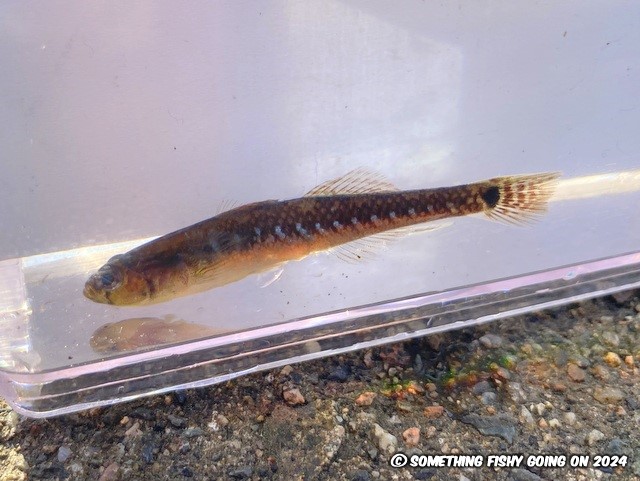
I’m not taking part in any species hunting competitions, but it was still nice to get another species ticked off for 2024 with this two spotted goby.

Having quickly caught our two target goby species, we headed further north up the shoreline, passing Europe’s only underground sand mining facility, to reach the village’s small marina. Nev and I targeted tiny fish with tanago hooks whilst Ben continued casting metals around hoping to tempt a sea trout. 

Ben fishes from the marina pontoons with small metals, hoping to catch a sea trout.

It didn’t take any of us long to catch fish. Nev and I very quickly pulled out several sand goby, whilst Ben began to supply some of the marina’s boat owners with freshly caught mackerel. 

One of several sand goby that we caught. 

Nev was over the moon to catch a sand goby as it was another addition to his competition tally. We carried on searching the sandy bottom and caught a few more species. There were lots of tiny poor cod around, and I also caught a couple of tiny grey gurnard.  
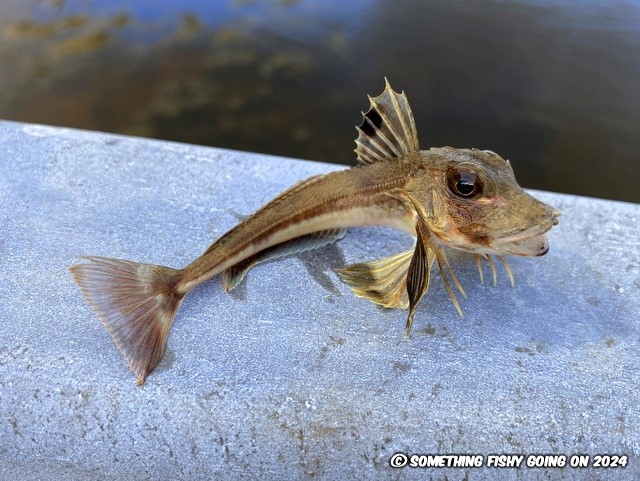
Perfection in miniature and incredibly adorable into the bargain!

The last time I visited this spot I thought I saw one of the UK’s two smaller clingfish species, so I was scanning the bottom trying to spot one of those. When I saw a small dark fish sitting motionless, I spent some time trying to catch it. It didn’t seem interested at first, moving around a few centimetres at a time before settling in a new position. Borrowing a bright pink cheburashka weight from Nev I was able to more accurately lower a tiny piece of ragworm right in front of the fish and after a while it took the hook into its mouth. Quickly lifting the fish up, I was slightly disappointed to discover it was in fact a tiny short spined sea scorpion. 

My first of the year, but not the species I thought I’d been trying to catch!

Ben had come over to see what we’d been catching before returning to the pontoons to target sea trout again. Just before we all called it a day, Nev managed to catch a juvenile short spined sea scorpion too, which was also an addition to his species hunt tally. By this point, light was beginning to fade, and we called it a day. With a ferry to catch as well as an overnight closure of the road through Glencoe and a detour increasing my journey time home, I said farewell to Ben and Nev and hit the road. It was great meeting up with them both, and I wish them success with their future species hunting. I might not be too long until Ben and I meet up again for another spot of species hunting, he’s invited me down to Pembrokeshire to try and catch my first ever UK grey triggerfish. Fingers crossed the right conditions for them materialise! 

Tight lines, Scott.

Saturday, June 17, 2023

Too hot to fish?

I headed west with my mate Ryan on Tuesday for a couple of days species hunting. The weather was glorious. Probably too hot if the truth be told, but we decided to smear ourselves in sun cream and go anyway. Discussing our plan of attack during the drive there, and the potential species we could catch, we set a target of twenty species between the two of us for the trip. Our first stop was Loch Creran Head, where we fished scaled down three hook flapper rigs baited up with small sections of ragworm. We fished from some bladderwrack covered rocks exposed by the tide to begin with before moving to some steep rocks above the high tide mark further east once the tide began to flood. Several unusual mini species that I’ve never caught before inhabit the sea floor in this area, so I had my fingers crossed. From our first cast we caught plenty of fish but nothing unusual, unfortunately.

Loch Creran Head on a hot sunny day.
As I’ve discovered during recent sessions there, the loch contains a very health black goby population. This makes it very difficult to catch rarer, less aggressive species. Ryan had never caught a black goby before but the novelty soon wore off and he got bored of catching them.
We also caught a few common dragonet. Another new species for Ryan.

After a few hours we’d more than had our fill of catching black goby, so we packed up and drove north to fish from the old stone pier in Kentallen. Fishing wasn’t non stop action, no doubt due to the midday sun blazing down, but a few wrasse and goby species bumped up our trip tally. Ryan also caught a butterfish and I caught a Connemarra clingfish which spiced things up. Then out of nowhere it started raining pretty heavily, so we hastily packed up and hit the road again.

Loch Linnhe on a hot sunny day.
Only my second ever Connemarra clingfish. The first addition to my personal 2023 species hunt of the trip.

An hour or so, a ferry crossing and twenty odd miles of single track road later, we arrived in Lochaline. After grabbing some food we self checked into the bunkhouse there where we'd be spending the night, and then headed down to the village’s West Pier to fish for a few more hours. Again, we caught lots of wrasse and goby as well as lots of poor cod and a few pollock. In the process I added three more species to my 2023 tally.

Small but perfectly formed, my first cuckoo wrasse of 2023.
Dozens of leopard spotted goby were caught. Another species added to my 2023 tally.
We caught a few rock goby too. My first of 2023 also.
We caught lots of goldsinny wrasse.
Some very colourful rock cook wrasse as well.
I also caught what would turn out to be the only short spined sea scorpion of the trip. My second in a week.
The Sound of Mull on a... Wait a minute! Is that rain coming or a swarm of midgies?

It turned out to be rain followed by swarms of midgies. Thankfully I had a can of Smidge in the car!

As the sun began to get very low in the sky we decided to call it a night. We’d caught fifteen species between us by the end of the first day, which I felt was a pretty good effort. Having left Edinburgh at 05:30 we were both feeling a little bit tired. Back at the bunkhouse we both had a much needed shower. The scent of sun cream, ragworm juice and Smidge isn’t a pleasant combination!

In the morning we were up early again and were down at Lochaline’s ferry terminal fishing by 06:00. We headed there because I knew it was a good spot to catch a certain diminutive species and after catching lots of them, we decided to head to a new spot.

Several two spotted goby in my photo tank.

I wasn’t sure if fishing was permitted out on the pontoons of Lochaline Harbour, but there were no signs saying it wasn’t and none of the people who had their vessels moored there seemed to mind us fishing, some even showing an interest in what we were trying to catch, which was mainly sand goby. I did see what I think might have been a tiny clingfish, but it disappeared underneath a scallop shell and I couldn’t tempt it out. Through the crystal clear water we also saw some trout cruising about and a solitary flounder moving along the bottom, but we failed to catch any of them. Before we left I did manage to add a painted goby to our tally, taking it to eighteen. With the plenty of time left before we had to head home we only had two species left to catch to reach our target!

Lochaline Harbour on a hot sunny morning. Surely this should be called Lochaline Marina?
I lost count of the number of sand goby I caught. Ryan caught his first ever sand goby too.
Ryan tries to tempt a trout on small metals.
I pinched his spot and sat relaxing in the sun waiting for mini species to bite. After catching even more sand goby and a couple of common dragonet I managed to add a painted goby to our tally.

Before we left Lochaline we decided to head back to the West Pier for a couple of hours. I was hoping we’d get lucky and pull out a Yarrell’s blenny but all we caught were wrasse, goby and some poor cod. The next stop on our adventure was a new mark I'd spotted on Google Maps. Heading north from Lochaline we took a right turn onto a winding B road, driving through some amazing scenery before ending up on a slipway next to a small stone pier on the northern shore of Loch a’ Choire.

What a beautiful view!

Three hook flapper rigs were cast out, but these didn’t produce any fish. I then spotted a common blenny down the side of the slipway and Ryan dropped a bait down in front of it. Species number nineteen caught we jumped back in the car and headed to Fort William to fish Loch Linnhe again from the town 's West End Car Park. I was confident we’d get a dab or a grey gurnard there, but the water was a bit coloured up, and we caught neither. Ryan managed a couple of pollock before we decided to head off to try the Linnhe Picnic Area a few miles south of Fort William. The water there was also coloured up a bit and there was a fair amount of suspended weed to contend with as well. We soldiered on and after several fishless casts I wound in my three hook flapper to put fresh bait on and was pleasantly surprised to discover a Yarrell’s blenny on the bottom hook!

My first Yarrell’s blenny of the year.
A cool twentieth species of the trip for us.
Holding the fish in a rock pool I got this great photo of the fish's funky "eyebrows"!

After that things remained slow, but we fished on for a while and Ryan eventually caught a nice dab before we finally called it a day and began the three hour drive home.

The last fish of the trip.

So it had been a great little trip in very hot weather. We’d done very well, catching twenty one species in total. Not bad considering just how hot it had been. I’d added five species to my 2023 species total and taken it up to ninety nine. I think I’ll pop out and try to make it one hundred before I fly out to Singapore on Tuesday. It’ll be even hotter there, but will that stop me fishing for an incredible variety of new species? Not a chance!

Tight lines, Scott.

Sunday, June 04, 2023

An American species hunter in Scotland.

At the start of May I received an email from a young American species hunter by the name of Brandon. One of the things I really like about writing the blog is that it occasionally brings myself and other like minded anglers together. In his email he explained he enjoyed my blog, would be visiting Scotland at the end of May and was keen to meet up, so we could do some fishing together. I told him that I would meet up with him when he was in Edinburgh, and I'd help him catch a few new species for his life list. After I finished work last Sunday I picked him up from his Airbnb, and we visited the Water of Leith, as Brandon was keen to catch his first bullhead. Waiting for it to get dark, we targeted minnows for an hour or so. They weren't particularly active however, although I did manage to catch one. It was an opportunity to try out a small "photo tank" that I recently bought to take to Singapore with me.

My new photo tank works quite well I think.

Once it got dark we headed to my favourite bullhead spot and began searching the shallows with our head torches. The bullheads were out in numbers, and as usual, couldn't resist a maggot on a small hook dropped right in front of their relatively large mouths. Before long we’d lost count of how many we'd caught. Whilst Brandon took lots of photos of bullheads I began scouring the bottom for bigger specimens. A monster bullhead soon appeared, out from underneath an overhanging section of the bank. A new personal best bullhead was soon in my photo tank!

Brandon photographs the latest addition to his life list.
My new PB bullhead. Possibly. I didn't weigh it.

Our mission accomplished, we headed back to the car. After dropping Brandon off, I headed home, satisfied with a successful guiding effort. I was working in the morning, but we arranged to meet up the following evening again.

Whilst I was working on Monday, Brandon was out fishing on Granton Breakwater. He wanted to catch some wrasse and I told him that this was a good spot to try. The wind had a made it a pretty tough session, but he caught his first ever ballan wrasse, so he was happy with that. I managed to get away from work thirty minutes early and headed down there to pick him up. Off we went to Dunbar Harbour for a session targeting, to begin with, flounder and plaice. We arrived a little too early but as the tide flooded and the depth of water over the sandy corner we were fishing in increased, we eventually spotted some flat fish chasing our ragworm sections as we slowly twitched them along the bottom. My first fish of the evening was a small plaice, which was my first of the year. Plaice make up a small percentage of the flatfish I've caught in Dunbar Harbour of the years. so it was a slice of luck to catch one straight away. It was followed fairly quickly by a small flounder.

A small plaice. Another species added to my 2023 tally.
A flounder soon followed.

Soon afterwards Brandon also got lucky and caught his first ever plaice. After the sun had set and light begun to fade I hooked a big flounder that unfortunately came off just as it was coming to the surface. A short time later, Brandon hooked a big one too. Perhaps it was the fish I'd lost. It was certainly too big to swing up, so I grabbed my 5.9m landing net from the car and netted it for him.

A tiny plaice. Size doesn't matter to species hunters. They all count.
Brandon uses a Tupperware tub full of water to photograph his fish. This is a great tool for identification purposes and shows most of the fishes features very well.
A big flounder. Size doesn't matter to species hunters. They all count.

Once it was dark we spent a couple of hours fishing into some mixed ground at the back of the harbour. We were hoping that shore rockling, five bearded rockling or viviparous blenny might take our worm baits, but it wasn't to be and at midnight we packed up and headed back up the A1. The following day I was off work and Brandon had to be back in Edinburgh by 19:00, so we decided to make an early start to a day of species hunting.

After getting about three and a half hours sleep, I jumped in the car and picked Brandon up at 06:00. We drove west to East India Harbour in Greenock where we had a small list of species that I thought Brandon and I could catch around there. A common dragonet was our first target. Rigging up running ledger rigs and baiting small hooks with a little section of ragworm, we cast out as far as we could and slowly wound in. On my second cast I felt a bite and stopped winding. Waiting a second or two before lifting, I felt the weight of a fish and reeled it in. When a stunning male common dragonet appeared on the surface I was absolutely delighted!

I’ve wanted to catch one of these for years! Absolutely stunning! Just look at those colours.

Brandon caught his first common dragonet shortly afterwards too, so our session had got off to the perfect start. After a few more common dragonet and some dab from further out we began fishing over the rocky, weedy ground closer in, but surprisingly this didn't produce anything, so Brandon suggested we try fishing inside the harbour instead.

Dab are another species you can catch at range from East India Harbour.

This suggestion proved to be a great one. In the past I've never had much joy fishing inside the harbour but as soon as we took a look we spotted lots of wrasse moving around over the rocky bottom, including some pretty big rock cook wrasse. One hook paternoster rigs were dropped down and quite a few wrasse were soon being caught. Mainly rock cook wrasse and corkwing wrasse, but we also had some goldsinny wrasse and a ballan wrasse too. The rock cook wrasse and goldsinny wrasse were firsts for Brandon. He'd caught corkwing wrasse in the Mediterranean before but one of his was the most turquise coloured example I've ever seen!

Another very colourful UK wrasse species, the rock cook is probably my favourite.
Brandon caught this bright turquoise corkwing wrasse.
The Tupperware tub put to good use again. Look at those colours!
We didn't catch as many goldsinny wrasse as I was expecting. They normally make up the bulk of catches over the rough ground close in.

As the sun got a little higher in the sky, things really slowed down. We watched as all the wrasse that had been cruising around headed down into the gaps in between the boulders to seek shade. A few shoals of sand smelt turned up at this point, and we caught a few of those, another new species for Brandon. Before we began fishing on the outside again, Brandon caught a rock goby, a black goby and a two spotted goby. The last two being new to him.

The Tupperware tub is great for capturing the detail of fish's fins like those of this sand smelt.

Switching back to fishing the outside of the harbour the bites dried up almost completely, and I only caught three fish in a couple of hours, a common dragonet, a goldsinny wrasse and a black goby.

I'd have preferred to catch a rock goby as I'd already caught a few black goby this year.

It was the early afternoon by this point, and as the fishing had slowed to a crawl, we decided to switch to freshwater targets and headed back east to Magiscroft Coarse Fishery. Brandon wanted to catch his first gudgeon and it's probably the best place to catch them that I know. On the way we hit heavy traffic as we approached the middle of Glasgow. Brandon took the opportunity to have a nap.

A tired species hunter.

Before long the traffic started moving again and we soon arrived at Magiscroft. It didn't take us too long to set up some puddle chucker floats and catch a few gudgeon from a shallow peg on the venue's main loch. All mine were pretty average in size, but Brandon managed to catch a couple that were pretty chunky!

An average gudgeon. Size doesn't matter to species hunters. They all count.

A large gudgeon. Size doesn't matter to species hunters. They all count.

Having caught what we came for, as well as a few roach and perch, we then jumped back in the car and headed to the River Forth so we could spend an hour or so trying to catch dace. I thought it might be tough as the water levels were very low due to the lack of rain recently and this proved to be the case. We trotted maggots down the faster flowing water but all we caught were lots of minnow and the odd salmon parr.

An Atlantic salmon parr in my photo tank. Another species towards this year's challenge.

Soon it was time to go, so we packed up and headed back to the capital where I dropped Brandon off at his Airbnb. It was great to meet him and I really enjoyed both our fishing and our conversations about fish, fishing and species hunting. I hope our paths cross again in the future, and we'll hopefully keep in touch in the meantime.  I enjoyed helping him add ten species to his life list whilst we were together and also gave him advice that helped him add two more in the shape of the ballan wrasse he caught from Granton Breakwater and I also gave him information that led to him catching his first bitterling a couple of days after he left Edinburgh on his way to Manchester. Furthermore, whilst playing at being a guide, I'd also added another two species to my 2023 species hunting challenge, catching my first plaice and Atlantic salmon of the year. The large male common dragonet was probably my own highlight of our time together and is a capture I won't forget.

Tight lines, Scott.