Showing posts with label Mayan Cichlid. Show all posts

Saturday, April 13, 2024

Species hunting adventures in Florida: Part 3.

On the third day of our trip I felt dreadful, and the weather was dreadful too. It was very wet and very windy. After visiting a large sporting goods store for a look at the fishing tackle, we had Cuban sandwiches for lunch and I tried to figure out somewhere we could go fishing that would offer us some protection from the elements. We ended up visiting Silver Palm Park, where I thought we might be able to tuck ourselves away under the draw bridge there. 

Upon arrival, we realised that we could get a little shelter if we went underneath the bridge into the “wildflower park” next door. No wildflowers to be seen, just a landscaped park with metal sculptures of flowers. Anyway, the problem was, I didn’t think fishing was permitted there. Determined to keep us dry and catch some fish, I got setup and started fishing anyway, figuring at worst we’d be asked to leave. There were insane numbers of sergeant major close in, so after catching a few, I started casting further out. I caught a few fish before an understanding park ranger arrived and told us we couldn’t fish where we were and politely asked us to head back to Silver Palm Park where fishing was permitted!

I caught a few tomtate grunt,…
…and a couple of lane snapper before we were asked to move. 

There were some canvas canopies in Silver Palm Park, but the wind was blowing the rain in at an angle, and they were set back from the water's edge. In short, they weren't very effective shelters. Lillian stayed underneath one, and I stood in the rain fishing for a while. A few fish were biting, and I caught a few slippery dick and a few checkered puffer.


Slippery when wet? Slippery all the time!
I caught a few checkered puffer, my first puffer species of the trip.
Party trick time!

It was far from ideal, so we decided to pack up and leave once I had used up the two shrimps I had cut up into chunks. I was also feeling absolutely terrible and told Lillian that I was sorry, but I just wanted to go back to our accommodation, so I could crawl into bed. That’s exactly what I did when we got back. I think I fell asleep about 17:00, and slept right through until the following morning. Right through all the rain and thunderstorms that Lillian described as pretty wild. 

By early afternoon the rain had begun to subside, and I felt a bit better, so we headed to the Sawgrass Trailhead At Atlantic Boulevard armed with a tub of worms. I fished from one of the sluice gates over the canal and there were a few fish around. After about an hour we had to run back to the car to get out of a heavy rain shower, but it passed over fairly quickly and afterwards the clouds began to break up, the sun occasionally appearing through the gaps, and the fish seemed to become more active. 

I prefer the second option!
From the deeper water in the centre of the canal I caught some spotted tilapia,...
…and some redear sunfish.
Some of them were a reasonable size!

Switching my attention to some smaller fish that seemed to prefer the rocky margins of the canal, I caught another two species for the first time. The second came out from under a rock and grabbed my worm before trying to make a dash back from where it had come from.

I caught a few of these nice looking spotted sunfish,…
…and my first warmouth. An aggressive little ambush predator and another member of the sunfish family.

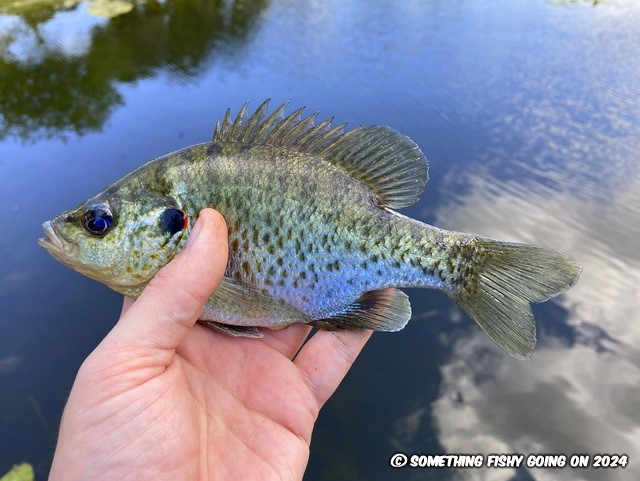
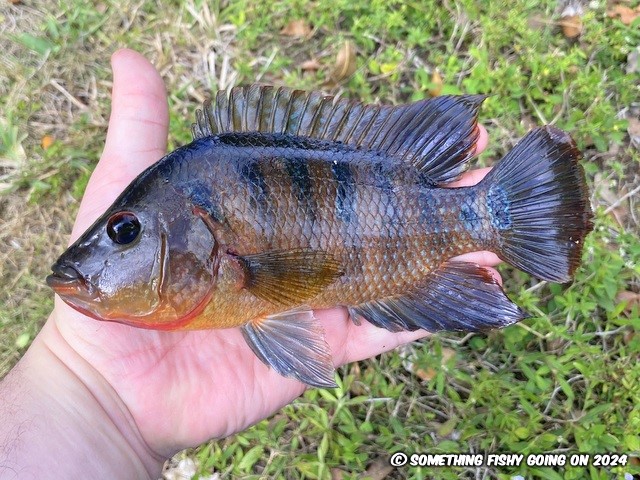
After a break for lunch, we headed to Vista View Park on the recommendation of someone we had got chatting with as we fished. He told us that the ponds there were full of fish, so I thought it was worth a visit. Once there, I fished from a small pier. I caught some bass, a few Mayan cichlids and some bluegills. I believe the bluegill were actually a subspecies, called coppernose bluegill. They are only found in a couple of regions, one being southern Florida. Their status may very well change in the future, and like the Florida bass, they may be reclassified as a distinct species in their own right. 

 A nicely marked Mayan cichlid. 
I believe this is a coppernose bluegill. 
You can see where the name comes from. 

Pretty soon it was time to leave as the park was about to close. I’d really been enjoying the sessions I'd done in freshwater. Before the trip I thought I'd spend the majority of my time fishing for saltwater species, but it had been a fairly even split so far, and I didn't really see that changing during the rest of the holiday either. 

Tight lines, Scott.

Click here for the next part.

Friday, April 12, 2024

Species hunting adventures in Florida: Part 2.

On the morning of our second day, I wasn't feeling too great. I put it down to all the travelling, a full day out fishing in the glorious Florida sunshine, and probably not drinking as much water as I should have. In the back of my mind however was the fact that a couple of my workmates had been ill the week before we flew out, and I was hoping that I hadn't picked up whatever virus they had been suffering with, as what they had was quite nasty.

Anyway, keen to open my freshwater account, we visited a Walmart Supercenter to grab a large sandwich sub to share for lunch and a tub of redworms from the fishing section. We then drove to the first spot, a large pond surrounded by various office and business buildings. The target species here was a member of the sunfish family, the warmouth. After struggling to find a parking spot that didn't risk the hire car being towed away, we walked around the pond and found a gap in the trees where we could access the water.

A fairly nondescript, reasonably sized, semicircular pond. Florida has hundreds, if not thousands, of water features like this!

Fishing a small section of redworm on a small hook, and casting my helicopter rig just out beyond the lily pads, I got lots of bites straight away and had soon caught a few small bluegill.

My first bluegill from its native range. I've caught them before in Japan.

After a while, Lillian pointed out some small groups of diminutive, but colourful fish, swimming around in the submerged lily stalks a few feet out. I wound in and quickly tied on a smaller hook and squeezed a small split shot a few inches above it. Lowering a tiny piece of redworm into their midst proved irresistible, and I quickly caught a few of them. 

This, I believe, is an African jewelfish. Although there is some controversy around exactly what species of these are present in the water systems of Florida.
This specimen with the deep red markings is the same species I think. Possibly a male in breeding colouration?

After catching a dozen or so, I switched back to my original rig and fished out past the lily pads and also in the gaps between them, to try and catch a warmouth. Sadly, all I managed to catch were more small bluegill. After a while, we decided to have a break for a few hours and headed to the Morikami Museum and Japanese Gardens. The gardens were beautiful and there were lots of interesting birds, insects, lizards and fish to see as we enjoyed a relaxing stroll.

We weren't the only people chilling out in the gardens. 
It may look like this Iguana was also relaxing, but being cold-blooded, it was no doubt warming itself up on this rock!

Having seen a few of Mayan cichlid in the various ponds as we had strolled around the Japanese gardens, I was keen to get back to fishing again. Our next stop to do just that was a small pond next to a retail park. The target species there was an oddly named and very colourful cichlid, the Eastern happy. Another species that has been released into the freshwater bodies of Florida by the State’s aquarium owners. Whilst trying to locate one of these, I caught two other species, one of which has only recently been recognised as a species in its own right.

At first glance I thought this was a bluegill, but actually it's the bluegill's cousin, the redear sunfish.

Freelining my worm down in amongst some vegetation whilst searching for an Eastern happy, letting it sink slowly, my rod was pulled over quite abruptly by what turned out to be a small bass. It managed to swim through, and get itself tangled up in some lily stems, but applying gentle force I managed to eventually pull it free.

This is a Florida bass. Only recently recognised as a distinct species. Beforehand, it was considered a subspecies of largemouth bass. They grow much faster than the largemouth and much bigger too. Obviously, this one has some growing still to do!

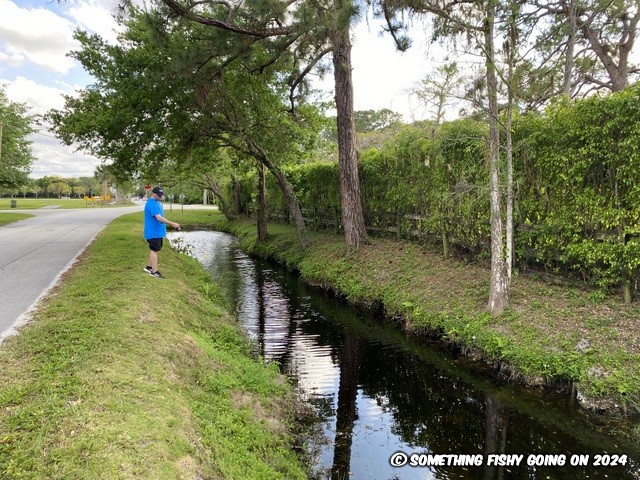
We spent a bit of time exploring the pond but couldn't locate any Eastern Happy, so we decided to drive to another spot in search of one. The third and final spot for the day’s fishing was a small, relatively shallow ditch by the side of a small road. To look at it, you would not imagine it held many fish if any, but the amount of fish in there and the variety was incredible, taking me somewhat by surprise. 

From this small roadside ditch, my freelined worms caught a ridiculous amount of fish.
As well as bluegill and redear sunfish, I caught lots of super aggressive Mayan cichlids,..
...spotted tilapia,...
...some very cool looking jaguar cichlid,...
...and a nile tilapia too.

In addition, I also managed to catch a couple of Eastern mosquitofish. Dropping my whole worm into the margins, where there were a lot of them, they immeadiately started eagerly attacking it. Two of them biting onto the end of it and holding on while I lifted them out!

An Eastern mosquitofish. Turns out they are ravenous little swines and not too clever either!

By now, some grey clouds had started to roll overhead. Rain was on the way and thunderstorms were forecast the following evening. Whilst I was having lots of fun raiding the roadside ditch and catching lots of new species in the process, I was also aware that I was feeling a little under the weather myself. My nose was beginning to turn into a water feature, my eyes were itchy, and a headache was developing. At that point, I was pretty certain the lads at work had given me a parting gift. We called it a day on the fishing front and headed to a pharmacy to get something that would hopefully alleviate my steadily worsening symptoms.

Tight lines, Scott.

Click here for the next part.

Friday, July 21, 2023

Species hunting adventures in Singapore: Day 6.

On the penultimate day of our trip, we got a taxi out past Changi Airport and caught the first ferry from Changi Point over to Pulau Ubin, an island off the north east coast of the mainland. Our main target species for the day would be barramundi, although personally I would be targeting any species that we encountered. 

After arriving on Pulau Ubin, we headed west into the interior, making our way towards Jelutong Bridge, a well known spot to target barramundi over low water. On the way there the road crossed over a pipe that ran into a small concrete ditch on the left hand side of the road. The ditch was about a meter wide and was heavily stained a rusty orange colour. Despite the fact it didn't look very habitable, I spotted some small fish in it and quickly set up my Rock Rover. A bit of prawn on a split shot rig was dropped in, I quickly caught a few fish, and we were soon hiking again to what was supposed to be the first fishing spot!

Cantor's gudgeon was the first fish I caught from the rusty ditch.
It was followed by a few super aggressive knight goby.
Just before we left the ditch I caught a small Mayan cichlid.

The tide was out when we arrived at Jelutong Bridge, and much to my delight there were lots of mudskipper sitting out on the exposed mud! I quickly set about catching some of them. Some species were skittish and skipped away when I dropped a bit of prawn near them. Others eagerly skipped over and ate it with a ravenous appetite. Swinging them in, the first few I thought were hooked obviously weren’t, spitting the bait out before skipping off merrily back down to their holes in the mud. It was very frustrating! Chris then managed to successfully catch one which made me even more determined, so I decided to tweak my presentation slightly, tying on a slightly bigger hook, so I had more hook point exposed. When a mudskipper took the bait into its mouth I struck just a little bit harder too. This did the trick, my hook sets were much better and I quickly landed a few smaller mudskipper. There seemed to be two species that were keen on prawn and I caught them both.

My first ever species of mudskipper was the barred mudskipper.
I also caught some of these yellowspotted mudskipper.

Lee then pointed out a huge mudskipper down near the edge of the water, so I cast a piece of prawn over in its vicinity. The brute headed directly towards it, ate it straight away and I struck firmly, setting the hook. The fish "fought" pretty hard, thrashing about on the ground, but I managed to pull it up the muddy embankment. I was so excited, but when I stooped down to lift it up to unhook it, the fish thrashed about wildly and managed to unhooked itself. The sight of me trying to grab it as it made a thrashy, skippy escape must have been pretty hilarious, but it was so fast I just couldn’t grab it, and it made good its escape, entering the water and swimming rapidly along the surface, off into the mangroves, out of sight. I had a scout around but couldn’t see any more giant mudskipper so turned my attention to fishing for barramundi with Chris and Lee. After a while thrashing the water with various small hard lures, I decided to target a couple of other species that I could see swimming around in the current near the base of the bridge. The first was a species of halfbeak. There were lots of them around, and they were very easy to catch as they were all competing for the tiny baits I dropped in. Next, I targeted some small striped fish with yellow tails. Getting through the halfbeak was difficult, but eventually I managed to catch one. 

The water was full of these stripe-nosed halfbeak. Strange little fish with the oddest of mouths. The long beak is actually their bottom jaw. Their top jaw is a small flap just in front of their eyes, like a little trap door.
The other fish turned out to be banded archerfish. This family of fish have a large, upturned mouth that they use to spit water at insects to try and knock them from overhanging branches into the water so that they can eat them. How amazing is that?!

After a while there had been no sign of any barramundi, so we decided to head further west to Puaka Bridge to try there. Shortly after we arrived, Chris came and told me he had spotted a giant mudskipper and very generously showed me where it was and let me try to catch it, which luckily I managed to do almost straight away. Learning from my previous error, the fish was quickly popped into a net before being unhooked. Once I did remove the hook, it was actually pretty placid, so I was able to get a few photos before releasing it. I was over the moon with this capture. 

My first giant mudskipper! Quite a handful but, believe it or not, much smaller than the one that outsmarted me!
He was actually pretty chilled out once unhooked!

Lee, who had gone off through some trees to the right of the bridge, had been focusing on catching barramundi the whole day, so I went over to see how he was getting on. He’d seen a couple of them, but hadn’t had any luck getting them to take any of his lures. They just didn't seem to be in the mood. He had also been photographing a small monitor lizard that he had befriended. It kept appearing, eating some ants and then slowly skulking off again.

Lee’s new pal. 

He then pointed out a needlefish to me that was lazily basking in the margin nearby, so I went back to the bridge and grabbed my rod. A piece of freelined prawn was dropped in, the fish slowly edged forward until its toothy beak was alongside it, before it awkwardly ate it the way needlefish do.

My first spottail needlefish. Another new species added to my tally.

So the day was proving very productive species wise, even if the main target on Pulau Ubin hadn’t shown any interest in our attempts to trick it with various fish shaped bits of plastic. As the tide continued to flood into the mangroves, more and more archerfish began to show up. Lee stubbornly stuck to targeting barramundi, but Chris and I decided to have some fun freelining chunks of prawn and caught dozens of archerfish. Eventually I caught a bigger one that didn't look quite the same. It turned out to be a different species. 

In amongst all the banded archerfish I caught this solitary spotted archerfish.
Chris had lots of fun catching archerfish too. 

Lee even managed to get in on the archerfish action, catching one on a top water plug. 

It was soon time to make the hike back to the pier where we'd catch the ferry back to the mainland. Just before we left, some anglers turned up with live prawns to fish them under floats for barramundi. Maybe that would have been a more productive method. We didn’t really have time to hang around to find out though, unless we wanted to spend the night or pay for a very expensive boat charter!

Tight lines, Scott.

Click here for the next part.