Showing posts with label Three Spined Stickleback. Show all posts

Thursday, May 14, 2026

There’s a first time for everything.

I’ve not been out much recently, but last week I had a very enjoyable session with two local lads who have caught the species hunting bug, Luca and Luke. They were both keen to visit a couple of my favourite spots to target two freshwater micro species. Meeting up about an hour before sunset, we headed to the pond in Inverleith Park to kick things of by catching a load of three spined stickleback. There were enormous numbers of them present and fishing tiny pieces of maggot on tanago hooks we spent an while catching one after another. Between the three of us we must have caught over a hundred by the time we headed to my favourite bullhead spot on the Water of Leith. It was also the first time Luca and Luke had caught the species, so it was nice to witness that. Nothing beats the feeling of catching a new species!

The humble three spined stickleback. As far as I’m aware, it’s the only species of fish in Inverleith Pond and it’s thriving in there!
There were plenty of males in breeding colouration amongst the ravenous shoals. 

After a short walk, we were at the shallow rocky edge of the Water of Leith. Turning on our head torches, we began scanning the bottom for our target. Almost immediately, we spotted a few bullhead sitting motionless in gaps between the rocks and dangling a piece of maggot in front of them, we all quickly caught a few. Again, they were Luca and Luke’s first ever. After catching a few small specimens, I spotted a much larger individual and focused my attention on catching that. It was quite stubborn initially, refusing to move at first, but eventually it got fed up of the maggot being twitched around in front of it and ate it. 

At just shy of 10cm, this bullhead was a bit of a beast!

After a while, it started raining and having caught what we were after, we called it a night. Catching these two species is very easy, but it still was nice to help Luca and Luke catch their first three spined stickleback and bullhead. They’re both keen to catch a few more new species over the summer, so I dare say more opportunities to help them do so will come along over the coming months. 

Tight lines, Scott. 

Monday, July 28, 2025

So you're telling me there's a chance!

After hearing reports of a striped red mullet being caught on Granton Breakwater, I decided to get out and try my luck. The angler who caught the striped red mullet has fished on Granton Breakwater for many years and this was his first one. One other friend also caught one there many years ago, so clearly they are a potential catch, albeit an extremely rare one. So, I was under no illusions about my chances when I visited the venue last week. I had two sessions, neither producing a striped red mullet. Fishing small baits on the bottom, I did catch a lot of pin whiting, a few juvenile grey gurnard and a couple of mackerel. The breakwater was very busy and there were lots of people fishing of various ability levels. I witnessed a few leads being cracked off and flying away towards the horizon, and several cans of lager being cracked open too. When “the mackerel are in”, I’ve got to be honest and say it’s not my favourite place to fish!

My mate Ryan came down and joined me for a couple of hours during the first session and as we chatted away, he told me that a friend of his had caught a couple of dragonet in St Abbs Harbour. Quite unusual I thought. Having fished St Abbs Harbour quite a lot over the last decade, or perhaps even a little longer, I’ve never caught or heard of anyone else catching a dragonet there. I just assumed that they were common dragonet, but when I thought I better check and Ryan sent me photos of the fish in question a couple of days later, I was shocked to see that one of them was actually a reticulated dragonet! I jumped straight in the car and headed down there!

St Abbs Harbour has been very good to me over the years, most recently producing my first Scottish topknot. 

My first session was pretty productive in terms of the number of fish and species I caught, but no dragonet were in amongst them. The following morning I headed back down armed with some fresh ragworm. When I arrived, the tide was out and there wasn't much water in the harbour, so I decided to kill some time targeting three spined stickleback. It didn't take long to find a few fairly large specimens in a small rockpool. Tying on a tanago hook, baiting it up with a tiny piece of ragworm and twitching in front of them produced a couple pretty quickly.

First up was this large female.
It was followed by a very colourful male.

Heading back around to the harbour, I rigged up a running ledger and began casting it out onto the cleaner areas out in the middle of the outer harbour. I wouldn't really describe these areas of the harbour floor as sandy, it’s more like fine gravel with a few patches of rougher ground and weed. Slowly twitching the tiny bait back towards me along the bottom, the fish weren't biting as much as the previous day. Eventually I caught a long spined sea scorpion, a common blenny and a nice flounder.

St Abbs Harbour is a great venue to target flounder on ultra light tackle.

As the tide continued to fill the harbour, the fishing slowed down even further, and I went an hour or so without catching any more fish. Eventually, I cast out and just after my rig hit the bottom, my rod tip registered some interest. Leaving the bait for a few seconds to allow this to develop, I wound down and felt the weight of a small fish thrashing away. As it came to the surface, I recognised the shape almost immediately. It was my first ever dragonet from St Abbs Harbour.

A small dragonet, but which species? At first glance it looked like a common dragonet.
In my photo tank, the fish just sat on the bottom and didn’t want to flare its fins, so I had to lift it out to gently extend the second dorsal myself. 
The second dorsal fin had ten rays and a distinctive diagonal pattern to the markings on it. I'd caught my first Scottish reticulated dragonet!

I was over the moon, but couldn’t quite believe I’d caught one after spending such a short an amount of time trying. It felt a bit surreal if I’m honest. Quite a contrast to the umpteen sessions I’d put in to catch the topknot! I continued fishing for a bit longer, but it remained pretty slow, so after catching another two long spined sea scorpion and a second flounder, I called it a day, heading back up to Edinburgh happy enough! I really didn’t expect to catch another new Scottish species so soon after my first Scottish topknot. Chasing fish, particularly rarer species, when you hear about them being caught often leads to disappointment in my experience, but on this occasion, racing to the scene of an unusual capture had really paid off! The reticulated dragonet that Ryan’s friend had caught was a male, much more colourful than my fish, with much taller dorsal fins too, so there are at least two of them in there! I’ll leave them for other anglers to target for the time being, I’m going to get some sabiki out and try to catch a sprat next! Who knows how long that will take!

Tight ines, Scott.

Monday, May 19, 2025

Behind blue eyes.

Having stocked up on tanago hooks fairly recently, and also treated myself to a cheap and cheerful tanago rod, I visited the Water of Leith and Inverleith Pond last week to catch a few fish on it. I already own a six foot tanago rod, which I find is sometimes a little too long, especially when you want to target tiny fish in really close, so my new four foot rod was definitely a much-needed addition to my collection of fishing rods. Besides, at the bargain price of six pounds, I just couldn't resist!

There's just something about pink fishing tackle, right?

I usually dangle tiny chunks of maggot under a tiny Chianti pole float, but decided to give an actual tanago float a go. I bought some of them when I was in Japan a few years ago, and don't recall ever using them, which is borderline criminal, when I think about it. They're designed with minuscule fish in mind, tiny and brightly coloured, but sadly I didn't have a pink one that would have completed my look for the day.

Bright orange would have to do.

At both venues, it didn't take too long for the tanago float to register some interest, although rather than pulling the float under, the little spiky culprits just towed it sidewards. At the first sign of these lateral movements, I gently lifted my rod and caught a few three spined stickleback. In amongst them were some males in breeding colouration.

Eyes like little sapphires. Stunning.

A little bit of micro fishing on a sunny day. Good fun, and actually quite therapeutic. Stickleback are under appreciated if you ask me. They’re pretty cool little fish. Having given the tanago float a go, I think I prefer a Chianti pole float, they seem to give better bite indication in my opinion. I’m quite happy with my colourful little tanago rod, but I’d like to catch a few slightly bigger fish on it. Perhaps I’ll visit the Union Canal and target some of the roach in there.

Tight lines, Scott.

Thursday, August 15, 2024

Searching high and low.

Last Friday afternoon I resumed my search for a topknot, splitting a fairly long session over two venues. This first I visited was the gantry over the inlet area at Torness Power Station. Armed with some live prawns, I fished over a steeply sloping concrete surface, trying to drop my bait in underneath the weed line where I believe there’s a very slim possibility that my target could be located. It was a very windy day, which made bite detection difficult from my elevated position, with the strong gusts picking up my line and pulling my rod around a bit too. Things were pretty slow to begin with, but after a while the wind dropped off ever so slightly and this coincided with some wrasse beginning to bite. 

Even with its relatively small mouth, this goldsinny wrasse made short work of a prawn. 

After catching a few smaller fish, something much bigger grabbed my bait and did its best to get into the kelp. After a short battle, that tested my fish fighting abilities on ultralight tackle as well as my knot tying, a chunky ballan was brought to the surface and my 5.9m extending net handle was put to very good use. 


A bit of a lump! Would have struggled to land this without my net.
At over 40cm, this was the biggest ballan I’ve caught in a while.

I carried on fishing away until my bait was all used up, catching a few more ballan wrasse in the process. A couple of small coalfish and cod also took my prawn, but no funky flatfish sadly. After collecting a few more prawns, I drove south to St Abbs Harbour for the second half of my session, arriving just as the sun was beginning to get fairly low in the sky. 

St Abbs Harbour/Campervan Park as light just begins to fade. 

Waiting for it to get dark, I headed to the mouth and then worked my way around the inside of the largest section of the harbour. Just outside the entrance, I fished with prawns to begin with, but my supply was being depleted rapidly by large shoals of juvenile pollock and coalfish. To conserve my bait for my target species, I switched over to a soft plastic. 

My bait for the evening. Too good to quickly waste on juvenile pollock and coalfish.

Quite a few of the greedy little fish aggressively attacked my HTO Knight Worm. 

Moving around to fish down the walls inside the largest section of the harbour, I switched back to prawns again. Dropping my rig down and keeping it in close to the vertical surfaces, hoping that it would land near a bug-eyed flatfish, they instead were swallowed whole by a few long spined sea scorpion.

You've got something stuck in your teeth mate.

Once it got dark, I put my headtorch on and began searching down the walls and in the exposed rockpolls outside the harbour. Scanning slowly, hoping to suddenly spot the reflection of a topknot's beady eyes, the strong light from my narrow beam was not returned, so I began speculatively dropping a live prawn into likely looking holding places. After a while, I climbed down onto some rocks and started shining my light around. I spotted some small fish, but wasn't too sure what they were. Luckily I had my tango rod in my backpack and put it to good use catching some of them. They turned out to be fairly large three spined stickleback.

Three spined stickleback are anadromous, meaning they can live in saltwater, returning to freshwater to spawn. 

I then spotted a fifteen spined stickleback, a much trickier target, but I love a little micro species challenge so decided to turn my attention to catching it. Lowering my tanago hook baited with a miniscule piece of raw prawn down, I was expecting a frustrating time trying to catch it. In my experience, they are usually quite fussy eaters and take a bit of patience to get them to bite, but much to my delight on this occasion it quickly ate my offering.

God, I love tango hooks! They make the impossible, possible! This is only my third ever fifteen spined stickleback!

Quite pleased with my unexpected stickleback species interlude, I turned my attention back to hunting for a topknot. Exploring different areas over the next couple of hours, things were very slow, and eventually I'd gone a couple of hours without catching anything at all. When I started taking photographers of the large sea slaters that were crawling about all around the top of the harbour wall where I had ended up, I knew it was probably time to call it a night! 

Creatures of the night. I might be joining them again soon.

So my search for a topknot continues. For the foreseeable future, I think they'll remain my main target species to take my lifetime Scottish tally to Ninety-eight. I think some of the rocky venues around Greenock and Gourock may hold more topknots, so I think I may charge my headtorch up and head through there for after dark sessions once the days get a little shorter. I'll also be trying through there during the daytime as well in the meantime!

Tight lines, Scott.

Tuesday, July 23, 2024

In the mood for micros.

I’ve been out enjoying a few short freshwater micro fishing sessions over the last few days. I just got the urge to go out and do it, I’m not sure why. Maybe I’ve been fishing in saltwater too much lately! Anyway, fishing locally, it’s been good fun and a relaxing way to spend an hour. The first target species was the humble minnow. I caught a few of them from the Water of Leith, fishing small chunks of maggot on a tanago hook under a pole float.

 Minnow are one of my favourite UK freshwater mini species. 

A few days later, I visited Inverleith Pond. As far as I’m aware, there is only one species of fish present in this small, semicircular body of water in Inverleith Park. I’m not sure if fishing is even permitted, but there are no signs saying it’s not, so until I’m told otherwise I’ll continue to visit it once every few years when I get the urge to! Again, a tiny piece of maggot was fished under a pole float to try and tempt some of the pond’s three spined stickleback. Plenty of interest was registered on my tiny float, but I struggled to connect with most of the bites. I guess the average size was pretty minuscule!

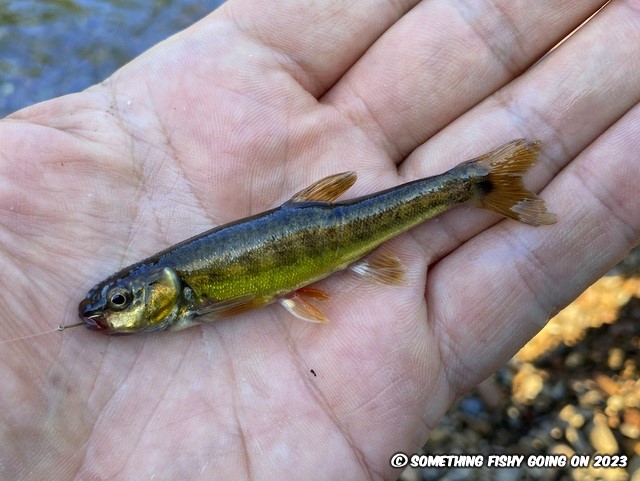
I only managed to catch five three spined stickleback. Still, it was an enjoyable little session. 

After dark the same day, I popped out again. This time armed with my headtorch to go hunt some bullhead in the rocky shallows of the Water of Leith. Catching them is ridiculously easy. Just scan your headtorch over the gaps in the rocks until you spot one on the bottom, and slowly lower a maggot down in front of their face. No need to chop a small piece of maggot off, they have relatively large mouths for a small fish! A little patience is required, because their response isn’t always instantaneous, sometimes they sit motionless ignoring the wriggling bait for a short time. Eventually though, they give in to temptation and lurch forward, greedily guzzling it down. 

Experts at hiding during the day. After dark, no so clever. 

So, micro fishing has added another three species to this year’s tally. I don’t really have a species target in mind for this year. My focus has instead been shifted towards trying to catch new species. This doesn’t mean I don’t still enjoy catching much more familiar species, even the small ones!

Tight lines, Scott.

Friday, August 18, 2023

A numbers game.

I only had one day off this week and with nine spined stickleback in mind I headed down to Dumfries and Galloway with my mate Ryan, where there are populations of this lesser known species. We arrived early in the afternoon and explored a couple of spots looking for likely stickleback holding bodies of water. Armed with my tanago rod, I fished a few pools in a small stream to begin with, but there was no sign of any fish at all in any of them, so we headed to a second spot a short drive away. This area had several marshes and ditches, but we quickly discovered that most of them were pretty inaccessible. After walking around for a while, Ryan spotted a path through some long grass that lead towards a drainage ditch and after a few minutes of trudging through some soggy ground we found a spot next to the ditch and began fishing. 

Overgrown and full of dirty water, but this drainage ditch looked ideal!

Baiting up with just the tiniest piece of maggot on my tanago hook, it took a little while for my Chianti pole float to register any interest. Eventually, the scent of my bait seemed to draw some fish in and we were soon both catching three spined stickleback, taking turns to catch them and carefully checking each one.

Only three spines. Not the stickleback I was after!

After about half an hour or so we were well into double figures of three spined stickleback, and I was just explaining to Ryan the less obvious differences between the three spined and the nine spined stickleback when I swung a fish to hand. Upon inspection, I realised had actually caught the latter! Mission accomplished! Eagerly popping the diminutive fish into my photography tank, I headed up from the ditch to take some photos in better light. 

The nine spined stickleback is a longer fish and not so deep in the body either relative to its three spined cousin. As its name suggests, it most often has nine spines. I counted ten on mine. They can have only eight though and as many as twelve. In the water in my tank was a funky little bonus aquatic insect. These tiny invertebrates are no doubt part of a stickleback’s diet.
I took another quick photo for scale before I popped it back into the ditch. Tanago hooks really are a game changer when it comes to fishing for the smallest species, and they don’t get much smaller than nine spined stickleback, they are after all the smallest freshwater species in the UK. 

Well, I was over the moon and yet another step closer to my goal of catching one hundred Scottish fish species. I think a barbel is now the only "straight forward" species I can catch in Scotland, and catching one has proved tricky so far. After that, things are going to get tough. I believe there are two species of sturgeon stocked in Drumtassie Coarse Fishery, so those are perhaps also viable targets, so I'll maybe pay that a visit soon.

Tight lines, Scott.

Saturday, July 08, 2023

The end of the rainbow?

Last month, the day before I flew out to Singapore, my luggage was all packed, so I headed out for a couple of hours to fish the Biel Water. Many years ago I caught some small rainbow trout there, escapees from a fish farm that used to sit next to the small East Lothian river. I wasn’t sure if the farm was still operational but thought I’d try my luck anyway. When I arrived, I slowly crept down to the water's edge and quickly set about freelining single maggots. I soon discovered there were lots of minnow and the odd three spined stickleback in the first pool I tried.

I've caught quite a lot of minnows this year,...
...and a fair amount of three spined stickleback too!

As I fished away, there were lots of insects hatching and a kingfisher flew upstream in a streak of electric blue. At one point a mayfly landed on my rod a couple of times. Raising my rod up towards myself, I carefully cupped my hand over it and then picked it up for closer inspection. 

I'd never seen a mayfly so close before. Insects are strange looking things!

Suddenly I realised that I was having so much fun catching lots of diminutive fish that I'd forgotten the reason for my visit! Refocussing, I headed upstream to try another pool. Almost immediately, I caught a small trout from under some overhanging tree branches, but it wasn't the species I was after.

Not the trout I was after.

I fished on for a couple of hours, catching more minnows and another two small brown trout. I didn’t catch any rainbow trout, as I've already said, I’m not even sure the fish farm is still operating and if not any escapees might be long gone. I'll just have to visit a trout fishery later in the year to catch a rainbow trout I suppose. Not my favourite places to frequent but at least there’s also the chance to catch a brook trout too while I'm there.

Tight lines, Scott.

Monday, May 29, 2023

SIBly the best?

On Tuesday last week, I headed west and met up with my mate and fellow species hunter Gordon for a day afloat in his SIB on the upper section of Loch Creran. He recently sent me a link to a diver’s photos of some interesting mini species that were taken in Loch Creran, so we thought we’d spend a day fishing tiny baits to see what might take them. 

Upper Loch Creran on a breezy, overcast day.
Our fishing platform for the day. You can also see the bladderwrack beds that make fishing from the shore with ultra light tackle very difficult. Getting your rig back through them is problematic.

Things were pretty slow to start with, mainly due to the fac that the SIB was drifting a little too fast along the northern shore of the loch, so we tied off on a large grey buoy at the eastern end of the loch to try there. We soon started getting some little taps, and I eventually caught one of the small culprits on a tiny piece of ragworm. It wasn't anything unusual sadly, but it was proof that our delicate rigs and tiny baits were working OK if nothing else.

The first fish of the day was a sand goby. 

After the sand goby was caught the bites dried up, so after a while we decided to untie the SIB from the buoy and to have a go drifting again, along the loch's southern shore this time. The water there was fairly deep relatively close to the shore and the drift was a little slower. By slowly letting out line as we drifted, we managed to leave our rigs in a stationary position and were soon catching lots of black goby.

We caught a few black goby.

After a couple of hours we'd caught a dozen black goby between us and nothing else. We were both feeling a little bit cold too by this point, so we decided to head back in and after packing up the SIB we headed off to get some hot food. Before heading home, we spend a couple of hours fishing at Kelly's Pier on Loch Etive. I was hoping to catch a painted goby for my 2023 species hunt and managed to do just that. I also caught a single black goby and a few rather rotund three spined stickleback.

A painted goby. My third goby species of the day.
A nice photo showing the black goby's elongated dorsal fin ray.
The sticklebacks were pretty chunky. What a bloater!

So, no unusual species were caught, but we did learn a little about fishing from the SIB in upper Loch Creran. If we do it again, we'll do so when the weather is nicer and there is little wind. We might also use an anchor to fish over the one area. The drifts along the southern shore did also give some ideas about potential shore fishing spots too. Perhaps fishing from the SIB isn't the best approach to take? All food for thought. So, a fairly productive day trip for formulating future trips there, and I also added a sand goby and painted goby to this year's species tally in the process!

Tight lines, Scott.

Friday, May 12, 2023

Mystery fish?

I was told recently by a workmate that there were strange fish swimming about in big shoals in the Water of Leith. He’d seen them a few times and assured me they were “Definitely not minnows! 100%!”. So, after work on Wednesday evening, I went down to the spot where he’d seen them and freelined small maggots on a size 18 hook. You’ll never guess what I caught! Dozens of minnow!

Mystery solved!
I also caught a three spined stickleback. 

I wasn’t really that surprised to be honest. I mean, what else could it have been? Anyway, it was a fun way to spend an hour, so I can’t complain about the lack of strange fish too much! 

Tight lines, Scott.

Wednesday, April 26, 2023

Let's just go anyway.

Before I went off on my recent Asian adventure, I booked a night in Glencoe Youth Hostel, so I could have a two day fishing trip to the area with my mate Ryan shortly after I got back to the UK. When I got back and checked the forecast however, it was dreadful for the two days. I could have cancelled the booking at the hostel, but we decided just to go and brave the weather.

Lots of nice scenery on the way there.

We drove up there fairly early and began fishing on an old pier on Loch Linnhe at close range into rocky, weedy ground. Small sections of ragworm and strips of squid were the baits of choice. I was hoping to repeat last year's Connemarra clingfish capture and was fishing straight down the side to begin with. It was windy, a few light showers passed by and things were very slow, but we were getting the odd little sharp rattling bite. After switching to very small hooks, I caught a rock cook wrasse and Ryan also got off the mark with a goldsinny wrasse shortly afterwards.

My first rock cook wrasse of the year.
Ryan swears by beads. He's always buying them in work. I've been known to use them occasionally, but not usually for mini species.

It went quiet again for a while when a seal appeared right in front of us, but after a while Ryan caught a couple of pollock. The wind then got stronger, so we headed off to try a different spot that I thought would offer us more shelter. 

One of Ryan's pollock.

The second spot, whilst certainly more comfortable, didn't produce anything at all, so after about an hour we moved to a third. Only one fish was caught there, so we headed back to the car and drove south to fish in Loch Creran from a pontoon near some moored yachts.

Mark number three produced my first long spined sea scorpion of the year.

The fishing at the pontoon was dreadful as well, with neither of us catching anything. The rain had started again at this point, and truth be told we were both a bit fed up, so we decided to get some food and alcoholic beverages and head to the hostel to check in, warm ourselves up and chill out for the remainder of the evening.

On the second day, we headed to a mark in Oban, but there were no fish there whatsoever. It's a mark that's normally like an aquarium, so given it was devoid of life, we didn't hang about. Pretty frustrated, we cut our losses and head home but decided to visit Kelly's Pier on Loch Etive, where we were rewarded with a bit of a soaking. At least whilst there, I managed to catch a couple of species in the shape of some three spined sticklebacks and two spotted goby. Tanago hooks proving to be deadly for targeting micro species yet again.

Another species ticked off for my 2023 species hunt.
A great photo showing the electric blue scales on a two spotted goby

So the trip had probably panned out exactly the way I had expected it too. Poorly! Maybe just over a dozen fish between us in less than favourable conditions. All in all, not a total disaster though, as I'd still managed to add four species to my 2023 tally. That's what happens when you book a trip away at this time of year, too far in advance. Sometimes, Scottish weather throws a spanner in the works. 

Tight lines, Scott.