Last Sunday morning the third leg of my south coast fishathon began at 02:30 when my alarm went off. After getting ready and driving along the coast I met up with dedicated local bass angler, Bill Fagg and his adorable, very clean and well behaved but soon to be adorable, very filthy and quite naughty dog Poppy at 04:00. We headed along the rugged Jurassic Coast and Bill told me about some of the history of the area. As we walked along and day broke, and it was a beautiful sunny one, perhaps too beautifully sunny for me to be wearing waders, I became very aware of the jagged cliffs towering above us. The hills might have eyes but these cliffs definitely have teeth and sharp dangerous ones at that.
 |
| These cliffs are constantly crumbling. Like a huge long set of hour glasses small pieces are constantly trickling down forming heaped piles at the base of the cliffs. Every now and then a bigger collapse occurs. My fingers were crossed that I wouldn't be standing under such an event! |
After about an hour of walking along the coast we reached the first spot and started fishing. Bill is a big fan of Slug-Gills, a home made hybrid of a Slug-Go and a Red Gill and I soon had one tied on and we began walking along the shingle, casting out and retrieving the weedless lures as we went. No sign of any fish after working the first area so we moved further along the coast. Poppy wasted no time getting quite filthy as we went. Rolling around in huge mounds of maggot filled rotting seaweed and a host of other foul smelling stuff she found lying around.
 |
| Poppy smells some rancid rotting kelp and gets stuck in. |
 |
| Bass and mullet gorge themselves on these kelp fly maggots on large spring tides. A fact Bill uses to locate and catch bass. The smell was quite disgusting especially on such a hot day. |
As we went along the shore Bill kept ahead of me and at one point had walked a fair bit along the beach
from me when I noticed his rod suddenly bend over and he soon landed a fish. Shortly afterwards and still a bit further along the
shoreline from me he landed a second. This looked promising I thought,
perhaps my first bass of 2013 would soon grab my Slug-Gill and be landed on the shingle shortly afterwards. I had a
few casts at the spots Bill had caught his fish but I couldn't repeat his success. We kept working our way along the coast and by this point I had
lost confidence in the Slug-Gill, or should I say my ability to use it, and started trying a few of my own
lures. This made no difference at all however and I noticed Bill had started
coming back towards me. When he reached me I asked him if he'd caught anymore fish and he told me it was just the two that I'd seen him catch. We started heading back along the coast towards our starting point fishing as we went. I decided to try a Keitch Easy Shiner on a weedless jighead and began casting it out and slowly bouncing it
along the bottom back to me. Finally I had a few taps but they didn't
feel like those of a regular bass. I cast out again to the same area and had a
few more taps before hooking a fish that wasn't very big and I
quickly landed it. My first bass of the day looked rather strange I must admit.
 |
| My first Dorset bass was a "dark brown and orange with light green spots bass". |
I returned the fish, caught up with Bill and told him the news. Despite catching such a beautiful fish I was still keen to catch a regular bass so we carried on fishing and soon reached a spot we had covered earlier in the day. It was now approaching
midday and the heat had become rather unbearable in my non-breathable waders.
Poppy was obviously feeling the heat too and when we reached a long stretch of shingle she had a well deserved rest from rolling in foul smelling stuff.
 |
| Bill suspected that the large brown stain was some fox excrement. Lovely. |
Bill and I carried on
fishing, working our way along the shingle fishing over a shallow reef that had a few small boulders strewn across it. No doubt they were once part of the cliffs behind us. A sobering thought which made me take a few steps forward. As I continued to fish the area I caught another three rather odd Dorset bass.
 |
| The rare "chocolate and lime bass" is unique to Dorset too. |
 |
| Poppy comes over and sniffs my catch to see if it's something she can roll on before it is set free. |
I laughed out loud and told Bill how it was funny that I had travelled all the way to Dorset to catch a bass and I'd managed to catch four of these very special Dorset bass instead but that at least he had managed to catch two regular bass so there are some around so maybe there was still a chance I could get one too. It was at this point that Bill broke it to me that the two bass he had caught earlier were also special bass!
 |
| Bill's Dorset "dark green bass". |
 |
| This chunky Dorset "mottled brown and green bass" fell for Bill's Slug-Gill. |
We then start heading back towards the cars still fishing as we went. Spotting a few fish swirling over gullies on the way we had a cast or two in their direction but got
no response which meant they were probably mullet.
 |
| Bill, Poppy and some mullet. |
By this point the sun was shining intensely and I was slowly being cooked in my waders. Resigned to the fact that I'd have to wait to get my first regular bass of 2013 we called it a day and headed back to the car park. On the way Poppy misjudged the depth of a rockpool and ended up getting a bit of a bath which was quite funny. Bill told me that was the first time he'd seen her swimming. I thought it was probably a good way for some of those stains to get loosened up and would perhaps make Bill's job easier when he got home to get Poppy back into a reasonable state! It was a real pleasure meeting Bill and Poppy and whilst it was
disappointing not to get a regular bass it was still an enjoyable session.
As a species hunter I don't think I could spend all my time targeting one fish in particular but who knows that may change in the future and I must say that I really admire Bill's dedication to fishing for bass on what he calls "his patch". He told me that last year he fished every Sunday without fail, even in horrible weather and often blanked as a result but he still clearly loves getting out there walking along enjoying the coastline and fishing. He takes the rough with the smooth and has been rewarded
recently with some cracking fish.
 |
| Bill with a large bass (or Dorset silver wrasse). One he caught earlier this year. When I wasn't around. |
By now my juices were running clear so I thanked Bill and Poppy for
taking me out, said goodbye, scurried off into the toilet block at the
car park and got out of my waders, dried off a bit, put on sensible
clothes for the hot weather and drove back to Weymouth.
When I got back to the B&B I was absolutely shattered. The first half of my trip had obviously caught up with me and the early start that day, all the walking I'd done and with the sun having taken its toll, I had a shower and went to bed at about 5pm. I must have needed a good rest because I pretty much slept right through until about 7am on Monday morning! Feeling energised and ready to go fishing again, after having a hearty full English breakfast, I drove east along the coast to Swanage to fish from the pier.
 |
| Swanage Pier on a sunny day. |
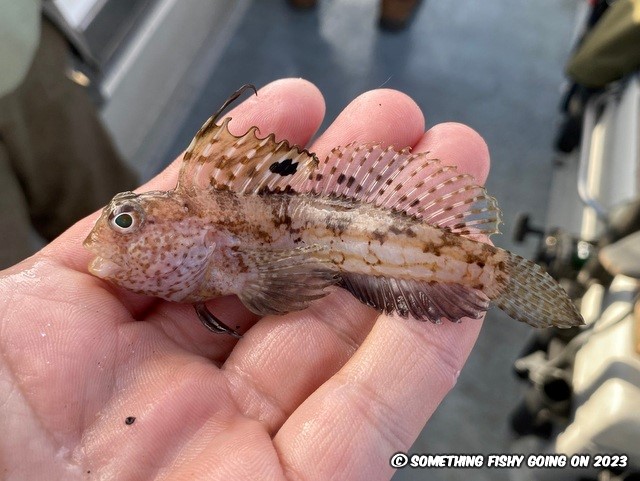
The target here was a black faced blenny, a species most anglers have probably never heard of. A fish found in the Mediterranean and here are at the most northerly point in their range they have in the past been spotted by divers under the pier. I went armed with an ultralight rod and fished a mini one up one down rig. Using small pieces of ragworm and Gulp! Sandworm sections I was soon into several small corkwing and ballan wrasse and a few tompot blennies.
 |
| The open section in the middle of the lower deck seemed like a good place to start and the upper deck overhead provided me with welcome shelter from the sun. |
 |
| Nice little corkwing wrasse. |
Then I caught a small wrasse that I initially thought was another corkwing but upon closer inspection I realised it to be a small Baillon's
wrasse a new species for me! I was so excited by this surprise catch I forgot the reason for
my visit for the next hour or so as I happily fished away with a
huge grin on my face, catching a few more Baillon's wrasse in the process.
 |
This little Baillon's wrasse was a very welcome bonus capture.
New species # 2 and addition #8 to my 2013 species tally. |
Then I remembered what I was there to catch and decided to try another
spot and ventured out into the sun for an hour or so. The result was the same however, with a steady stream of the small
wrasse and tompot blennies grabbing my natural and synthetic offerings. Moving back to the lower deck and trying another section of the open centre this continued all afternoon. A quartet of pollock, a solitary goldsinny
wrasse and a weed covered spider crab broke this pattern up every now and then and despite the frantic
action that saw me land over one hundred fish, the pier wardens
appearance at five to six to say the pier was about to be locked up
signalled the end of the session and I had not caught the little exotic fish I had come for.
 |
| Another Baillon's wrasse. Lovely looking wrasse with quite unique markings. |
 |
| Lots of tompot blennies under the pier too. Another species I really love. |
 |
| I caught over fifty ballan wrasse. This one was the nicest I think. In perfect condition with stunning markings on that huge tail. |
 |
| This goldsinny wrasse was the only one I caught which was a bit odd really as they normally live in shoals. |
 |
| Spider crabs are very strange even for a crab. |
Talking to the pier warden as I left he told me that the spot I had been fishing in when he came down to announce the pier was closing was not too far from where the black faced blennies had been sighted this year. I kicked myself for not thinking of speaking to him when I had arrived! I guess I'll have to head back there again for another go. A bit annoyed with myself but still happy to have caught a new species I had my photo taken before I headed back to Weymouth to sort out my gear for my first boat trip of two the following day.
 |
| Baillon's wrasse, ballan wrasse, corkwing wrasse, goldsinny wrasse, pollock, tompot blennies and black faced blennies? |
Tuesday morning I was up early again and headed along to Weymouth Angling Centre for 06:30 to pick up my bait. I arrived at the pick up point where the boat was tied up and boarded the boat with nine other anglers.
 |
| The good ship Flamer IV skippered by Colin Penny. |
First off we headed to one of the entrances to Portland Harbour to try for mackerel to use as bait. It quickly became apparent after a few drifts that there weren't many around and only a few were caught. More pollock were caught actually and I caught one of those and no mackerel. As everyone had brought frozen mackerel this wasn't a major problem though and we were soon drifting over large mussel beds fishing for plaice. I went for a single hook trace with lots of black and green beads and a silver spoon baited up with a few ragworm and tipped off with a strip of squid. It was hard trying to feel for bites with my lead constantly rattling along the mussels. A few of the other anglers caught plaice before I felt what I thought was a bite and lowered my rod tip to allow the fish to swallow the bait to ensure a good hook hold before striking. When I did strike I felt the weight of a fish that put a reasonable bend in my 12/20lb class rod but soon had it reeled up to the surface. Skipper Colin soon had it in the net.
 |
| Slightly bigger than the one I caught from Sutton Harbour Marina in Plymouth! |
As we drifted over the mussel beds most of the anglers on board caught plaice. Some other species were caught too. I caught a lesser spotted dogfish and a small pouting which was addition #8 to my 2013 species tally but I returned it straight away and didn't take a photo of it. A few black bream were caught too and I had my fingers crossed I'd get one too at some point during the trip or on the boat the following day as it would be a new species for me. After a few hours Colin announced we were heading off to to target turbot and brill. A change to 20/30lb class gear and a very simple rig consisting of a sliding lead clip with a 5ft flowing 30lb trace with a 4/0 Sakuma Manta on the end and a strip of mackerel on for bait. We were soon drifting over some huge shingle banks and after a short period the first turbot was caught. A few more soon followed before I felt a couple of bites and let out a little line before striking. A good fish on the end, again skipper Colin was ready with the net and when my fish broke the surface I was briefly disappointed to see it wasn't a turbot but was soon happy enough when it was identified as a small eyed ray as it was my first ever.
 |
This lovely small eyed ray was definitely a most welcome bonus capture.
New species #3 of the trip and addition #9 to my 2013 species tally. |
Shortly afterwards I felt a good bite and let out some line again before striking into a fish, this one felt much smaller and before long came up from the depths into sight and I was very pleased to see it was my first ever turbot. Taking no chances Colin netted the fish for me.
 |
My first ever turbot. Small by turbot standards but I didn't care. Such a beautiful fish. Such a big mouth!
New species #4 of the trip and addition #10 to my 2013 species tally. |
A short while later Colin announced that we were heading to a spot that often threw up the odd brill. Hooks baited up and 10oz leads soon heading towards the sea floor again I knew there was a slim chance of catching a brill but two were caught, both by the same angler, before Colin declared that we were heading back to port. It had been a great trip out on Flamer IV targeting flat fish with Colin demonstrating throughout the day why he is a top skipper. The following day I was hoping his skills would help me catch some more new species as I had chartered his boat for a days species hunting. When we got back to port many of the anglers on board offered me their left over ragworm which was gratefully accepted before I headed back to the B&B to tie up a few rigs for the following day. Once back though it soon became apparent that I didn't have enough components for making as many rigs as I perhaps needed so I decided to make up rigs that I thought were likely to be lost and would supplement these with ready made rigs in the morning from the Weymouth Angling Centre.
In the morning I headed to the shop and stocked up on mainly Sabikis as well as a few other ready made rigs before heading to pick up point. I boarded the boat and the rest of the lads were already there. Fellow keen species hunter Malcolm Ruff whom I had fished with the week before in Plymouth and had very kindly brought bait for both him and myself, Steve Clements who has fished for England and Alan, one of the anglers who had been on the flat fish trip the day before and wanted to come along. With just four of us on board it would make for a comfortable days fishing and as I was surrounded by very experienced boat anglers I knew I could learn a few things from them throughout the day and they could no doubt help me catch a few fish. First off again we tried to catch a few mackerel to use as fresh bait but again there weren't many around with only a few being caught as well as some small pollock. We then fished close in to Portland Harbour breakwaters and in the entrances. Fishing baited mini species rigs, in my case half a set of sabikis, on 6/12lb class gear we were soon catching lots of small wrasse and some odd looking gobies that didn't quite look like any of the species found in the UK. Malcolm and I popped some of them in a large bucket of water so we could examine them when we got a chance. After I caught a few small ballans and a few goldsinny wrasse the other guys started catching cuckoo wrasse and then I caught some too. A few black bream were also caught but despite my best efforts I couldn't seem to catch one.
 |
| Mystery gobies. Were they a new species for me? They had many features of a black goby the main difference being their lighter colouration. I'm not sure yet so I haven't included them as a new species or as an addition to my 2013 tally. I took loads of detailed pictures and hope to get a positive ID soon.* |
 |
| A nice male cuckoo wrasse for Steve. |
 |
I had three females in total. This female cuckoo wrasse looks like it's just started changing sex. You can see the markings on its back are fading and the male bright colours are beginning to develop around its head in particular.
Addition # 11 to my 2013 species tally. |
We then headed to one of Colin's red band fish marks. This was the species that I most wanted to catch on the day so I was worried when Colin said he was concerned that the wind would make the drifts too fast for us to fish the muddy bottom effectively and that we may have to try a less productive backup mark but I needn't have worried. After no time at all Steve was first to catch one and quickly followed it up with a few more showing that Colin had put us onto the right spot yet again. He was using a dedicated rig however that over time he had discovered was very effective. I was beginning to worry that my cut down three hook sabiki rig wasn't quite going to cut it and was considering asking Steve if he had a spare one of his when I felt a few plucks and paused for a moment before gently lifting into a fish. Colin told me to reel up very slowly as red band fish have delicate mouths so following his advice I took my time. Colin had the net ready just to be safe and before too long the most bizarre fish I have ever caught was unhooked and wriggling in my hands.
 |
I can't tell you just how weird these fish are! They have to be seen to be believed really so you'll have to go out fishing with Colin on Flamer IV to find out!
New species #5 and addition #12 to my 2013 species tally. |
 |
| A very large cavernous mouth in realtion to its size and filled with odd looking little teeth. |
Malcolm and Alan were both keen to catch one too so we did a few more drifts. Steve was clearly a master and pulled out a few more and I managed a further two before Malcolm caught one too after being wound up by Steve. One last drift to see if Alan could get one but sadly he didn't manage it so off we went to another spot to try for another species I really wanted to catch, a butterfly blenny. Unfortunately though none were caught and after a short time with little action Colin was fairly quick to suggest a move to another spot. This time we went a fair bit out to sea to try for tope and ray species at anchor. As well as fishing a single large bait on the bottom we also fished for bream using lighter gear. Steve told me that bream like yellow beads and while I was busy messing about putting them onto my rig Malcolm shouted over to say I had a bite on my other rod. I took too long to react though and Malcolm lifted the rod and struck into the fish but when I took the rod from him after a few turns of the handle there was nothing on it. Lesson learnt I abandoned the light rod and stayed next to my big bait rod. This would see me catch a couple of lesser spotted dogfish. Steve meanwhile was catching a string of rays as well as fishing a lighter rod and catching bream. This prompted me to wind up my large bait and try with my lighter gear for a while. Colin soon spotted I was only fishing one rod and wasn't best pleased as he was keen to see me land a bigger fish, hopefully a tope which would be a new species for me. Setting up my trace with a second pennel hook Colin quickly showed me one of his preferred ways to hook up a squid and mackerel cocktail and this was soon on the sea floor to hopefully tempt a shark which it did rather quickly in the form of a small thornback ray.
 |
| A nice little thornback ray. How cute. |
Soon rebaited in the way Colin had showed me, another squid and mackerel cocktail was soon on the bottom to tempt a big fish. It was down for a while and whilst I was trying to watch that rod as well as feel for bites on the rod in my hand Colin, who was stood next to me saw a bite and lifted the other rod and struck into the fish for me quickly handing me the rod and taking the other one out of my hands. The fish on the end felt decent but as I've had a tope hooked before, when the fish didn't start running I knew it was something else and given the dead weight nature of the fight my money was on a ray. Colin's guess was an undulate ray and he was correct.
 |
| As a paying customer I'll happily take the credit but basically I just reeled this fish up for the skipper. Thanks Colin! |
 |
I love the patterns on undulate rays. They are lovely sharks.
Addition #13 to my 2013 species tally. |
After a while we headed back towards dry land stopping on the way at a spot where I could try for gurnards and bream. Malcolm caught a small tub gurnard and Alan had a red gurnard. Both of which would have been a new species for me had I caught one but I didn't and after another dogfish it was soon time to head back to port. I thanked the lads for a great days fishing and Colin for being a great skipper before saying goodbye and heading back to my car. I was soon on the road again, driving further east along to East Sussex and inland away from the sea as well. Having spent the last eight days fishing for saltwater species I planned on spending the last couple of days of my south coast fishathon winding down enjoying a spot of coarse fishing.
Tight lines, Scott.
*Subsequent careful examination of the photos and counting fin rays and lateral line scales led me to believe that the gobies I caught were simply lightly coloured black gobies, perhaps females. Studying the head canal pore and sensory papillae pattern, which are unique to each species of goby, also supports this conclusion.