Monday, May 19, 2014

Species hunting adventures on Lanzarote : Part 1.

Last Monday I set off with my partner Lillian and my sister Sharon for a one week holiday to the Canary Island of Lanzarote. Whilst it was a family holiday I did of course pack some fishing tackle. Two sets of gear went in the case, my Graphiteleader Compatto Finezza and Daiwa Caldia 2500 loaded up with #0.4 PE Sunline Small Game for ultra light fun and my Graphiteleader Compatto Argento and Daiwa Caldia 3000 loaded up with 10lb Power Pro for targeting larger species with metals and hard plastics. Whilst my sessions would mostly be short early morning and evening ones I set myself a target of catching twenty five species including ten new ones whilst on the island.

We arrived in Lanzarote at about half past five in the evening and picked up our hire car. Sharon drove us to Puerto Del Carmen where we'd be staying. We quickly got the cases unpacked and before the sun set we decided to have a stroll. I had already sussed out where the nearest pier to our apartment was on Google Maps so I grabbed my ultra light gear and off we went towards the crystal clear waters of the Eastern Atlantic. Soon at the waters edge the girls left me to it, going for a walk along the shoreline whilst I stayed on the pier and fished for an hour or so. I started with a drop shot rig with a #10 hook baited up with half a Gulp! Angleworm. I could see fish which I recognised as Canary damselfish and other light yellow fishes with dark tail markings which turned out to be Azores chromis. They didn't hang about and started biting straight away. With small toothy mouths the bites though plentiful were hard to connect with and they quickly destroyed my lures but I had plenty with me and soon caught a few of both species of damselfish and then an ornate wrasse.

My first fish of the trip and my first new species. An Azores chromis.
My second new species of the trip. Canary damselfish have beautiful iridescent purple markings on them.
An ornate wrasse. I caught lots of these on Crete last year. They are super aggressive.

By the time the girls returned I had added a few more damselfish and a couple of small scorpionfish to my tally before the light went and the action slowed right down. I headed back to the apartment quite pleased with a fairly productive start to the trip including two new species.

I got up early on Tuesday morning and headed down to the same spot for sunrise.

This small pier next to Pila de La Barrilla beach was only ten minutes from our apartment.

Fishing Gulp! really is as close as you can get to fishing with bait so I decided to fish it under a float. This proved very effective and I soon caught a few damselfish. Then I got a pleasant surprise when I caught one of my "Most Wanted" targets for the trip, a Macaronesian sharpnose puffer.

What a cool little fish with lovely blue spots all over its flanks. It didn't puff itself up but it was still very neat.

I carried on with the float for a while longer and caught some more damselfish and a few ornate wrasse. I then decided to switch to a small paddletail lure on a jig head to see what was around near the bottom further out. Flicking it out I let it sink before slowly retrieving it close to the bottom, lifting the rod when I felt it hit rocks on the sea floor. I felt a few small taps but didn't connect with anything and upon retrieving the lure I found the tail had been nipped off.

Ecogear Grass Minnows have a nice action. When they are whole!

I replaced the lure and cast out. Once again I felt a few taps and it came back tailless. No doubt the razor sharp teeth of the multitudes of small aggressive fish were responsible. Rather than quickly deplete my supply I decided to switch to the trusty drop shot rig. A paddletail with no paddletail has lost its fish attracting action and at least if the fish take chunks out of my Gulp Angleworm I can still fish it I reasoned. Casting out and letting it hit bottom I held the rod feeling for bites. Nothing. I lifted the rod and moved the lead back towards me a bit and waited again. Then I felt a good solid take and reeled in to find a small Atlantic lizardfish on the end.

The Atlantic lizardfish is an ambush predator. I'd find out just how vicious they could be later in the holiday.

Casting back out again I got the lead about half way back when I felt another positive bite and this time it was another sand dwelling predator, a greater weever.

It was a rather feisty one and kept thrashing about so I carefully unhooked it with my forceps without touching it and used them to put it back as well. Better safe than sorry and in agonising pain heading to hospital.

I carried on fishing and after a few more damselfish and a few ornate wrasse I hooked another small fish and got it partially in when I felt slightly more resistance. Strange. Had something else grabbed my fish? No, it was different species of puffer, and it had puffed itself up on the way in. Putting it back, it floated for a minute or two before expelling the water and swimming off. On the very next cast I caught a second specimen of the same species, but it remained deflated.

At the time adding a second puffer species to my tally was a nice surprise, but I had no idea which species they were.
A bit of Googling later, and I identified them as Guinean puffers.

Very happy to have added four species to my trip tally including another two new ones I realised that the tide had receded exposing some rockpools at the end of the pier and also enabling access to a small rocky outcrop there too. As I wandered over I immediately spotted lots of gobies in the rockpools. Moving my drop shot weight up to just below my hook I lowered small pieces of Gulp down in front of some bigger specimens and quickly caught three of them.

Initially I thought these may be giant gobies but I was pretty sure their range didn't extend as far down as the Canary Islands. They also had subtle light blue spotting across them that doesn't show up very well in this photo. Again a bit of research back at the apartment revealed them to be Madeira gobies.

Then as I moved from pool to pool and climbed around the rocks I spotted some blennies poking their heads out from under a rock in a fairly large rock pool. Dropping my small lure in front of them they were a bit less gung-ho than the gobies but I soon tempted one out and hooked it. Another new species for me it was a fairly bland brown and olive green colour with a few discrete light blue markings around its eyes. It was surprisingly well behaved and was much less aggressive than some other blenny species. It didn't even try to bite me once which was mildly disappointing but I love blennies so was still happy to catch it.

Again I knew this was a new species but had to do some searching online later to identify this as a rockpool blenny.

So in two short sessions I had caught ten species including six new ones. With a drive up the coast to visit a few tourist attractions planned for the morning and early afternoon I headed back up to the apartment to find out if the girls were up and ready to go at about half past nine fairly pleased with how things were going.

Sunday, May 11, 2014

There's more than one way to skin a flounder.

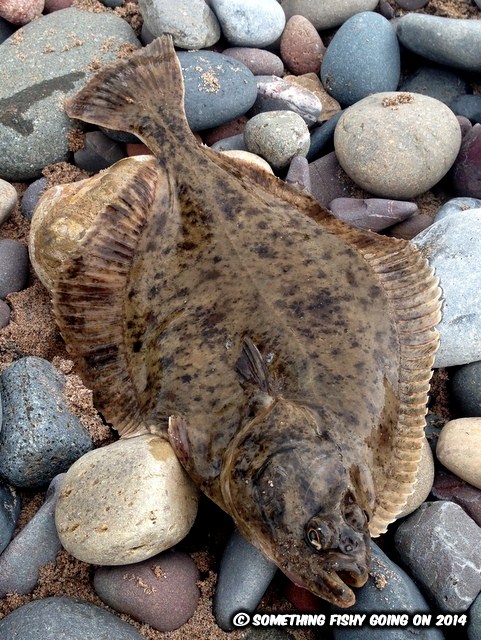
I met up with my mate Nick last Sunday for a session targeting flounder from Thorntonloch Beach. He warned me beforehand that he might be a bit hungover and sure enough when I rang him to say I was down at Dunbar Harbour at the prearranged time he had just woken up. Not a problem as I had some ultra light tackle with me and had a quick fish at "flattie corner" while he got ready. There were plenty of small flatfish around and it was good fun watching them chase my lure as I slowly worked it along the bottom. Before long one of them was hooked and was quickly hoisted up to my hand and unhooked. It was a flounder but was quite unusual in that instead of a white underside it was exactly the same colour underneath as its back. Quite odd and perhaps the result of a genetic mutation if I had to guess. Unfortunately when I tried to photograph its anomalous belly the flounder took the chance to flip out of my hand, straight over the edge of the harbour wall and down into the water below before quickly shooting off down to the bottom.

The all brown flounder. You'll just have to take my word for it!

Before long Nick arrived and we headed off to dig some blow lug to use as bait. This didn't take long at all and we soon had enough for the session to go with the mackerel, black lug and squid we already had. Back on the road we headed further down the coast and parked up before walking along the beach. As we walked along we soon found a spot with some nice looking fish holding features that the tide would soon cover. We both opted to fish using a different approach. Nick fished a more traditional setup with two light beachcasters with multiple hook rigs. I meanwhile had only brought a light rod and planned to fish a single bait on a running ledger. Nick was also giving circle hooks a go and while I stood holding my rod upon retrieving his first two casts both rigs produced a double shot of flounders. With no obvious bites shown on either of his rods though the fish had taken the hooks into their mouths and were not lip hooked. Luckily I had a set of forceps with me and we managed to unhook them all. I thought the length of his snoods might be the cause and suggested Nick shorten them to help the circles work and improve bite detection. It went quiet for a while and as the tide flooded we moved back up the beach.  A couple more flounder were caught by Nick taking his tally to six and after changing his bait presentation slightly so that the circle hook was at the top of the bait the last one was nicely hooked. 

At the time its light colouration reminded me of the honeycomb centre of a Crunchie bar. Maybe I was hungry?

I meanwhile hadn't had so much as a bite and due to not getting a lot of sleep the previous couple of nights I started feeling rather tired. So much so that I stopped fishing and had a lie down further up the beach. You would have been forgiven for thinking I was the one suffering from a hangover! It was quite a relaxing spot and the sun even put in an appearance briefly. With no more bites coming for Nick and with both of us feeling a bit drained we decided to call it a day just before high water. As I had hardly anything to pack up I messed about balancing stones on top of each other whilst Nick sorted his gear.

So many different types of stone on the beach but there's nothing fishy going on here. No adhesives were used, just a steady hand.

Well my choice of approach had failed miserably. In fishing, when it comes to tactics, there's usually more than one way to skin a cat, or in this instance a flounder, but on the day I guess I chose the wrong one. I really prefer using a light rod held in hand so when a flounder is hooked they can show their fighting qualities but I guess it also reduces my chances of catching them and getting the right balance can be tricky. Food for thought for future beach flounder sessions.

Tight lines, Scott.

Thursday, May 08, 2014

Getting warmer.

The other day I had a bit of an urge to catch some blennies so I jumped in the car and headed down to blenny Mecca, Torness Power Station outflow, with what was left of my box of ragworm from Tuesday afternoon's session at Greenock. When I got there the tide was on its way in and had just started to flood into the boulders that make up the sea defences to the right of the outflow. This is normally the best spot to explore but to my surprise there didn't seem to be many blennies around. It was hard work finding them but eventually I caught one or two and was quite happy.

A small luke warm blenny.

As more and more warm water from the outflow flooded into the gaps between the boulders though more and more blennies began appearing and it got to the point where I could see them all sitting on the submerged rock faces of the boulders. They were eagerly fighting over my small ragworm chunk as soon as it went in. This was great fun to watch and I had soon caught over thirty of the funky little fish. It's amazing what a few degrees rise in water temperature can do to fish feeding behaviour and the fish were noticeably warmer too. 

A larger and almost par boiled blenny.

Just as my bait supply began to dwindle out of nowhere a small eel appeared. The colour of its long fins made me think it was a tiny conger eel but despite it hanging around in the same gap between the boulders for five minutes or so I could not catch it to confirm this despite it having a few slashes at my bait. Rather annoyingly the gathered hordes of ravenous blennies beat it to my hook every time and soon I had run out of ragworm. Oh well, I had satisfied my need to be bitten numerous times by blennies and while a bonus bootlace conger eel would have been a nice treat it was still pretty cool to see one and I headed home quite content. 

Tight lines, Scott.

Bits and bobs.

I'm rather excited at the moment because I'm off to Lanzarote next Monday. As anticipation builds I  have been sorting out my tackle so I can do a little bit of fishing whilst there. Noting I was low on a few bits and bobs I'd already sorted out a load of drop shot weights and treated myself to some new #0.4 PE braid. With a small list of items still required I drove through to the Glasgow Angling Centre on Tuesday to pick them up. I also thought whilst through there I would head a bit further west to the Clyde Estuary and see if I could catch some goldsinny wrasse so I put some ultra light gear in the car. The shopping was quickly done and I exited the superstore before any potentially expensive impulses got the better of me and my bank balance. Armed with some ragworm I headed along the motorway and was soon at the small marina opposite Morrison's in Greenock. Setting up a very simple one up rig with a #10 wormer hook I was soon getting bites close in and landed a couple of small pollock.

Tempted from the weeds close in by a chunk of ragworm.

Being overcast and a bit windy I was concerned that the conditions weren't ideal for wrasse to be active but I was soon proven wrong when I began to feel the rather distinctive sharp taps of a wrasse and quickly hooked the fish responsible, a small dark brown goldsinny.

Mission accomplished. My first wrasse of 2014. Looking forward to a few exotic ones next week hopefully!

One of my goals this year is the improve my fish handling, particularly in saltwater. To work towards this objective I've bought  myself a 4m long telescopic landing net handle and a rubberised net that I can use around harbours and on rock marks. As I caught the fish I had the net propped over the railing in front of me and unhooked the fish over it before using it to return the fish rather than drop them from my elevated position. I fished on for a couple of hours and caught a second goldsinny wrasse, a few more pollock and then had to use the net to land a nice little codling which I probably would have struggled to land without it.

My net came in handy for this handsome chap.

I was obviously quite pleased with the way the session went and was very happy to catch my first wrasse of the year. Using the net as an unhooking aid meant the fish were safe if I dropped them and returning the fish using the net worked very well too. If these practices minimise the risk of unnecessary injury and improve the chances of a successful release then they can only be a good thing so I'll be using the net whenever appropriate in the future.

Tight lines, Scott.

Friday, May 02, 2014

Most Wanted : True Crucian.

It seems true crucian are becoming rarer and rarer these days with the parentage of some "crucian" that are caught being subject to doubt. This is due to the fact that they breed quite easily with other cyprinids producing hybrids. This will happen wherever crucians are found along side other carp species and most commercial fisheries aren't too fussy about this. For match purposes bag weights are all that matters and the sometimes questionable genetics of the fish being caught isn't of concern to the anglers competitively filling their keep nets. To muddy the waters further, brown goldfish and F1 carp can sometimes be mistaken for crucian. All of this makes finding photographs of a true crucian a bit tricky so rather than take the risk of including a picture of anything less than a 100% pure crucian I've decided to use a wonderful old drawing to illustrate an example of the species.

The crucian. A rather handsome fish I'm sure you'd agree.

With a few questionable pretenders swimming around how can an angler be sure his crucian is indeed a crucian without going to the length of having DNA testing carried out on a sample scale? Crucian's shape and colour can vary but there are a few key identifying features that can be looked for. They have no barbules. The dorsal fin is large and convex. The caudal fin is almost straight edged when extended vertically. Scale counts can be performed. I guess most pleasure anglers would be happy to call it a crucian if it looked like one but knowing for sure matters to us species hunters, well it does to this one anyway!

To make things easy for fussy folk like myself there are a few carp free fisheries who pride themselves in the purity of their crucian stock and go to great lengths to protect it. To help ensure I catch a bonafide crucian I've decided to pay a visit later this year to one such fishery, Marsh Farm in Surrey. Considered by many as specimen crucian mecca, I'd be happy to catch one of any size!

Tight lines, Scott.