Showing posts with label Rock Cook Wrasse. Show all posts

Thursday, September 19, 2024

Returning the favour.

Now and then, a fellow angler who has found this blog, or my Instagram account, gets in touch looking for more detailed information on some of the fishing spots I post about or to ask me where I would recommend they go to catch a certain species. I’ve been helped many times over the years by other anglers who have been very generous with their advice and knowledge, so I like to do the same whenever I can. Species hunter Ben contacted me last year about haddock fishing off the north coast of Scotland, and we’ve kept in touch ever since. When he told me he and a friend were coming up to Scotland from Pembrokeshire for a few days and had based some of their mark choices on my blog posts, I decided to go and meet up with them. The weather was pretty terrible while he was up here with his friend Nev, but their final day trip to Lochaline saw a slight improvement in the conditions and I got up early to make the long drive up there to fish with them. Four hours later, I arrived at the first spot. 

Logs on the logging pier in Lochaline. I found two species hunters fishing behind them in the corner. 

When I joined them, they were each had a mackerel bait out in the incredibly deep water directly in front of the pier and were fishing for mini species down the side of the pier with ragworm baited sabiki rigs while they waited for bites on their heavier gear. Both of them are taking part in species hunting competitions and were up in Scotland hoping to add to their already very impressive totals. Ben’s main target for the session was a spurdog, whilst Nev was hoping to catch a leopard spotted goby. I fished small pieces of ragworm down the side of the pier, keen to catch a quintet of UK wrasse species. I managed four of the five quite quickly, but a cuckoo wrasse proved elusive, and I didn’t catch one until later on in the day, completing the set. 

With their lovely pastel shades markings, rock cook or small mouthed wrasse were present in large numbers.
I caught lots of them in Norway recently, but this was my first Scottish cuckoo wrasse of the year.
My four hundred and fifty seventh* goldsinny wrasse of the year! *Estimated, but it feels like I've caught that many. This particular specimen had lovely golden markings on it.

While I was fishing away, chatting to Ben and Nev about fishing, species hunting and various fish species we’d all caught over the years, they both added a couple of species to their competition tallies. Ben caught a coalfish and shortly afterwards a small spurdog, and Nev caught a Connemara clingfish followed later on by a leopard spotted goby. Later in the afternoon we decided to change venue and headed around to the stone pier near the ferry terminal in the village. From this spot, Nev wanted to target a couple of small goby species and Ben was keen to try for a sea trout. Whilst Ben fished metals, Nev and I baited tanago hooks with tiny pieces of ragworm and caught a few painted goby and two spotted goby with relative ease. 
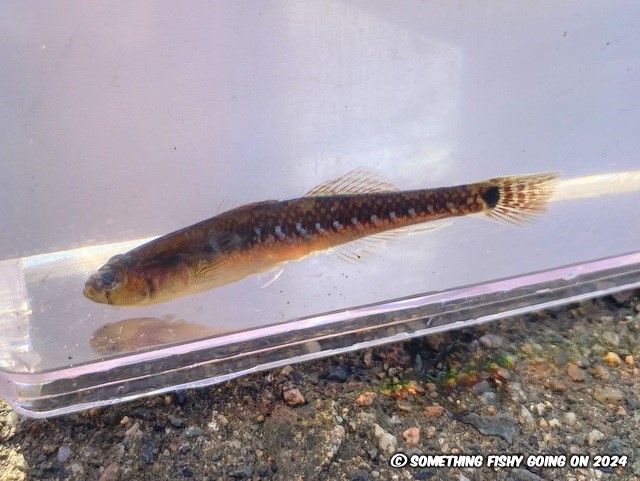
I’m not taking part in any species hunting competitions, but it was still nice to get another species ticked off for 2024 with this two spotted goby.

Having quickly caught our two target goby species, we headed further north up the shoreline, passing Europe’s only underground sand mining facility, to reach the village’s small marina. Nev and I targeted tiny fish with tanago hooks whilst Ben continued casting metals around hoping to tempt a sea trout. 

Ben fishes from the marina pontoons with small metals, hoping to catch a sea trout.

It didn’t take any of us long to catch fish. Nev and I very quickly pulled out several sand goby, whilst Ben began to supply some of the marina’s boat owners with freshly caught mackerel. 

One of several sand goby that we caught. 

Nev was over the moon to catch a sand goby as it was another addition to his competition tally. We carried on searching the sandy bottom and caught a few more species. There were lots of tiny poor cod around, and I also caught a couple of tiny grey gurnard.  
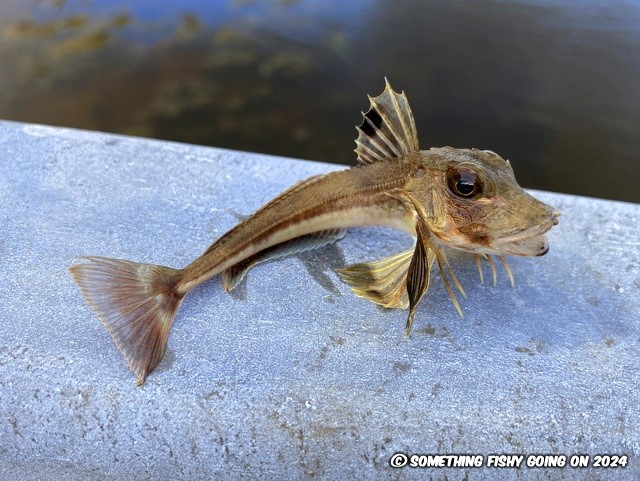
Perfection in miniature and incredibly adorable into the bargain!

The last time I visited this spot I thought I saw one of the UK’s two smaller clingfish species, so I was scanning the bottom trying to spot one of those. When I saw a small dark fish sitting motionless, I spent some time trying to catch it. It didn’t seem interested at first, moving around a few centimetres at a time before settling in a new position. Borrowing a bright pink cheburashka weight from Nev I was able to more accurately lower a tiny piece of ragworm right in front of the fish and after a while it took the hook into its mouth. Quickly lifting the fish up, I was slightly disappointed to discover it was in fact a tiny short spined sea scorpion. 

My first of the year, but not the species I thought I’d been trying to catch!

Ben had come over to see what we’d been catching before returning to the pontoons to target sea trout again. Just before we all called it a day, Nev managed to catch a juvenile short spined sea scorpion too, which was also an addition to his species hunt tally. By this point, light was beginning to fade, and we called it a day. With a ferry to catch as well as an overnight closure of the road through Glencoe and a detour increasing my journey time home, I said farewell to Ben and Nev and hit the road. It was great meeting up with them both, and I wish them success with their future species hunting. I might not be too long until Ben and I meet up again for another spot of species hunting, he’s invited me down to Pembrokeshire to try and catch my first ever UK grey triggerfish. Fingers crossed the right conditions for them materialise! 

Tight lines, Scott.

Sunday, August 18, 2024

Mind the gap.

I've been out a couple of times this week to continue my ongoing search for a topknot. On Tuesday I headed down to Torness Power Station for a few hours at the inlet area. Once again, I opted to drop live prawns down into gaps in the rocks and kelp. I believe prawns make up a large part of the topknot’s diet along with small fish so should in theory give me the best chance to tempt one. It was a very small neap tide, and as a result, the session wasn’t the most action packed. I did catch a few fish and my mate Nick joined me for a few hours. It was good to catch up with him and we discussed our up coming fishing trip to Norway at the end of this month. 

My first fish of the session was this colourful corkwing wrasse. 
There were lots of juvenile cod around too that were happy to munch a prawn. 
From the gaps in the rocks and kelp I also pulled out a few long spined sea scorpion. 

After Nick left, the tide had come in a bit and I headed down to carefully clamber around on the large sea defence boulders. Again, dropping a prawn down into the deepest holes I could find, I patiently sat waiting for bites. 

Any second now.

Surprisingly, my efforts only produced one fish. The bite felt a little odd, and was followed by a slow steady pull down of my rod tip. Was it a topknot?

Nope! It was a very small ballan wrasse and the final fish of a pretty poor session. 

The following day I met up with my mate Ryan, who’s also going to Norway with Nick and I, and we headed west to fish for topknot at spots in Greenock and Gourock. We fished artificials at the first spot, but things were pretty slow so after a couple of hours we headed west to the second mark in Gourock. Once there, we climbed down the rocks and collected a few shellfish to use as bait. Fishing small pieces on small hooks down in deep gaps in the weed covered rocks had fairly predictable results. Lots of goldsinny wrasse! Probably Ryan’s least favourite species to catch. 

Goldsinny wrasse on a dog whelk. 

After a few dozen goldsinny wrasse, I caught a tompot blenny. My fourth in a week, but I always love catching them. 

Big, chunky and colourful with tons of character. The king of blennies in my opinion!

A lot more goldsinny wrasse later, I hooked a fish that felt very small and was delighted when a Connemarra clingfish appeared. Clingfish are such a weird group of fish. 

I’ve caught a few clingfish over the last few years, but every time I catch one I’m reminded just how bizarre they are. For a small fish they have a large mouth. They’re also incredibly slimy.
Their head is very large in proportion to their overall size and the structures on their underside produce amazingly strong suction on any surface, including your hands.  
Basically if they’re not on the move they’re stuck down. The candy striped eyes of the Connemarra clingfish are amazing and they have some colourful red and purple markings too.

Whilst not the species I was hoping for, I was nevertheless on a bit of a high after catching this fish. It’s a reasonably rarely caught species after all and a very cool one at that. Ryan meanwhile, was pretty much catching only goldsinny wrasse. Having seen me catch these other two species, he was keen to catch either a tompot blenny or a Connemarra clingfish himself, so I swapped spots with him. Sadly, he didn’t catch either, and to make matters worse I caught another two tompot blenny from the spot he had been fishing originally! Eventually, the tide began to rise up over the area we were fishing and would soon force us from the rocks we were standing on. Shortly before we left to get some cold drinks and head to a third spot, we both caught a small rock goby each. Thinking I’d already caught one this year, I didn’t take a photo of mine. Checking my records later, I realised it had been my first of 2024. I’m sure I’ll catch another one before the year is out.

Before heading home we stopped off at another spot in Greenock to try to catch a grey gurnard. Casting further out past the rocks and weed onto cleaner ground, we didn’t have any joy locating any of them, so we had a few drops down the side. A few dozen goldsinny wrasse, a few corkwing wrasse and a couple of long spined sea scorpion later, I caught a small rock cook wrasse.

So colourful and rather cute. Look at that minuscule mouth!

We were almost about to leave when Ryan pointed out a massive dense shoal of small herring congregated in a corner to the left of us. I had literally just remarked that it was probably mackerel corralling them in there, when the surface began to erupt violently in a feeding frenzy. I’m not too fussy about targeting mackerel if I’m honest, but on ultralight tackle they offer fantastic sport, so this was too good an opportunity to miss! We both quickly tied on small metal jigs and had some fun catching a few of the frantically feeding fish. 

Little rockets on ultralight tackle.

It was a unexpected and fun way to end a fairly long day’s fishing. It was also Ryan’s first experience of catching mackerel on ultralight tackle and I’m pretty sure it won’t be his last! Yet again no sign of a topknot, but I’m pretty determined to keep trying until I get lucky and catch one, no matter how long it takes!

Tight lines, Scott.

Saturday, May 18, 2024

Name that fish!

Being a bit of a geek, I pride myself on my knowledge of fish. From time to time, I get asked to identify fish by fellow anglers who catch species they might not be familiar with. Last weekend, I was sent some pictures of a tiny clingfish by my mate Andrew. “Is this just a juvenile Connemara clingfish?”, he asked. I didn't think it was, but after looking at more of his photos of the fish in question, photos of the clingfish I have caught myself in the past, and quickly consulting some books I own to jog my memory of the clingfish species found in the UK, I was certain it was not.

The tiny fish in question. Those black marks are millimetres apart!

The fish’s dorsal and anal fins were too small and were also separate from the tail fin for it to be a Connemara clingfish. The Connemarra clingfish has much bigger dorsal and anal fins that reach the tail fin but aren't connected to it. Both the shore clingfish and the Cornish sucker, now recognised as two distinct species, also have much larger dorsal and anal fins which are connected to the tail fin. By elimination, it could only be one of the two remaining UK cling fish species, the two-spotted clingfish or the small-headed clingfish. Colouration varies greatly, so their teeth require examination, as this is the only key identifying feature that can be relied upon to distinguish between the two. Both possess small, rounded incisors at the front of their jaws. The small-headed clingfish also has one to three large canine teeth on each side of their mouth, whilst two-spotted cling fish have none. Obviously Andrew had not checked his fish’s teeth, so we cannot be certain of its identity one hundred percent, but after showing his photo to others who have encountered both these small clingfish, the consensus seems to be that it is a small-headed clingfish.

Either way, I was very excited by his capture, and we hastily arranged to meet up midweek to see if we could catch another one. On Wednesday, I drove through to Greenock, and we met up at East India Dock to fish there for a couple of hours while we waited for the tide to go out so we could visit his clingfish mark. Predictably, the resident goldsinny wrasse were soon munching my slightly unorthodox choice of hookbait.

Double maggot! Normally used for freshwater fishing, they’re a perfect little wriggly snack for small saltwater species too!

After catching lots of wrasse, it was soon time to head off to hunt for clingfish. After a short drive and parking the car, walking a short distance and scrambling down some rocks, we were soon fishing in the area where he’d caught the clingfish a few days earlier. Things were a little slow, but eventually we both caught some corkwing wrasse and a few painted goby.

Painted goby, a new species for Andrew.

After a while, Andrew switched to dropping his rig down into gaps in the boulders we were standing on. He was hoping to catch a large short spined sea scorpion he’d hooked and lost a few days earlier. He didn’t get one, but was rewarded with a nice tompot blenny instead.

Andrew’s first tompot blenny of 2024.

After a couple of hours, I had tried a few different baits on my tiny hook, but hadn’t caught the clingfish I was after. Eventually, the tide forced us to leave the mark, so we spent an hour fishing under a nearby pier. As well as catching a few more painted goby, I caught what I was confident was a common goby.

A lateral line scale count was later carried out to confirm this was indeed a common goby.

By midafternoon, Andrew had already stayed a couple of hours longer than he had originally planned, or should I say, been given permission for. That’s married life and being the father of a newborn baby for you I suppose!

On my own for the rest of the day, I headed back to East India Dock, where I fished for a few more hours. All I caught were a few goldsinny wrasse, with only a solitary long spined sea scorpion taking an interest in my squid tentacles.

I love long spined sea scorpion.
They're such charismatic little fish!

Feeling a bit hungry by this point, I headed off to get some food and to check into my accommodation for the night. I was planning on revisiting the cling fish spot again the following day. It was at this point I noticed I was a little bit sunburnt. Oops. Overcast or not, that's what will happen if you go fishing without a hat and don't put any SPF on! Despite this, I decided to head out for another hour's fishing near where I was staying. I quickly got setup again on some benches with some fishy mosaics embedded in them.

The mackerel are in!

After fishing next to the benches for a while and catching nothing, I walked a hundred meters or so along the promenade and fished near some rocks. This proved to be a good decision, as after a chunky corkwing, I caught a pollock and a codling that took my squid strip and put a good bend in my ultra light rod.

A nice pollock.
Followed up a few casts later by this nice codling.

I returned to my accommodation and had a reasonably early night. I didn’t sleep too well though, due mainly to my pulsating head, and in the morning I decided to have a lie in. Once up, I checked out of the hotel and went to a supermarket to grab some food, a hat, and a bag of raw prawns to use as bait. I’d tossed the remainder of my squid into the sea the previous evening, as it didn’t smell too great, but I had some maggots left to use as well.

I headed to East India Dock whilst the tide dropped. Once there I set up a three hook flapper rig with #18 hooks and cast them out as far as I could as I was hoping to catch a dragonet. I hadn’t been fishing long when Andrew drove along from the end of the breakwater, he had been out “walking his dog”, who was in the back of his car. He told me he’d had a short session on the inside of the pier, and he had lost a nice ballan wrasse in the rocks there.

I fished away, but things were pretty slow. The wind had also picked up, so I decided to just stay put for the rest of the day. Eventually I caught a sand goby, a few dabs and a black goby at distance on tiny pieces of prawn.

My setup was so sensitive that I saw this sand goby’s bite.
I caught quite a lot of these small dab.
My little tank is great for seeing all the features of small fish like this black goby.

In the afternoon, the wind dropped off and the clouds parted. By early evening, it was a beautiful day. Slathered in SPF 50, I hid in the shade of my car’s open boot and turned my attention to dropping maggot into the rocks directly in front of me. This had predictable results and I caught quite a few wrasse. Mainly goldsinny, but I did also catch a couple of corkwing and a solitary rock cook.

A lovely calm sunny evening.
Fishing in close produced this colourful male corkwing wrasse
I love catching rock cook wrasse. They’re so cute with their tiny little lips.

After a while, I switched back to fishing at distance, but the current had dropped off and so did the bites. After over an hour with no fish showing any interest in my baits, I packed up and made the drive home. Before I left I had a brief chat with another angler who told me that some topknot had been caught recently from down in the rocks at East India Dock. Greenock, and the surrounding area, really is a bit of a species hotspot. No doubt I’ll be back there again soon to hunt for topknot and tiny clingfish.

Tight lines, Scott.

Saturday, June 17, 2023

Too hot to fish?

I headed west with my mate Ryan on Tuesday for a couple of days species hunting. The weather was glorious. Probably too hot if the truth be told, but we decided to smear ourselves in sun cream and go anyway. Discussing our plan of attack during the drive there, and the potential species we could catch, we set a target of twenty species between the two of us for the trip. Our first stop was Loch Creran Head, where we fished scaled down three hook flapper rigs baited up with small sections of ragworm. We fished from some bladderwrack covered rocks exposed by the tide to begin with before moving to some steep rocks above the high tide mark further east once the tide began to flood. Several unusual mini species that I’ve never caught before inhabit the sea floor in this area, so I had my fingers crossed. From our first cast we caught plenty of fish but nothing unusual, unfortunately.

Loch Creran Head on a hot sunny day.
As I’ve discovered during recent sessions there, the loch contains a very health black goby population. This makes it very difficult to catch rarer, less aggressive species. Ryan had never caught a black goby before but the novelty soon wore off and he got bored of catching them.
We also caught a few common dragonet. Another new species for Ryan.

After a few hours we’d more than had our fill of catching black goby, so we packed up and drove north to fish from the old stone pier in Kentallen. Fishing wasn’t non stop action, no doubt due to the midday sun blazing down, but a few wrasse and goby species bumped up our trip tally. Ryan also caught a butterfish and I caught a Connemarra clingfish which spiced things up. Then out of nowhere it started raining pretty heavily, so we hastily packed up and hit the road again.

Loch Linnhe on a hot sunny day.
Only my second ever Connemarra clingfish. The first addition to my personal 2023 species hunt of the trip.

An hour or so, a ferry crossing and twenty odd miles of single track road later, we arrived in Lochaline. After grabbing some food we self checked into the bunkhouse there where we'd be spending the night, and then headed down to the village’s West Pier to fish for a few more hours. Again, we caught lots of wrasse and goby as well as lots of poor cod and a few pollock. In the process I added three more species to my 2023 tally.

Small but perfectly formed, my first cuckoo wrasse of 2023.
Dozens of leopard spotted goby were caught. Another species added to my 2023 tally.
We caught a few rock goby too. My first of 2023 also.
We caught lots of goldsinny wrasse.
Some very colourful rock cook wrasse as well.
I also caught what would turn out to be the only short spined sea scorpion of the trip. My second in a week.
The Sound of Mull on a... Wait a minute! Is that rain coming or a swarm of midgies?

It turned out to be rain followed by swarms of midgies. Thankfully I had a can of Smidge in the car!

As the sun began to get very low in the sky we decided to call it a night. We’d caught fifteen species between us by the end of the first day, which I felt was a pretty good effort. Having left Edinburgh at 05:30 we were both feeling a little bit tired. Back at the bunkhouse we both had a much needed shower. The scent of sun cream, ragworm juice and Smidge isn’t a pleasant combination!

In the morning we were up early again and were down at Lochaline’s ferry terminal fishing by 06:00. We headed there because I knew it was a good spot to catch a certain diminutive species and after catching lots of them, we decided to head to a new spot.

Several two spotted goby in my photo tank.

I wasn’t sure if fishing was permitted out on the pontoons of Lochaline Harbour, but there were no signs saying it wasn’t and none of the people who had their vessels moored there seemed to mind us fishing, some even showing an interest in what we were trying to catch, which was mainly sand goby. I did see what I think might have been a tiny clingfish, but it disappeared underneath a scallop shell and I couldn’t tempt it out. Through the crystal clear water we also saw some trout cruising about and a solitary flounder moving along the bottom, but we failed to catch any of them. Before we left I did manage to add a painted goby to our tally, taking it to eighteen. With the plenty of time left before we had to head home we only had two species left to catch to reach our target!

Lochaline Harbour on a hot sunny morning. Surely this should be called Lochaline Marina?
I lost count of the number of sand goby I caught. Ryan caught his first ever sand goby too.
Ryan tries to tempt a trout on small metals.
I pinched his spot and sat relaxing in the sun waiting for mini species to bite. After catching even more sand goby and a couple of common dragonet I managed to add a painted goby to our tally.

Before we left Lochaline we decided to head back to the West Pier for a couple of hours. I was hoping we’d get lucky and pull out a Yarrell’s blenny but all we caught were wrasse, goby and some poor cod. The next stop on our adventure was a new mark I'd spotted on Google Maps. Heading north from Lochaline we took a right turn onto a winding B road, driving through some amazing scenery before ending up on a slipway next to a small stone pier on the northern shore of Loch a’ Choire.

What a beautiful view!

Three hook flapper rigs were cast out, but these didn’t produce any fish. I then spotted a common blenny down the side of the slipway and Ryan dropped a bait down in front of it. Species number nineteen caught we jumped back in the car and headed to Fort William to fish Loch Linnhe again from the town 's West End Car Park. I was confident we’d get a dab or a grey gurnard there, but the water was a bit coloured up, and we caught neither. Ryan managed a couple of pollock before we decided to head off to try the Linnhe Picnic Area a few miles south of Fort William. The water there was also coloured up a bit and there was a fair amount of suspended weed to contend with as well. We soldiered on and after several fishless casts I wound in my three hook flapper to put fresh bait on and was pleasantly surprised to discover a Yarrell’s blenny on the bottom hook!

My first Yarrell’s blenny of the year.
A cool twentieth species of the trip for us.
Holding the fish in a rock pool I got this great photo of the fish's funky "eyebrows"!

After that things remained slow, but we fished on for a while and Ryan eventually caught a nice dab before we finally called it a day and began the three hour drive home.

The last fish of the trip.

So it had been a great little trip in very hot weather. We’d done very well, catching twenty one species in total. Not bad considering just how hot it had been. I’d added five species to my 2023 species total and taken it up to ninety nine. I think I’ll pop out and try to make it one hundred before I fly out to Singapore on Tuesday. It’ll be even hotter there, but will that stop me fishing for an incredible variety of new species? Not a chance!

Tight lines, Scott.