Showing posts with label Coalfish. Show all posts

Monday, January 12, 2026

Starting again from scratch.

Another year has begun, and for us species hunters, it's time to reset our annual species tallies. Last year, I caught one hundred and ninety one different species of fish, including forty three new ones. Not too shabby, all things considered! On Saturday evening, I headed back down to Cove Harbour with my mate Ryan to spend a few hours in the freezing cold targeting rockling. A bit of a swell was still running following the latest storm, which made fishing with light tackle fairly testing, but before too long I had pulled out my first fish of 2026.

The five bearded rockling was also my last species of 2025.

As the night progressed, we caught a few coalfish and the odd small cod on our small black lug baits. Despite the conditions, the fishing was enjoyable, and in between bites we chatted away. We mainly talked about our recent trip to Japan and all the things we were missing about it. We also discussed some potential destinations for trips this coming year.     

There were plenty of these reasonably sized coalfish around...

...as well as some small cod.

Towards the end of the session, we both caught a shore rockling each. These are easily distinguished from their five bearded cousin as they possess two fewer "beards". They also grow a bit bigger too.

The shore rockling has three beards. So does the three bearded rockling, but in my opinion the two species look nothing alike due to their very different colourations!

Before we knew it, the time had come to head back up the path to the car and drive back up the A1 to Edinburgh. It had been another enjoyable winter session and I think Ryan and I will be out again for more of the same over the next few weeks, although we may fish more locally.

Tight lines, Scott.

Tuesday, September 09, 2025

In the right plaice, at the right time.

I was supposed to drive down to Pembrokeshire at the beginning of September to spend a few days targeting grey triggerfish with fellow species hunter Ben Price, but conditions were terrible, so we took the decision to postpone the trip for two weeks. In the meantime, I’ve had a few sessions down at the inlet area of Torness Power Station, fishing at the spot where the striped red mullet was caught recently. For the first session, I headed down there with my mate Ryan to have a go at catching my one hundred and third Scottish species. Fishing three hook flappers baited with ragworm on two rods didn’t produce that many fish sadly. After several hours, I’d only caught three in fact!

A tiny dab,..
…a nice chunky flounder,..
…and a solitary coalfish.

Despite the lack of fish, it was still an enjoyable session and we were rewarded with a nice sunset before calling it a day and heading back up the road. 

Barns Ness Lighthouse and the Bass Rock off in the distance. 

Over the following week I returned three more times for another three attempts. I couldn’t get my hands on any ragworm, so I grabbed a bag of frozen raw prawns from the supermarket and dug some small blow lug to use as bait. Sadly, all three sessions turned out to be just as slow as the first one. Over twelve hours in total, fishing two rods, only produced a few tiny whiting and some flatfish. Mainly small dab, but in amongst them I was rewarded with a nice plaice. 

At 30cm, this is by far the biggest plaice I've caught on the east coast. Their numbers here seem to be increasing. 

So, some pretty tough sessions that didn’t produce a first Scottish striped red mullet for me. I’ve subsequently been told about more of them being caught in the area by other anglers though, so I’ll just keep trying. Hopefully there’ll be some more around for a little bit longer before the water temperature starts to drop and I think it’s just a simple case of being in the right place at the right time. I was supposed to be heading down south again soon, but Mother Nature seems determined to sabotage that  again, which will allow me to have a few more cracks at adding another species to my Scottish tally. 

Tight lines, Scott.

Friday, October 18, 2024

Short, but sweet.

Back in August, I was contacted by fellow species hunter, Luke Ovgard, about fishing around Edinburgh, as he was going to be spending a weekend in the Scottish capital with his two brothers in October. Not a particularly great time of the year to go fishing, I warned him, but I agreed to meet up with him when he was here to try and help him catch something new. Luke has travelled all over the world and caught over 1350 species along the way, including many of those found around the coast of this part of Scotland, so he sent me a spreadsheet containing all the species he’s ever caught. Having a look through it, I spotted a few species he hadn't caught that we could try to catch. If the conditions were favourable, I felt that we could possibly encounter ballan wrasse, butterfish, leopard spotted goby, pollock, poor cod and Yarrell’s blenny. Luke arrived from Stuttgart, where he currently lives and works, last Thursday evening, and spent the weekend sightseeing in Edinburgh and exploring further afield, making it as far north as Fort William. I had a couple of sessions last week in preparation for ours, just to see what was around. For the first session, I collected some live prawns to use as bait. Netting them out, I found a couple of tiny fish in my net with them.

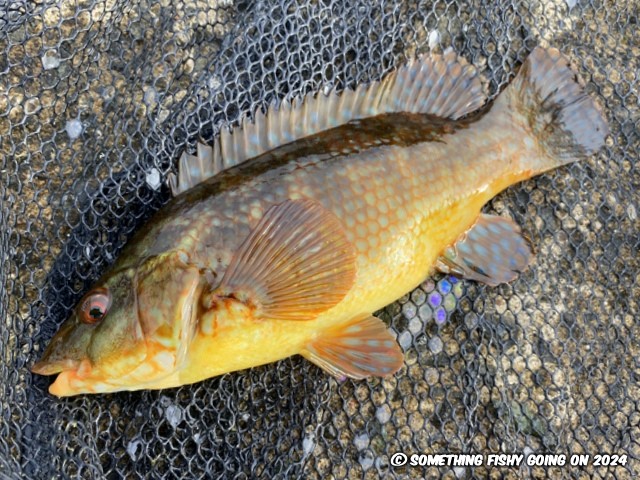
Probably the smallest wrasse I’ve ever seen. I believe it’s a corkwing wrasse.
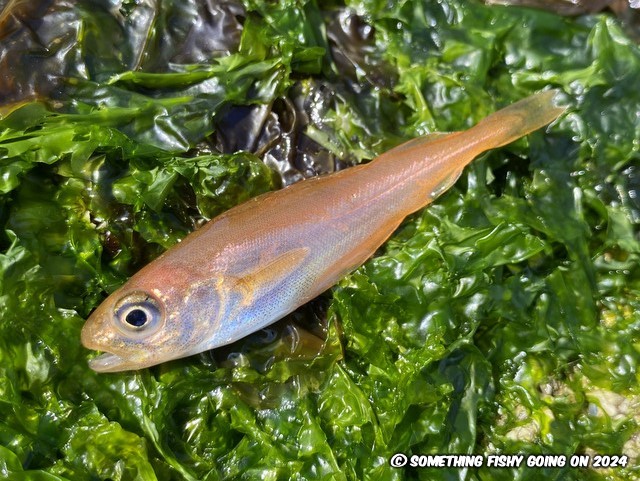
In amongst the prawns was also a tiny sand smelt.

Over the two sessions prior to meeting up with Luke, I caught a few fish, but the conditions were far from ideal. The temperature had dropped, and it was very windy too, making fishing quite unpleasant. The sea was pretty rough too and was coloured up as a result. Given the effort required to catch hardly any fish, I was concerned that we might struggle.

At St Abbs I did catch a few coalfish, but it's a species Luke had caught already, on the other side of the Atlantic, in Maine.
At the inlet area at Torness Power Station, I caught a few juvenile cod. Luke had caught this species already as well.
Trying to catch a ballan wrasse proved to be a bit of a waste of time, with only this solitary long spined sea scorpion taking my ragworm section. Another species that Luke had already ticked off.
During the second session, I caught a solitary poor cod. The only fish I caught over the two trips that Luke hadn’t caught before!

We had originally planned to meet up on Sunday evening, but the highland road trip Luke's brothers had organised that day ruled that out. In the end, we met up early on Monday morning, only fishing together for just over two hours, the only time available before Luke had to head to the airport. Arriving at the inlet area of Torness Power Station, the wind had dropped off, had also changed direction and the sea was pretty flat. Whilst it was still very cold, we were pleasantly surprised by the amount of fish we caught. In amongst them, Luke caught his first ever poor cod and pollock, which he was over the moon about.

Luke's first ever pollock.

I was really enjoying his company, and while we fished away we had a great conversation about some of the species we’ve caught, some of the places we’d fished and some of our future species hunting plans. Before we knew it though, it was time to pack up. Focusing on the fishing and our discussion, I hadn’t even taken any photos during the session. It had been great to meet up and when I dropped Luke off, he surprised me with a parting gift, a copy of his book “Fishing across America”, which I am currently reading. I really hope our paths cross again in the future. If he visits Scotland again, which I've suggested he does and next time during the summer months, I’m sure we could travel around Scotland for a few days catching lots of fish! It would be a pleasure to fish together again, and hopefully I could help him add a few more species to his already very impress tally!

Tight lines, Scott.

Friday, September 06, 2024

Packing for Norway.

Two weeks ago, when I really should have been packing my bags for a one week trip to Norway, I put doing that off until the last minute and crammed several fishing sessions in hunting for a topknot. With the summer coming to an end, I guess I figured I had better make the most of what was left of it. By the time I got back from Scandinavia it would be Autumn after all.

The weather wasn’t great when I visited Torness Power Station for my first session, but I tucked myself away down in the sea defence boulders and dropped live prawn down into the deepest holes I could find.

This nice deep hole didn’t produce a topknot,..
…only this solitary blenny.

After a few pretty fruitless hours, scrambling around the rocks and not catching much, I drove down to St Abbs to try my luck there. The fishing there was much more productive, and there were lots of ballan wrasse around that were more than happy to munch a live prawn. A few long spined sea scorpion found them tempting as well. I’m sure a topknot would eagerly eat one too. I suppose I just didn’t manage to put my bait near one.

The rocky areas surrounding the outside of St Abbs harbour held plenty of ballan wrasse.
They're home to a few long spined sea scorpions too.

A couple of days later, I headed back to St Abbs again, this time to fish Starney Bay from the rocks on its right hand side.

Only accessible at low tide, I hadn’t visited the rocks on the right of Starney Bay for a long time.

It was a beautiful day when I made my way down from the coastal path, scrambled over the rocks and finally got out onto the point, and I was soon catching a few fish. Dropping sections of ragworm and live prawns down close to the vertical rock surfaces produced a couple of ballan wrasse, which were followed by a succession of coalfish.

Coalfish give a great account of themselves on ultralight tackle.

I did intend to stay on the rocks for several hours, but a change in the weather forced me to alter my plans. Thankfully, I made it back across the gully that fills up as the tide rises just in time, otherwise I would have been stuck out on the point for a few hours in the rain. By the time I made it to St Abbs Harbour, the blue sky had been replaced by dark grey rain clouds passing overhead, and I did end up getting slightly wet a few times as rain sporadically fell. I focused my efforts on lowering live prawns down the vertical concrete surfaces, exploring as much of them as I could. I may have been slightly damp, but the fishing was pretty good, and I was also rewarded with some pretty spectacular rainbows.

Somewhere over the rainbow, topknot lie.
Live prawn has become one of my favourite baits this year. Fish love them, collecting them is easy, and best of all they are free!
One of several chunky ballan wrasse I caught.

I carried on fishing into darkness, working over the same areas I’d covered earlier in the session. Eventually, I ran out of prawns, so I switched to sections of ragworm. This produced a couple of long spined sea scorpion and a small lobster.

A bizarre creature, but sadly not the one I’ve been after for weeks!

Two days later, Lillian and I went for a walk around Butterdean Wood in East Lothian. Afterwards, we visited the inlet area at Torness Power Station where I was permitted to fish for a couple of hours to use up some ragworm I had left over from my previous session. This produced a few wrasse, and a couple of other species, but once again no funky flatfish, unfortunately.

Yet another ballan wrasse over 40cm on ultralight tackle,..
...a colourful corkwing wrasse,..
...a nicely coloured small codling,..
...and a couple of butterfish. I think those take me into double digits of butterfish caught this year!

Just as we were about to leave, another angler who was heading off offered me some cracking, freshly dug ragworm. At that point, I had no intention of fishing the following day as I still had to pack for Norway, but this generous offer was too good to turn down, so I gratefully accepted the free bait.

So, the day before I flew out to Norway, and with most of my packing still to do, I headed west to Gourock, to use my newly acquired supply of fantastic quality worms for one final pre holiday topknot session. At the first spot, rather unsurprisingly, all I caught was endless wrasse and a few tompot blenny and long spined sea scorpion.

If I never catch another goldsinny wrasse again...

Three tompot blenny made a nice change from the endless wrasse!

My mate Andrew popped down to fish with me on his lunch hour, and as we caught more of the same species I'd been pulling out all morning, we had a good chat about topknot. Just after he left to go back to work, I headed along to a try a second spot in Greenock that I know has produced several topknot this year. I only had a small amount of ragworm left, and the resident goldsinny and corkwing wrasse rapidly set about depleting that. Almost out of bait completely, a fairly gentle take resulted in all hell breaking loose when I lifted into it. A large fish started stripping line from my reel at a worrying rate. Luckily, the fish didn’t dive into the submerged rocks, instead charging off, swimming furiously away from me horizontally just above them. It made a few of these surging runs before I eventually got it up to the surface. Extending my net down, a large ballan wrasse was drawn into it and lifted up onto the venue's distinctive cobbled brick.

43cm of very chunky ballan wrasse. I didn't bother weighing it, but I'm confident it was my heaviest one of the year on ultralight gear. A real test of the tackle I was using!

I had a last few drops after catching the large ballan wrasse and caught a few more goldsinny wrasse, but it was soon time to head back to Edinburgh to do what I had been putting off all week, pack my suitcase full of fishing tackle! Sadly, a fishing session packed week in the lead up to my Norwegian adventure had not produced a topknot. I’m back from Norway now, and I’ll keep trying to catch a topknot in the coming weeks. The days will be gettting shorter soon, so I’ll be out after dark more often too I think. The wrasse should be less of an obstacle once the sun has vanished below the horizon and topknot are supposed to be more active at night as well.

Tight lines, Scott.

Thursday, August 01, 2024

Scratching around.

I’ve had a few short sessions over the last week, trying to catch larger sandeel species and my first topknot. The inlet area of Torness Power Station was the first venue and after collecting some bait in the shape of a handful of dog whelks, I tied on a small metal to try and tempt any large sandeel species that might have been present. A few years ago, I caught a sandeel there that I suspect may have been a Corbin’s sandeel. I took photos of it at the time, but really I should have kept it, so I could have carried out a thorough inspection to confirm its identity as either a Corbin’s sandeel or a greater sandeel. 

Matching the hatch in fly fishing terms. Large sandeel species eat small sandeel species. 

After an hour or so, I hadn't caught any sandeel, instead catching quite a few reasonably sized coalfish that were good fun on my ultra light setup. 

These plump coalfish put up a spirited fight. 

After a while the incoming tide forced me from the concrete platform where I was fishing, so I scrambled back up the sea defence boulders where I spent some time dropping pink isome down into the gaps between them. I was hoping to catch a topknot, but after trying several deep holes, all I’d caught were a couple of long spined sea scorpion. I then switched my attention to fishing over a rocky area at the edge of a large kelp bed. Baiting up small hooks with the flesh from the dog whelks was quite productive, with several mini species falling for their strong scent. 

This leopard spotted goby was first to munch a chunk of shellfish. Looks like popcorn but tastes a bit fishy. 
This blenny also took a liking to the small bait. 
As did this long spined sea scorpion. 

A few days later, I decided to visit the end of Granton Breakwater at low tide, to fish in the rocky bottom between the end of the breakwater and the rotten remains of the old wooden pier that used to be there. Fishing small pieces of ragworm I was expecting to maybe catch a few wrasse, but instead all I caught were some tiny poor cod, and I had to go down to tiny hooks to discover what was tapping away. 

There were lots of these, my first poor cod of the year, but sadly nothing else. 

The following day I headed to Newhaven Harbour to use up a small amount of maggots that I had left in my fridge that had started to turn. The juvenile whiting were loving them, hitting them as soon as my rig settled at the bottom of the wall I was fishing down.

Maggot proving once again to be a very effective bait for saltwater targets.

After a while, a piper turned up and began playing his pipes for the passengers arriving from a cruise ship that was moored out in the Forth. It was quite cool catching a few fish as he played his instrument behind me!

What's more Scottish than a red-headed, red-faced young man playing the bagpipes!

The juvenile whiting were numerous and equally ravenous, but eventually a viviparous blenny managed to get my wriggling little baits in its mouth first and was quickly hoisted up.

I've caught a few of these lately, but on maggot was a first for me.

All good fun, and my expectation of catching anything new during these types of sessions is minimal, but you never know. I just got back from a two-day trip down to Dumfries & Galloway with my mate Ryan, and on Saturday I'm heading back down there again with my mate Nick. Ryan and I had a good time, although the fishing was challenging at times. We caught a few fish, but we didn't get the one species that we went for. I have no expectation of encountering anything unusual on Saturday evening, having already ticked off a Dover sole, but I'm looking forward to hopefully another action packed session. I might spend some time trying to catch a starry smoothound during the session, fingers crossed one can get to a peeler crab bait before the hordes of thornback ray do.

Tight lines, Scott.

Monday, July 15, 2024

So glad I went fishing.

Some days you go fishing when the conditions are less than ideal. Yesterday was one of those days. Overcast, rain forecast, and an onshore wind. Not great and a continuation of the poor summer we’ve had this year. Despite this weather, I drove down to St Abbs to use up some ragworm I had left over from my sessions at Newhaven Harbour the two previous days. As I expected, the sea was quite rough, so I focused my efforts initially inside the harbour, dropping fairly generous sections of ragworm down tight against the inside of its walls. 

Outside the harbour, the slowly undulating sea was breaking violently over the rocks.

This approach proved too tempting for the long spined sea scorpion hiding out on the vertical surfaces. Moving along and trying different spots, I soon caught about a dozen of the aggressive little ambush predators. One of them was a bit of an old warrior. It looked pretty beat up, and its spines were curled round at the tips. I’ve never seen one like that before.

This long spined sea scorpion had ragged, misshapen fins and its spines were blunt. Its right one noticeably curled right round at the tip.

Having covered a good portion of the harbour’s walls, I moved around to the harbour’s mouth where I was hoping to catch a flounder, but didn’t have any joy. The sandy area where they normally hang out was covered by loose sea weed that had been washed in by the swell. Turning my attention to the fringes of the kelp beds at the right hand side of the harbour’s entrance, I caught about half a dozen corkwing wrasse. All males, one of them had some very colourful markings.

The vivid colours on this corkwing wrasse were lovely, particularly the blues and greens on its fins.

At this point, I noticed that the weed covering the sandy area had been partially washed away from it, so I had a few more casts onto it to see if any flounder were lurking there. After a working my rig slowly across the sand back towards me a few times, a nice coalfish took my ragworm as I recast, and my rig dropped through the water column.

A nice chunky coalfish that put a bit of a bend into my ultra light rod as it tried to get into the kelp.

Things went quiet for a while and as the tide picked up a fair amount of suspended weed appeared, so I took the decision to head up the A1 to continue fishing at the inlet area of Torness Power Station, a spot I knew would afford some shelter from the northerly wind and accompanying swell. Walking back up the hill to where I had parked the car, I noticed a sticker on a rubbish bin and, curious about what it said, stopped to read it to find out.

Having recently taken the decision to quit my own job, I’m not working at the moment. I can relate to some aspects of the message conveyed in this sticker. I’m taking some time off to carefully consider what I want to do for a living going forward.

Arriving at my chosen spot, that produced lots of butterfish and leopard spotted goby during a visit last week, I soon caught a few tiny cod and a couple of small corkwing wrasse. The water was a little coloured up however, bites came intermittently, and I was struggling to connect with some of them. When I finally hooked another fish, it was a fairly large leopard spotted goby. I had my little photo tank with me and popped the fish into it for a photo.

All the details of the leopard spotted goby shown in their full glory.  The mini species tank really is a great thing for examining a fish's features fully!

After catching a few tiny coalfish and cod, the bites dried up almost completely. Persevering through a fairly long period with nothing showing any interest in my ragworm, I then had a very subtle knock that I slowly lifted into. Feeling the weight of a fish that wasn’t fighting particularly hard, I slowly wound it up in case it was something odd. When it appeared on the surface I initially thought it was a butterfish due to its brown and pink colouration, but as I lifted it up, and it got closer, I realised that it was in fact a Yarrell’s blenny!

One of my favourite UK blenny species! Its coolest features were laying limply on its forehead though. Time to put my photo tank to use again!
The fish just fit inside, but its impressive bushy eyebrows were on display in all their funky glory!

Many years ago, my mate Nick caught a Yarrell's blenny, not too far from where I caught this one, so I always hoped there was a potential resident population. I have over the years tried numerous times to catch one there myself and had kind of given up, so I was over the moon to finally get one at this venue. Shortly afterwards, I used up the last of my ragworm and called an end to a most enjoyable day’s fishing, during which I had been rewarded with some odd, colourful and interesting species. The Yarrell’s blenny in particular being a real highlight. They’re such a strange looking fish!

Being honest, I was pretty close to not going fishing at all due to the poor conditions. It just goes to show that sometimes you never know how a fishing trip will turn out. Even when the weather is poor, the fishing might not be!

Tight lines, Scott.